
The Professor’s House
Willa Cather (1873–1947), 1925
★ 3.78 from 10.7k ratings on Goodreads
A Midwestern professor looks back on two romances—one of the heart, one of the mind—and wonders which life was really his. A quiet, reflective novel with a melancholy undertow, moving slowly through memory and philosophical questioning in a lyrical, measured voice.
Feels like melancholy, longing and curiosity. About identity, memory and art.
Who it’s for
You may like it if you enjoy character-driven fiction about memory, identity, and the lives we might have lived. The reflective pace and the long shift to Tom Outland's first-person story may ask for patience if you want the professor to remain at the center.
Why read it
It gives you a close look at how a thoughtful person reckons with past choices, and Cather's prose makes the questioning itself feel worth your time.
Pages from the book
Science can explain sin, but it cannot make it thrilling.
But the fact is, the human mind, the individual mind, has always been made more interesting by dwelling on the old riddles, even if it makes nothing of them. Science hasn’t given us any new amazements, except of the superficial kind we get from witnessing dexterity and sleight-of-hand. It hasn’t given us any richer pleasures, as the Renaissance did, nor any new sins—not one! Indeed, it takes our old ones away. It’s the laboratory, not the Lamb of God, that taketh away the sins of the world. You’ll agree there is not much thrill about a physiological sin. We were better off when even the prosaic matter of taking nourishment could have the magnificence of a sin. The moment a cliff city appears through falling snow.
It was such rough scrambling that I was soon in a warm sweat under my damp clothes. In stopping to take breath, I happened to glance up at the canyon wall. I wish I could tell you what I saw there, just as I saw it, on that first morning, through a veil of lightly falling snow. Far up above me, a thousand feet or so, set in a great cavern in the face of the cliff, I saw a little city of stone, asleep. It was as still as sculpture—and something like that. It all hung together, seemed to have a kind of composition: pale little houses of stone nestling close to one another, perched on top of each other, with flat roofs, narrow windows, straight walls, and in the middle of the group, a round tower. The lake that promised you could always leave.
When he remembered his childhood, he remembered blue water. There were certain human figures against it, of course; his practical, strong-willed Methodist mother, his gentle, weaned-away Catholic father, the old Kanuck grandfather, various brothers and sisters. But the great fact in life, the always possible escape from dullness, was the lake. The sun rose out of it, the day began there; it was like an open door that nobody could shut. The land and all its dreariness could never close in on you. You had only to look at the lake, and you knew you would soon be free. It was the first thing one saw in the morning, across the rugged cow pasture studded with shaggy pines, and it ran through the days like the weather, not a thing thought about, but a part of consciousness itself. Willa Cather.Willa Cather visited Mesa Verde in 1915; its Ancestral Puebloan cliff dwellings inspired the 'Blue Mesa' ruins in Tom Outland's story.
Books that feel like this
More by Willa Cather
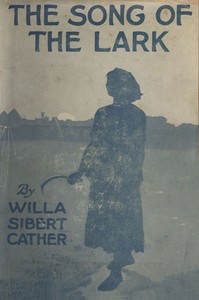
The Song of the Lark
Willa Cather, 1915
A Colorado minister's daughter with a voice too big for her town spends twenty years getting out — and finding out what the leaving costs.
Where to get it
Some of these links earn us a small commission, at no cost to you. It keeps BookFeed free.
Questions readers ask
- Is The Professor’s House for me?
- You may like it if you enjoy character-driven fiction about memory, identity, and the lives we might have lived. The reflective pace and the long shift to Tom Outland's first-person story may ask for patience if you want the professor to remain at the center.
- What is The Professor’s House like?
- A quiet, reflective novel with a melancholy undertow, moving slowly through memory and philosophical questioning in a lyrical, measured voice. Feels like melancholy, longing and curiosity. About identity, memory and art.
- What should I read after The Professor’s House?
- If you liked The Professor’s House, try Jacob’s Room (Virginia Woolf), Memoirs of a Geisha (Arthur Golden) and Circe (Madeline Miller).
A taste of the feed
How much of what we call delicacy is really other people's carelessness?
It is a common saying that women are delicate creatures, flowers, eggs, anything that may be crushed in a moment’s carelessness. If I had ever believed it, I no longer did.
Circe · Madeline Miller
A dog on a beach is not looking for anything it can name.
Their dog ambled about a bank of dwindling sand, trotting, sniffing on all sides. Looking for something lost in a past life. Suddenly he made off like a bounding hare, ears flung back, chasing the shadow of a lowskimming gull. The man’s shrieked whistle struck his limp ears. He turned, bounded back, came nearer, trotted on twinkling shanks. On a field tenney a buck, trippant, proper, unattired. At the lacefringe of the tide he halted with stiff forehoofs, seawardpointed ears. His snout lifted barked at the wavenoise, herds of seamorse. They serpented towards his feet, curling, unfurling many crests, every ninth, breaking, plashing, from far, from farther out, waves and waves.
Ulysses · James Joyce
How hard it is to believe that other people are as real as you are.
We are all of us born in moral stupidity, taking the world as an udder to feed our supreme selves: Dorothea had early begun to emerge from that stupidity, but yet it had been easier to her to imagine how she would devote herself to Mr. Casaubon, and become wise and strong in his strength and wisdom, than to conceive with that distinctness which is no longer reflection but feeling—an idea wrought back to the directness of sense, like the solidity of objects—that he had an equivalent centre of self, whence the lights and shadows must always fall with a certain difference.
Middlemarch · George Eliot
Read pages from books like this, one at a time
Keep reading in the feed