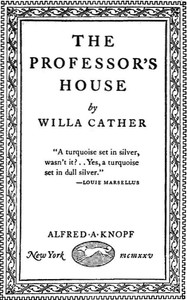
The Professor’s House
Willa Cather, 1925
A Midwestern professor looks back on two romances—one of the heart, one of the mind—and wonders which life was really his.
 BookFeed Ελληνικά
Pages from The Professor’s House that stand on their own, chosen for how they read today. The text is in the public domain.
Science can explain sin, but it cannot make it thrilling.
But the fact is, the human mind, the individual mind, has always been made more interesting by dwelling on the old riddles, even if it makes nothing of them. Science hasn’t given us any new amazements, except of the superficial kind we get from witnessing dexterity and sleight-of-hand. It hasn’t given us any richer pleasures, as the Renaissance did, nor any new sins—not one! Indeed, it takes our old ones away. It’s the laboratory, not the Lamb of God, that taketh away the sins of the world. You’ll agree there is not much thrill about a physiological sin. We were better off when even the prosaic matter of taking nourishment could have the magnificence of a sin. The moment a cliff city appears through falling snow.
It was such rough scrambling that I was soon in a warm sweat under my damp clothes. In stopping to take breath, I happened to glance up at the canyon wall. I wish I could tell you what I saw there, just as I saw it, on that first morning, through a veil of lightly falling snow. Far up above me, a thousand feet or so, set in a great cavern in the face of the cliff, I saw a little city of stone, asleep. It was as still as sculpture—and something like that. It all hung together, seemed to have a kind of composition: pale little houses of stone nestling close to one another, perched on top of each other, with flat roofs, narrow windows, straight walls, and in the middle of the group, a round tower. The lake that promised you could always leave.
When he remembered his childhood, he remembered blue water. There were certain human figures against it, of course; his practical, strong-willed Methodist mother, his gentle, weaned-away Catholic father, the old Kanuck grandfather, various brothers and sisters. But the great fact in life, the always possible escape from dullness, was the lake. The sun rose out of it, the day began there; it was like an open door that nobody could shut. The land and all its dreariness could never close in on you. You had only to look at the lake, and you knew you would soon be free. It was the first thing one saw in the morning, across the rugged cow pasture studded with shaggy pines, and it ran through the days like the weather, not a thing thought about, but a part of consciousness itself. A mesa that catches the sunrise before the valley does.
It was light up there long before it was with us. When I got up at daybreak and went down to the river to get water, our camp would be cold and grey, but the mesa top would be red with sunrise, and all the slim cedars along the rocks would be gold—metallic, like tarnished gold-foil. Some mornings it would loom up above the dark river like a blazing volcanic mountain. It shortened our days, too, considerably. The sun got behind it early in the afternoon, and then our camp would lie in its shadow. After a while the sunset colour would begin to stream up from behind it. Then the mesa was like one great ink-black rock against a sky on fire. What it costs to be endlessly kindled by other people's curiosity.
St. Peter had managed for years to live two lives, both of them very intense. He would willingly have cut down on his university work, would willingly have given his students chaff and sawdust—many instructors had nothing else to give them and got on very well—but his misfortune was that he loved youth—he was weak to it, it kindled him. If there was one eager eye, one doubting, critical mind, one lively curiosity in a whole lecture-room full of commonplace boys and girls, he was its servant. That ardour could command him. It hadn’t worn out with years, this responsiveness, any more than the magnetic currents wear out; it had nothing to do with Time. Why autumn looks better once someone brings it indoors.
The Professor happened to come home earlier than usual one bright October afternoon. He left the walk and cut across the turf, intending to enter by the open French window, but he paused a moment outside to admire the scene within. The drawing-room was full of autumn flowers, dahlias and wild asters and goldenrod. The red-gold sunlight lay in bright puddles on the thick blue carpet, made hazy aureoles about the stuffed blue chairs. There was, in the room, as he looked through the window, a rich, intense effect of autumn, something that presented October much more sharply and sweetly to him than the coloured maples and the aster-bordered paths by which he had come home. It struck him that the seasons sometimes gain by being brought into the house, just as they gain by being brought into painting, and into poetry. The life you built may not be the life you actually lived.
But now that the vivid consciousness of an earlier state had come back to him, the Professor felt that life with this Kansas boy, little as there had been of it, was the realest of his lives, and that all the years between had been accidental and ordered from the outside. His career, his wife, his family, were not his life at all, but a chain of events which had happened to him. All these things had nothing to do with the person he was in the beginning. The loneliness of a town after the lights go off.
The park was deserted. The arc-lights were turned off. The leafless trees stood quite motionless in the light of the clear stars. The world was sad to St. Peter as he looked about him; the lake-shore country flat and heavy, Hamilton small and tight and airless. The university, his new house, his old house, everything around him, seemed insupportable, as the boat on which he is imprisoned seems to a seasick man. Yes, it was possible that the little world, on its voyage among all the stars, might become like that; a boat on which one could travel no longer, from which one could no longer look up and confront those bright rings or revolution. What remains unknowable in the person sitting beside you.
He took up one of her gloves and began drawing it out through his lingers. She said nothing, but he saw her lip quiver, and she turned away and began looking at the house through the glasses. He likewise began to examine the audience. He wished he knew just how it seemed to her. He had been mistaken, he felt. The heart of another is a dark forest, always, no matter how close it has been to one’s own. Presently the melting music of the tenor’s last aria brought their eyes together in a smile not altogether sad. Willa Cather, 1925
A Midwestern professor looks back on two romances—one of the heart, one of the mind—and wonders which life was really his.
Read pages from books like this, one at a time
BookFeed is a feed of real passages from real books. It learns what moves you and finds your next book.
Open BookFeedFree, no sign-up.