
The Song of the Lark
Willa Cather (1873–1947), 1915
A Colorado minister's daughter with a voice too big for her town spends twenty years getting out — and finding out what the leaving costs. Cather's lyrical voice follows Thea's ambition and longing at an unhurried pace, with a strong sense of place and a defiant undertow.
Feels like longing, defiance and wonder. About ambition, art and home.
Who it’s for
You may like it if you're drawn to stories about artists, ambition, and the pull between a small town and a wider world. Cather's prose is lyrical and inward, and the twenty-year span makes for a slow, reflective read rather than a quick one.
Why read it
It gives you a clear-eyed look at what ambition asks of a person, and at what a hometown can both give and take.
Pages from the book
The world is arranged to take your best hour away from you.
There was some power abroad in the world bent upon taking away from her that feeling with which she had come out of the concert hall. Everything seemed to sweep down on her to tear it out from under her cape. If one had that, the world became one’s enemy; people, buildings, wagons, cars, rushed at one to crush it under, to make one let go of it. Thea glared round her at the crowds, the ugly, sprawling streets, the long lines of lights, and she was not crying now. Her eyes were brighter than even Harsanyi had ever seen them. All these things and people were no longer remote and negligible; they had to be met, they were lined up against her, they were there to take something from her. Very well; they should never have it. They might trample her to death, but they should never have it. The day a place you love becomes a place you will leave.
On her thirteenth birthday she wandered for a long while about the sand ridges, picking up crystals and looking into the yellow prickly-pear blossoms with their thousand stamens. She looked at the sand hills until she wished she were a sand hill. And yet she knew that she was going to leave them all behind some day. They would be changing all day long, yellow and purple and lavender, and she would not be there. From that day on, she felt there was a secret between her and Wunsch. Together they had lifted a lid, pulled out a drawer, and looked at something. They hid it away and never spoke of what they had seen; but neither of them forgot it. The odd lightness of the moment you finally leave.
But, of course, it was herself and her own adventure that mattered to her. If youth did not matter so much to itself, it would never have the heart to go on. Thea was surprised that she did not feel a deeper sense of loss at leaving her old life behind her. It seemed, on the contrary, as she looked out at the yellow desert speeding by, that she had left very little. Everything that was essential seemed to be right there in the car with her. She lacked nothing. She even felt more compact and confident than usual. She was all there, and something else was there, too—in her heart, was it, or under her cheek? Anyhow, it was about her somewhere, that warm sureness, that sturdy little companion with whom she shared a secret. Willa Cather.As a girl in Red Cloud, Nebraska, Cather cut her hair short and signed herself 'William' — she had already decided not to be the girl her town expected.
Books that feel like this
More by Willa Cather
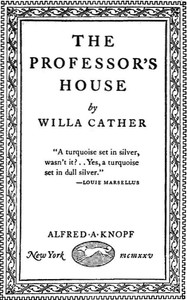
The Professor’s House
Willa Cather, 1925
A Midwestern professor looks back on two romances—one of the heart, one of the mind—and wonders which life was really his.
Where to get it
Some of these links earn us a small commission, at no cost to you. It keeps BookFeed free.
Questions readers ask
- Is The Song of the Lark for me?
- You may like it if you're drawn to stories about artists, ambition, and the pull between a small town and a wider world. Cather's prose is lyrical and inward, and the twenty-year span makes for a slow, reflective read rather than a quick one.
- What is The Song of the Lark like?
- Cather's lyrical voice follows Thea's ambition and longing at an unhurried pace, with a strong sense of place and a defiant undertow. Feels like longing, defiance and wonder. About ambition, art and home.
- What should I read after The Song of the Lark?
- If you liked The Song of the Lark, try A Portrait of the Artist as a Young Man (James Joyce), Girl with a Pearl Earring (Tracy Chevalier) and The Land of Little Rain (Mary Austin).
A taste of the feed
The child who can't invent monsters grows up to look very closely at real things.
Frans, Agnes, and I used to sit along that canal and throw things in—pebbles, sticks, once a broken tile—and imagine what they might touch on the bottom—not fish, but creatures from our imagination, with many eyes, scales, hands and fins. Frans thought up the most interesting monsters. Agnes was the most frightened. I always stopped the game, too inclined to see things as they were to be able to think up things that were not.
Girl with a Pearl Earring · Tracy Chevalier
Do we ever really change, or merely become ourselves?
Each of us has something within us which won’t be denied, even if it makes us scream aloud to die. We are what we are, that’s all. Like the old Celtic legend of the bird with the thorn in its breast, singing its heart out and dying. Because it has to, its self-knowledge can’t affect or change the outcome, can it? Everyone singing his own little song, convinced it’s the most wonderful song the world has ever heard. Don’t you see? We create our own thorns, and never stop to count the cost. All we can do is suffer the pain, and tell ourselves it was well worth it.
The Thorn Birds · Colleen McCullough
Read pages from books like this, one at a time
Keep reading in the feed