
Crime and Punishment
Fyodor Dostoevsky (1821–1881), 1866
★ 4.29 from 1.2m ratings on Goodreads
A broke student in St. Petersburg tests a theory that some people are above the law, and discovers the cost is not legal but psychological. Feverish and claustrophobic, the novel moves through tight rooms and tangled arguments, with a gothic dread pressing behind every thought.
Feels like passion, dread and awe. About power, death and identity.
Who it’s for
You may like it if you are drawn to moral struggle, guilt, and long psychological arguments rather than a tidy crime story. Some readers find the middle slow and the plot thin, so expect stretches where thought and atmosphere matter more than events.
Why read it
It gives you a close, uneasy look at a mind arguing itself into and around a crime, and at the social world that shaped it.
Pages from the book
What if the punishment you wanted most was remorse, and it never came.
And if only fate would have sent him repentance—burning repentance that would have torn his heart and robbed him of sleep, that repentance, the awful agony of which brings visions of hanging or drowning! Oh, he would have been glad of it! Tears and agonies would at least have been life. But he did not repent of his crime. Why crowds can feel easier than empty roads.
He felt very miserable. If it had been possible to escape to some solitude, he would have thought himself lucky, even if he had to spend his whole life there. But although he had almost always been by himself of late, he had never been able to feel alone. Sometimes he walked out of the town on to the high road, once he had even reached a little wood, but the lonelier the place was, the more he seemed to be aware of an uneasy presence near him. It did not frighten him, but greatly annoyed him, so that he made haste to return to the town, to mingle with the crowd, to enter restaurants and taverns, to walk in busy thoroughfares. There he felt easier and even more solitary. What the mind does when it cannot bear to be inside itself.
Raskolnikov turned to the wall where in the dirty, yellow paper he picked out one clumsy, white flower with brown lines on it and began examining how many petals there were in it, how many scallops in the petals and how many lines on them. He felt his arms and legs as lifeless as though they had been cut off. He did not attempt to move, but stared obstinately at the flower. What readers say
Readers emphasize moral struggle and guilt, while some praise the psychological depth and immersive tension. Others find it slow and thin on plot, though many readers call it a favorite.
Fyodor Dostoevsky.Dostoevsky was sentenced to death in 1849, reprieved at the last moment, and sent to a Siberian prison camp; he wrote Crime and Punishment in serial installments while dodging creditors.
Books that feel like this




More by Fyodor Dostoevsky
The Brothers Karamazov
Fyodor Dostoevsky, 1880
A father is murdered and his sons—sensual, intellectual, spiritual—argue over guilt, God, and whether anyone can love another person.
The Idiot
Fyodor Dostoevsky, 1868
A Christlike innocent lands in a Petersburg of money, vanity and feverish talk, and every room he enters begins to tilt.
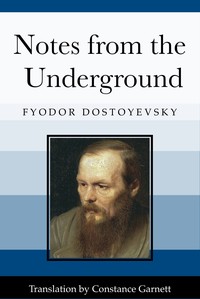
Notes from Underground
Fyodor Dostoevsky, 1864
A furious, funny, self-lacerating monologue from a Petersburg clerk who argues that freedom begins where reason and self-interest end.
Where to get it
Some of these links earn us a small commission, at no cost to you. It keeps BookFeed free.
Questions readers ask
- Is Crime and Punishment for me?
- You may like it if you are drawn to moral struggle, guilt, and long psychological arguments rather than a tidy crime story. Some readers find the middle slow and the plot thin, so expect stretches where thought and atmosphere matter more than events.
- What is Crime and Punishment like?
- Feverish and claustrophobic, the novel moves through tight rooms and tangled arguments, with a gothic dread pressing behind every thought. Feels like passion, dread and awe. About power, death and identity.
- What should I read after Crime and Punishment?
- If you liked Crime and Punishment, try Anna Karenina (Leo Tolstoy), Brave New World (Aldous Huxley) and Frankenstein (Mary Shelley).
A taste of the feed
The strange calm that arrives when a lie comes out perfectly.
Anna said what came to her lips, and marveled, hearing herself, at her own capacity for lying. How simple and natural were her words, and how likely that she was simply sleepy! She felt herself clad in an impenetrable armor of falsehood. She felt that some unseen force had come to her aid and was supporting her.
Anna Karenina · Leo Tolstoy
What is lost when nothing is allowed to stand between wanting and having.
Impulse arrested spills over, and the flood is feeling, the flood is passion, the flood is even madness: it depends on the force of the current, the height and strength of the barrier. The unchecked stream flows smoothly down its appointed channels into a calm well-being. (The embryo is hungry; day in, day out, the blood-surrogate pump unceasingly turns its eight hundred revolutions a minute. The decanted infant howls; at once a nurse appears with a bottle of external secretion. Feeling lurks in that interval of time between desire and its consummation. Shorten that interval, break down all those old unnecessary barriers.
Brave New World · Aldous Huxley
A mind wakes up with no history, and nobody to ask.
“But where were my friends and relations? No father had watched my infant days, no mother had blessed me with smiles and caresses; or if they had, all my past life was now a blot, a blind vacancy in which I distinguished nothing. From my earliest remembrance I had been as I then was in height and proportion. I had never yet seen a being resembling me or who claimed any intercourse with me. What was I? The question again recurred, to be answered only with groans.
Frankenstein · Mary Shelley
Read pages from books like this, one at a time
Keep reading in the feed