
The Invisible Man
H. G. Wells (1866–1946), 1897
★ 3.63 from 226.7k ratings on Goodreads
A stranger arrives at a country inn wrapped head to foot in bandages, and a small English village discovers that being unseen is not the same as being free. A tense, chilly Victorian tale that moves from village gossip to genuine dread, with a curious, scientific voice and a lonely centre.
Feels like dread and curiosity. About solitude, power and freedom.
Who it’s for
You may like it if you enjoy Victorian science fiction with a gothic edge and a moral question at its centre. The 1897 prose and period scientific talk can feel dated to some readers.
Why read it
It offers a compact, unsettling look at power without accountability, and the village setting makes the horror feel close and ordinary.
Pages from the book
What it feels like to watch your own hands disappear.
“The pain had passed. I thought I was killing myself and I did not care. I shall never forget that dawn, and the strange horror of seeing that my hands had become as clouded glass, and watching them grow clearer and thinner as the day went by, until at last I could see the sickly disorder of my room through them, though I closed my transparent eyelids. My limbs became glassy, the bones and arteries faded, vanished, and the little white nerves went last. I gritted my teeth and stayed there to the end. At last only the dead tips of the fingernails remained, pallid and white, and the brown stain of some acid upon my fingers. A gun six yards away, and the whole world suddenly dear.
Adye moistened his lips again. He glanced away from the barrel of the revolver and saw the sea far off very blue and dark under the midday sun, the smooth green down, the white cliff of the head, and the multitudinous town, and suddenly he knew that life was very sweet. His eyes came back to this little metal thing hanging between heaven and earth, six yards away. “What am I to do?” he said sullenly. The night an idea arrives complete, and the room goes quiet.
The invisible man rose and began pacing the little study. “You may well exclaim. I remember that night. It was late at night—in the daytime one was bothered with the gaping, silly students—and I worked then sometimes till dawn. It came suddenly, splendid and complete in my mind. I was alone; the laboratory was still, with the tall lights burning brightly and silently. In all my great moments I have been alone. ‘One could make an animal—a tissue—transparent! One could make it invisible! All except the pigments—I could be invisible!’ I said, suddenly realising what it meant to be an albino with such knowledge. It was overwhelming. I left the filtering I was doing, and went and stared out of the great window at the stars. ‘I could be invisible!’ I repeated. H. G. Wells.Wells trained as a biologist under T. H. Huxley. The Invisible Man appeared in 1897, the same year as Dracula — two monsters stalking England in one season.
Books that feel like this
More by H. G. Wells
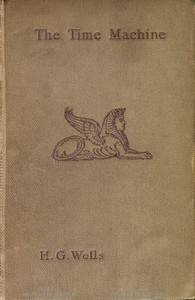
The Time Machine
H. G. Wells, 1895
A dinner-party tale of a man who returns from the far future with a warning about class, comfort and where the human species is heading.
Where to get it
Some of these links earn us a small commission, at no cost to you. It keeps BookFeed free.
Questions readers ask
- Is The Invisible Man for me?
- You may like it if you enjoy Victorian science fiction with a gothic edge and a moral question at its centre. The 1897 prose and period scientific talk can feel dated to some readers.
- What is The Invisible Man like?
- A tense, chilly Victorian tale that moves from village gossip to genuine dread, with a curious, scientific voice and a lonely centre. Feels like dread and curiosity. About solitude, power and freedom.
- What should I read after The Invisible Man?
- If you liked The Invisible Man, try The Hound of the Baskervilles (Arthur Conan Doyle), Dracula (Bram Stoker) and The strange case of Dr. Jekyll and Mr. Hyde (Robert Louis Stevenson).
A taste of the feed
A mind wakes up with no history, and nobody to ask.
“But where were my friends and relations? No father had watched my infant days, no mother had blessed me with smiles and caresses; or if they had, all my past life was now a blot, a blind vacancy in which I distinguished nothing. From my earliest remembrance I had been as I then was in height and proportion. I had never yet seen a being resembling me or who claimed any intercourse with me. What was I? The question again recurred, to be answered only with groans.
Frankenstein · Mary Shelley
Read pages from books like this, one at a time
Keep reading in the feed