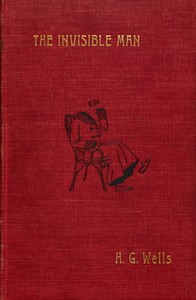
The Invisible Man
H. G. Wells, 1897
A stranger arrives at a country inn wrapped head to foot in bandages, and a small English village discovers that being unseen is not the same as being free.
 BookFeed
Pages from The Invisible Man that stand on their own, chosen for how they read today. The text is in the public domain.
What it feels like to watch your own hands disappear.
“The pain had passed. I thought I was killing myself and I did not care. I shall never forget that dawn, and the strange horror of seeing that my hands had become as clouded glass, and watching them grow clearer and thinner as the day went by, until at last I could see the sickly disorder of my room through them, though I closed my transparent eyelids. My limbs became glassy, the bones and arteries faded, vanished, and the little white nerves went last. I gritted my teeth and stayed there to the end. At last only the dead tips of the fingernails remained, pallid and white, and the brown stain of some acid upon my fingers. A gun six yards away, and the whole world suddenly dear.
Adye moistened his lips again. He glanced away from the barrel of the revolver and saw the sea far off very blue and dark under the midday sun, the smooth green down, the white cliff of the head, and the multitudinous town, and suddenly he knew that life was very sweet. His eyes came back to this little metal thing hanging between heaven and earth, six yards away. “What am I to do?” he said sullenly. The night an idea arrives complete, and the room goes quiet.
The invisible man rose and began pacing the little study. “You may well exclaim. I remember that night. It was late at night—in the daytime one was bothered with the gaping, silly students—and I worked then sometimes till dawn. It came suddenly, splendid and complete in my mind. I was alone; the laboratory was still, with the tall lights burning brightly and silently. In all my great moments I have been alone. ‘One could make an animal—a tissue—transparent! One could make it invisible! All except the pigments—I could be invisible!’ I said, suddenly realising what it meant to be an albino with such knowledge. It was overwhelming. I left the filtering I was doing, and went and stared out of the great window at the stars. ‘I could be invisible!’ I repeated. The way firelight invents a face you cannot unsee.
Her visitor, she saw as she opened the door, was seated in the armchair before the fire, dozing it would seem, with his bandaged head drooping on one side. The only light in the room was the red glow from the fire—which lit his eyes like adverse railway signals, but left his downcast face in darkness—and the scanty vestiges of the day that came in through the open door. Everything was ruddy, shadowy, and indistinct to her, the more so since she had just been lighting the bar lamp, and her eyes were dazzled. But for a second it seemed to her that the man she looked at had an enormous mouth wide open—a vast and incredible mouth that swallowed the whole of the lower portion of his face. It was the sensation of a moment: the white-bound head, the monstrous goggle eyes, and this huge yawn below it. The moment a room's furniture stops behaving like furniture.
The bedclothes gathered themselves together, leapt up suddenly into a sort of peak, and then jumped headlong over the bottom rail. It was exactly as if a hand had clutched them in the centre and flung them aside. Immediately after, the stranger’s hat hopped off the bedpost, described a whirling flight in the air through the better part of a circle, and then dashed straight at Mrs. Hall’s face. Then as swiftly came the sponge from the washstand; and then the chair, flinging the stranger’s coat and trousers carelessly aside, and laughing drily in a voice singularly like the stranger’s, turned itself up with its four legs at Mrs. Hall, seemed to take aim at her for a moment, and charged at her. What absolute power feels like in a crowded street.
“My mood, I say, was one of exaltation. I felt as a seeing man might do, with padded feet and noiseless clothes, in a city of the blind. I experienced a wild impulse to jest, to startle people, to clap men on the back, fling people’s hats astray, and generally revel in my extraordinary advantage. Everyone braces for scars and disfigurement. No one braces for nothing.
It was worse than anything. Mrs. Hall, standing open-mouthed and horror-struck, shrieked at what she saw, and made for the door of the house. Everyone began to move. They were prepared for scars, disfigurements, tangible horrors, but nothing! The bandages and false hair flew across the passage into the bar, making a hobbledehoy jump to avoid them. Everyone tumbled on everyone else down the steps. For the man who stood there shouting some incoherent explanation, was a solid gesticulating figure up to the coat collar of him, and then—nothingness, no visible thing at all! Someone is throwing stones, and there is nobody there.
The voice made no answer. Whizz came a flint, apparently out of the air, and missed Mr. Marvel’s shoulder by a hair’s-breadth. Mr. Marvel, turning, saw a flint jerk up into the air, trace a complicated path, hang for a moment, and then fling at his feet with almost invisible rapidity. He was too amazed to dodge. Whizz it came, and ricochetted from a bare toe into the ditch. Mr. Thomas Marvel jumped a foot and howled aloud. Then he started to run, tripped over an unseen obstacle, and came head over heels into a sitting position. Snow will find you out. So will rain, and so will fog.
And the snow had warned me of other dangers. I could not go abroad in snow—it would settle on me and expose me. Rain, too, would make me a watery outline, a glistening surface of a man—a bubble. And fog—I should be like a fainter bubble in a fog, a surface, a greasy glimmer of humanity. Moreover, as I went abroad—in the London air—I gathered dirt about my ankles, floating smuts and dust upon my skin. I did not know how long it would be before I should become visible from that cause also. But I saw clearly it could not be for long. Panic moves faster than the man who caused it.
People screamed. People sprang off the pavement: It passed in shouts, it passed by instinct down the hill. They were shouting in the street before Marvel was halfway there. They were bolting into houses and slamming the doors behind them, with the news. He heard it and made one last desperate spurt. Fear came striding by, rushed ahead of him, and in a moment had seized the town. H. G. Wells, 1897
A stranger arrives at a country inn wrapped head to foot in bandages, and a small English village discovers that being unseen is not the same as being free.
Read pages from books like this, one at a time
BookFeed is a feed of real passages from real books. It learns what moves you and finds your next book.
Open BookFeedFree, no sign-up.