
The Hound of the Baskervilles
Arthur Conan Doyle (1859–1930), 1902
★ 4.14 from 407.1k ratings on Goodreads
A doctor, a cursed family and a great black hound on Dartmoor: Holmes and Watson test whether a legend can be murdered. A damp, candlelit unease settles over the moor, and Watson's steady narration keeps you curious even while the fog thickens.
Feels like dread and curiosity.
Who it’s for
You may like it if you enjoy Victorian detective stories where atmosphere matters as much as clues, especially with Watson as your guide. Be ready for a long middle stretch with Holmes offstage, leaving Watson to carry the investigation and the period prose on his own.
Why read it
It gives you a compact mystery that treats fear as a clue, with a rational mind slowly testing a legend against the dark.
Pages from the book
A servant stands at a dark window, watching for something he won't name.
Barrymore was crouching at the window with the candle held against the glass. His profile was half turned towards me, and his face seemed to be rigid with expectation as he stared out into the blackness of the moor. For some minutes he stood watching intently. Then he gave a deep groan and with an impatient gesture he put out the light. Instantly I made my way back to my room, and very shortly came the stealthy steps passing once more upon their return journey. Long afterwards when I had fallen into a light sleep I heard a key turn somewhere in a lock, but I could not tell whence the sound came. What it all means I cannot guess, but there is some secret business going on in this house of gloom which sooner or later we shall get to the bottom of. A knock at the door can redraw the shape of a life.
“For the very simple reason that I see the dog himself on our very doorstep, and there is the ring of its owner. Don’t move, I beg you, Watson. He is a professional brother of yours, and your presence may be of assistance to me. Now is the dramatic moment of fate, Watson, when you hear a step upon the stair which is walking into your life, and you know not whether for good or ill. What does Dr. James Mortimer, the man of science, ask of Sherlock Holmes, the specialist in crime? Come in!” The countryside looks beautiful; the doctor sees only the year dying.
The wagonette swung round into a side road, and we curved upward through deep lanes worn by centuries of wheels, high banks on either side, heavy with dripping moss and fleshy hart’s-tongue ferns. Bronzing bracken and mottled bramble gleamed in the light of the sinking sun. Still steadily rising, we passed over a narrow granite bridge and skirted a noisy stream which gushed swiftly down, foaming and roaring amid the gray boulders. Both road and stream wound up through a valley dense with scrub oak and fir. At every turn Baskerville gave an exclamation of delight, looking eagerly about him and asking countless questions. To his eyes all seemed beautiful, but to me a tinge of melancholy lay upon the countryside, which bore so clearly the mark of the waning year. Yellow leaves carpeted the lanes and fluttered down upon us as we passed. Arthur Conan Doyle.Doyle hoped history would remember his historical novels; he was knighted in 1902 for defending Britain's role in the Boer War, not for Holmes.
Books that feel like this

More by Arthur Conan Doyle
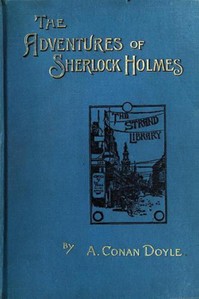
The Adventures of Sherlock Holmes
Arthur Conan Doyle, 1892
A detective who solves impossible crimes by noticing what everyone else looked past. Fifty-six stories of rooms, ruses and small, devastating deductions.
Where to get it
Some of these links earn us a small commission, at no cost to you. It keeps BookFeed free.
Questions readers ask
- Is The Hound of the Baskervilles for me?
- You may like it if you enjoy Victorian detective stories where atmosphere matters as much as clues, especially with Watson as your guide. Be ready for a long middle stretch with Holmes offstage, leaving Watson to carry the investigation and the period prose on his own.
- What is The Hound of the Baskervilles like?
- A damp, candlelit unease settles over the moor, and Watson's steady narration keeps you curious even while the fog thickens. Feels like dread and curiosity.
- What should I read after The Hound of the Baskervilles?
- If you liked The Hound of the Baskervilles, try Dracula (Bram Stoker), The strange case of Dr. Jekyll and Mr. Hyde (Robert Louis Stevenson) and And Then There Were None (Agatha Christie).
A taste of the feed
A house with no shadows at all, and every guest locking a door.
The others went upstairs, a slow unwilling procession. If this had been an old house, with creaking wood, and dark shadows, and heavily panelled walls, there might have been an eerie feeling. But this house was the essence of modernity. There were no dark corners - no possible sliding panels - it was flooded with electric light - everything was new and bright and shining. There was nothing hidden in this house, nothing concealed. It had no atmosphere about it. Somehow, that was the most frightening thing of all. They exchanged good-nights on the upper landing. Each of them went into his or her own room, and each of them automatically, almost without conscious thought, locked the door....
And Then There Were None · Agatha Christie
What it feels like to watch your own hands disappear.
“The pain had passed. I thought I was killing myself and I did not care. I shall never forget that dawn, and the strange horror of seeing that my hands had become as clouded glass, and watching them grow clearer and thinner as the day went by, until at last I could see the sickly disorder of my room through them, though I closed my transparent eyelids. My limbs became glassy, the bones and arteries faded, vanished, and the little white nerves went last. I gritted my teeth and stayed there to the end. At last only the dead tips of the fingernails remained, pallid and white, and the brown stain of some acid upon my fingers.
The Invisible Man · H. G. Wells
What a wall of forty-three pressed flowers can tell you that the police never could.
After putting down the telephone the eighty-two-year-old birthday boy sat for a long time looking at the pretty but meaningless flower whose name he did not yet know. Then he looked up at the wall above his desk. There hung forty-three pressed flowers in their frames. Four rows of ten, and one at the bottom with four. In the top row one was missing from the ninth slot. Desert Snow would be number forty-four.
The Girl With the Dragon Tattoo · Stieg Larsson
Read pages from books like this, one at a time
Keep reading in the feed