
The Happy Prince, and Other Tales
Oscar Wilde (1854–1900), 1888
★ 4.16 from 34.5k ratings on Goodreads
Five short fairy tales where a statue, a nightingale, a giant and a boastful firework teach tenderness and vanity with a sharp wit, in less time than a commute. Wilde's fairy tales move with a tender, witty voice, lyrical but plain, and their moral seriousness never quite loses its humor.
Feels like tenderness, humor and melancholy. About love, morality and society.
Who it’s for
You may like these if you enjoy short fairy tales with a moral edge, playful wit, and a soft heart. Some of the Victorian phrasing and openly stated lessons can feel old-fashioned if you want stories that stay ironic or modern throughout.
Why read it
It gives you Wilde's wit and tenderness in a short sitting, and its fairy-tale images make questions of kindness and vanity feel immediate.
Pages from the book
What you can only see once you are raised above your own life.
“When I was alive and had a human heart,” answered the statue, “I did not know what tears were, for I lived in the Palace of Sans-Souci, where sorrow is not allowed to enter. In the daytime I played with my companions in the garden, and in the evening I led the dance in the Great Hall. Round the garden ran a very lofty wall, but I never cared to ask what lay beyond it, everything about me was so beautiful. My courtiers called me the Happy Prince, and happy indeed I was, if pleasure be happiness. So I lived, and so I died. And now that I am dead they have set me up here so high that I can see all the ugliness and all the misery of my city, and though my heart is made of lead yet I cannot chose but weep.” What a rose looks like when a song is slowly making it.
She sang first of the birth of love in the heart of a boy and a girl. And on the top-most spray of the Rose-tree there blossomed a marvellous rose, petal following petal, as song followed song. Pale was it, at first, as the mist that hangs over the river—pale as the feet of the morning, and silver as the wings of the dawn. As the shadow of a rose in a mirror of silver, as the shadow of a rose in a water-pool, so was the rose that blossomed on the topmost spray of the Tree. Spring arrives everywhere in the garden except one corner, where a child is lost.
He saw a most wonderful sight. Through a little hole in the wall the children had crept in, and they were sitting in the branches of the trees. In every tree that he could see there was a little child. And the trees were so glad to have the children back again that they had covered themselves with blossoms, and were waving their arms gently above the children’s heads. The birds were flying about and twittering with delight, and the flowers were looking up through the green grass and laughing. It was a lovely scene, only in one corner it was still winter. It was the farthest corner of the garden, and in it was standing a little boy. He was so small that he could not reach up to the branches of the tree, and he was wandering all round it, crying bitterly. Oscar Wilde.Wilde first told these stories to his young sons, Cyril and Vyvyan, before publishing them; the first edition was illustrated by Walter Crane and Jacomb Hood.
Books that feel like this
More by Oscar Wilde
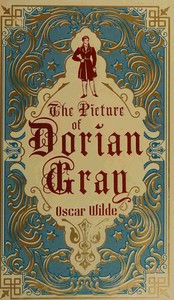
The Picture of Dorian Gray
Oscar Wilde, 1890
A beautiful young man wishes his portrait would age in his place. It is a sharp, funny, then frightening study of vanity, charm and moral drift, still uncomfortably current.
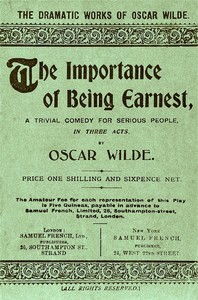
The Importance of Being Earnest
Oscar Wilde, 1895
Two friends invent imaginary relatives to escape their obligations, and their inventions collide in one country house full of people who talk in epigrams.
Where to get it
Some of these links earn us a small commission, at no cost to you. It keeps BookFeed free.
Questions readers ask
- Is The Happy Prince, and Other Tales for me?
- You may like these if you enjoy short fairy tales with a moral edge, playful wit, and a soft heart. Some of the Victorian phrasing and openly stated lessons can feel old-fashioned if you want stories that stay ironic or modern throughout.
- What is The Happy Prince, and Other Tales like?
- Wilde's fairy tales move with a tender, witty voice, lyrical but plain, and their moral seriousness never quite loses its humor. Feels like tenderness, humor and melancholy. About love, morality and society.
- What should I read after The Happy Prince, and Other Tales?
- If you liked The Happy Prince, and Other Tales, try Mansfield Park (Jane Austen), The Four Million (O. Henry) and The Velveteen Rabbit (Margery Williams Bianco).
A taste of the feed
A church hymn reaches a man who thought he had forgotten everything.
The moon was above, lustrous and serene; vehicles and pedestrians were few; sparrows twittered sleepily in the eaves—for a little while the scene might have been a country churchyard. And the anthem that the organist played cemented Soapy to the iron fence, for he had known it well in the days when his life contained such things as mothers and roses and ambitions and friends and immaculate thoughts and collars.
The Four Million · O. Henry
What it costs to become real, told by someone who has already paid.
“It doesn’t happen all at once,” said the Skin Horse. “You become. It takes a long time. That’s why it doesn’t happen often to people who break easily, or have sharp edges, or who have to be carefully kept. Generally, by the time you are Real, most of your hair has been loved off, and your eyes drop out and you get loose in the joints and very shabby. But these things don’t matter at all, because once you are Real you can’t be ugly, except to people who don’t understand.”
The Velveteen Rabbit · Margery Williams Bianco
How hard it is to believe that other people are as real as you are.
We are all of us born in moral stupidity, taking the world as an udder to feed our supreme selves: Dorothea had early begun to emerge from that stupidity, but yet it had been easier to her to imagine how she would devote herself to Mr. Casaubon, and become wise and strong in his strength and wisdom, than to conceive with that distinctness which is no longer reflection but feeling—an idea wrought back to the directness of sense, like the solidity of objects—that he had an equivalent centre of self, whence the lights and shadows must always fall with a certain difference.
Middlemarch · George Eliot
Read pages from books like this, one at a time
Keep reading in the feed