
Gitanjali
Rabindranath Tagore (1861–1941), 1910
★ 4.29 from 12.4k ratings on Goodreads
Short devotional songs that read like love letters to something unnamed. A way to spend an hour with longing, humility and joy, in English prose the poet shaped himself. The songs move slowly and lyrically, carrying longing, tenderness and faith in a voice that sounds like intimate prayer and plain speech.
Feels like longing, tenderness and joy. About faith, love and nature.
Who it’s for
You may like it if you are drawn to devotional poetry, quiet lyricism, or writing that treats longing and joy as companions. The English here is prose the poet shaped himself, so if you expect regular rhyme or metre, this will not give you that.
Why read it
It gives you a short, lyrical place to sit with longing and gratitude, and a view of devotion as tender rather than doctrinal.
Pages from the book
A wish for a last song that holds every kind of joy.
Let all the strains of joy mingle in my last song—the joy that makes the earth flow over in the riotous excess of the grass, the joy that sets the twin brothers, life and death, dancing over the wide world, the joy that sweeps in with the tempest, shaking and waking all life with laughter, the joy that sits still with its tears on the open red lotus of pain, and the joy that throws everything it has upon the dust, and knows not a word. A request for light, and a flame carried the other way.
On the slope of the desolate river among tall grasses I asked her, “Maiden, where do you go shading your lamp with your mantle? My house is all dark and lonesome—lend me your light!” she raised her dark eyes for a moment and looked at my face through the dusk. “I have come to the river,” she said, “to float my lamp on the stream when the daylight wanes in the west.” I stood alone among tall grasses and watched the timid flame of her lamp uselessly drifting in the tide. The morning you realise the world was never foreign to you.
When in the morning I looked upon the light I felt in a moment that I was no stranger in this world, that the inscrutable without name and form had taken me in its arms in the form of my own mother. Rabindranath Tagore.Tagore, the first non-European Nobel laureate in Literature (1913), made the English Gitanjali himself, and he also wrote the words and music of the national anthems of both India and Bangladesh.
Books that feel like this



Goblin Market, The Prince's Progress, and Other Poems
Christina Rossetti, 1862
Also longing and love.
More by Rabindranath Tagore
My Reminiscences
Rabindranath Tagore, 1912
A boy in a vast Calcutta house, a school he hated, a first snowfall, a mother's death: Tagore's own account of how a poet's mind is made.
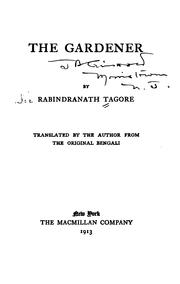
The gardener
Rabindranath Tagore, 1913
Fifty-odd small songs about love, parting, gardens and God, in the plain English prose the poet made himself, from the Bengali originals.
Where to get it
Some of these links earn us a small commission, at no cost to you. It keeps BookFeed free.
Questions readers ask
- Is Gitanjali for me?
- You may like it if you are drawn to devotional poetry, quiet lyricism, or writing that treats longing and joy as companions. The English here is prose the poet shaped himself, so if you expect regular rhyme or metre, this will not give you that.
- What is Gitanjali like?
- The songs move slowly and lyrically, carrying longing, tenderness and faith in a voice that sounds like intimate prayer and plain speech. Feels like longing, tenderness and joy. About faith, love and nature.
- What should I read after Gitanjali?
- If you liked Gitanjali, try Sonnets from the Portuguese (Elizabeth Barrett Browning), The Lily of the Valley (Honoré de Balzac) and Poetry (James Joyce).
A taste of the feed
What it costs to hand someone the ashes of your grief.
I lift my heavy heart up solemnly, As once Electra her sepulchral urn, And, looking in thine eyes, I overturn The ashes at thy feet. Behold and see What a great heap of grief lay hid in me, And how the red wild sparkles dimly burn Through the ashen greyness. If thy foot in scorn Could tread them out to darkness utterly, It might be well perhaps. But if instead Thou wait beside me for the wind to blow The grey dust up—those laurels on thine head, O my Beloved, will not shield thee so, That none of all the fires shall scorch and shred The hair beneath. Stand further off then! Go.
Sonnets from the Portuguese · Elizabeth Barrett Browning
The moment a parent's love turns into fear of the world.
Wind whines and whines the shingle, The crazy pierstakes groan; A senile sea numbers each single Slimesilvered stone. From whining wind and colder Grey sea I wrap him warm And touch his trembling fineboned shoulder And boyish arm. Around us fear, descending Darkness of fear above And in my heart how deep unending Ache of love!
Poetry · James Joyce
The heaviest thing you will ever have to carry is yourself.
God strengthen me to bear myself; That heaviest weight of all to bear, Inalienable weight of care. All others are outside myself, I lock my door and bar them out The turmoil, tedium, gad-about. I lock my door upon myself, And bar them out; but who shall wall Self from myself, most loathed of all? If I could once lay down myself, And start self-purged upon the race That all must run! Death runs apace.
Goblin Market, The Prince's Progress, and Other Poems · Christina Rossetti
Read pages from books like this, one at a time
Keep reading in the feed