
Kwaidan
Lafcadio Hearn (1850–1904), 1904
★ 3.81 from 6.6k ratings on Goodreads
Ghost stories and insect essays from a Greek-born Irishman who became Japanese: a stranger's report on a country of hungry ghosts and cherry trees. Quiet, lyrical ghost stories and insect essays, with a stranger's curious eye and a slow, old-fashioned hush.
Feels like wonder and dread. About death, memory and nature.
Who it’s for
You may like it if you enjoy quiet supernatural tales, old travel writing, and prose that savors sound and place. The English is from 1904 and can feel archaic, and the collection mixes ghost stories with insect essays, so some stretches are more reflective than eerie.
Why read it
Hearn's outsider's eye makes familiar ghost-story material strange again, and his attention to sound and landscape gives you something to linger over.
Pages from the book
The loneliness of being praised by a room you cannot see.
Then Hōïchi lifted up his voice, and chanted the chant of the fight on the bitter sea,—wonderfully making his biwa to sound like the straining of oars and the rushing of ships, the whirr and the hissing of arrows, the shouting and trampling of men, the crashing of steel upon helmets, the plunging of slain in the flood. And to left and right of him, in the pauses of his playing, he could hear voices murmuring praise: “How marvelous an artist!”—“Never in our own province was playing heard like this!”—“Not in all the empire is there another singer like Hōïchi!” Then fresh courage came to him, and he played and sang yet better than before; and a hush of wonder deepened about him. A vigil over a corpse, and the certainty that you are no longer alone.
All then left the house, except the priest, who went to the room where the dead body was lying. The usual offerings had been set before the corpse; and a small Buddhist lamp—tōmyō—was burning. The priest recited the service, and performed the funeral ceremonies,—after which he entered into meditation. So meditating he remained through several silent hours; and there was no sound in the deserted village. But, when the hush of the night was at its deepest, there noiselessly entered a Shape, vague and vast; and in the same moment Musō found himself without power to move or speak. He saw that Shape lift the corpse, as with hands, devour it, more quickly than a cat devours a rat,—beginning at the head, and eating everything: the hair and the bones and even the shroud. A theory of light that is also a theory about the dead.
Nevertheless there are wonderful things in Hōrai; and the most wonderful of all has not been mentioned by any Chinese writer. I mean the atmosphere of Hōrai. It is an atmosphere peculiar to the place; and, because of it, the sunshine in Hōrai is whiter than any other sunshine,—a milky light that never dazzles,—astonishingly clear, but very soft. This atmosphere is not of our human period: it is enormously old,—so old that I feel afraid when I try to think how old it is;—and it is not a mixture of nitrogen and oxygen. It is not made of air at all, but of ghost,—the substance of quintillions of quintillions of generations of souls blended into one immense translucency,—souls of people who thought in ways never resembling our ways. Lafcadio Hearn.Hearn lost the sight of his left eye in a schoolyard accident, arrived in Japan in 1890, and took the name Koizumi Yakumo on becoming a Japanese citizen.
Books that feel like this






More by Lafcadio Hearn
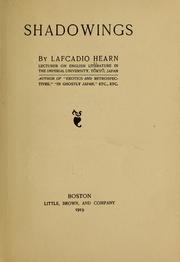
Shadowings
Lafcadio Hearn, 1900
A globe-trotting newspaperman in Meiji Japan collects ghost stories, insect songs, and notes on fear—curious, exact, and quietly strange.
Where to get it
Some of these links earn us a small commission, at no cost to you. It keeps BookFeed free.
Questions readers ask
- Is Kwaidan for me?
- You may like it if you enjoy quiet supernatural tales, old travel writing, and prose that savors sound and place. The English is from 1904 and can feel archaic, and the collection mixes ghost stories with insect essays, so some stretches are more reflective than eerie.
- What is Kwaidan like?
- Quiet, lyrical ghost stories and insect essays, with a stranger's curious eye and a slow, old-fashioned hush. Feels like wonder and dread. About death, memory and nature.
- What should I read after Kwaidan?
- If you liked Kwaidan, try Ghost Stories of an Antiquary (M. R. James), The Raven (Edgar Allan Poe) and Uncle Silas (Sheridan Le Fanu).
A taste of the feed
A midnight tap sounds like a visitor until the mind supplies otherwise.
Once upon a midnight dreary, while I pondered, weak and weary, Over many a quaint and curious volume of forgotten lore— While I nodded, nearly napping, suddenly there came a tapping, As of some one gently rapping, rapping at my chamber door. “’Tis some visiter,” I muttered, “tapping at my chamber door— Only this and nothing more.”
The Raven · Edgar Allan Poe
What fear does to the body before the mind can decide.
Why did I remain silent and motionless while such an outrage was being committed? If, instead of being a very nervous girl, preoccupied with an undefinable terror of that wicked woman, I had possessed courage and presence of mind, I dare say I might have given an alarm, and escaped from the room without the slightest risk. But so it was; I could no more stir than the bird who, cowering under its ivy, sees the white owl sailing back and forward under its predatory cruise.
Uncle Silas · Sheridan Le Fanu
Read pages from books like this, one at a time
Keep reading in the feed