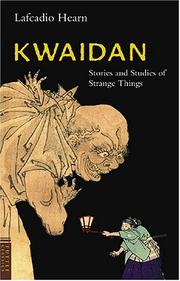
Kwaidan
Lafcadio Hearn, 1904
Ghost stories and insect essays from a Greek-born Irishman who became Japanese: a stranger's report on a country of hungry ghosts and cherry trees.
 BookFeed Ελληνικά
Pages from Kwaidan that stand on their own, chosen for how they read today. The text is in the public domain.
The loneliness of being praised by a room you cannot see.
Then Hōïchi lifted up his voice, and chanted the chant of the fight on the bitter sea,—wonderfully making his biwa to sound like the straining of oars and the rushing of ships, the whirr and the hissing of arrows, the shouting and trampling of men, the crashing of steel upon helmets, the plunging of slain in the flood. And to left and right of him, in the pauses of his playing, he could hear voices murmuring praise: “How marvelous an artist!”—“Never in our own province was playing heard like this!”—“Not in all the empire is there another singer like Hōïchi!” Then fresh courage came to him, and he played and sang yet better than before; and a hush of wonder deepened about him. A vigil over a corpse, and the certainty that you are no longer alone.
All then left the house, except the priest, who went to the room where the dead body was lying. The usual offerings had been set before the corpse; and a small Buddhist lamp—tōmyō—was burning. The priest recited the service, and performed the funeral ceremonies,—after which he entered into meditation. So meditating he remained through several silent hours; and there was no sound in the deserted village. But, when the hush of the night was at its deepest, there noiselessly entered a Shape, vague and vast; and in the same moment Musō found himself without power to move or speak. He saw that Shape lift the corpse, as with hands, devour it, more quickly than a cat devours a rat,—beginning at the head, and eating everything: the hair and the bones and even the shroud. A theory of light that is also a theory about the dead.
Nevertheless there are wonderful things in Hōrai; and the most wonderful of all has not been mentioned by any Chinese writer. I mean the atmosphere of Hōrai. It is an atmosphere peculiar to the place; and, because of it, the sunshine in Hōrai is whiter than any other sunshine,—a milky light that never dazzles,—astonishingly clear, but very soft. This atmosphere is not of our human period: it is enormously old,—so old that I feel afraid when I try to think how old it is;—and it is not a mixture of nitrogen and oxygen. It is not made of air at all, but of ghost,—the substance of quintillions of quintillions of generations of souls blended into one immense translucency,—souls of people who thought in ways never resembling our ways. The graveyard someone picks because it is older than electricity.
Besides, I should like, when my time comes, to be laid away in some Buddhist graveyard of the ancient kind,—so that my ghostly company should be ancient, caring nothing for the fashions and the changes and the disintegrations of Meiji (1). That old cemetery behind my garden would be a suitable place. Everything there is beautiful with a beauty of exceeding and startling queerness; each tree and stone has been shaped by some old, old ideal which no longer exists in any living brain; even the shadows are not of this time and sun, but of a world forgotten, that never knew steam or electricity or magnetism or—kerosene oil! Also in the boom of the big bell there is a quaintness of tone which wakens feelings, so strangely far-away from all the nineteenth-century part of me, that the faint blind stirrings of them make me afraid,—deliciously afraid. Grief given a growing thing, made to return on the same date each year.
After the funeral of O-Sodé, a young cherry-tree,—the finest that could be found,—was planted in the garden of Saihōji by the parents of O-Tsuyu. The tree grew and flourished; and on the sixteenth day of the second month of the following year,—the anniversary of O-Sodé’s death,—it blossomed in a wonderful way. So it continued to blossom for two hundred and fifty-four years,—always upon the sixteenth day of the second month;—and its flowers, pink and white, were like the nipples of a woman’s breasts, bedewed with milk. And the people called it Ubazakura, the Cherry-tree of the Milk-Nurse. What the dead come back for, and how little of them arrives.
On the night after the funeral of O-Sono, her little son said that his mamma had come back, and was in the room upstairs. She had smiled at him, but would not talk to him: so he became afraid, and ran away. Then some of the family went upstairs to the room which had been O-Sono’s; and they were startled to see, by the light of a small lamp which had been kindled before a shrine in that room, the figure of the dead mother. She appeared as if standing in front of a tansu, or chest of drawers, that still contained her ornaments and her wearing-apparel. Her head and shoulders could be very distinctly seen; but from the waist downwards the figure thinned into invisibility;—it was like an imperfect reflection of her, and transparent as a shadow on water. What remains in a room when the person in it simply stops being there.
With another cry of pain she turned aside her beautiful head, and tried to hide her face behind her sleeve. But almost in the same moment her whole form appeared to collapse in the strangest way, and to sink down, down, down—level with the floor. Tomotada had sprung to support her;—but there was nothing to support! There lay on the matting only the empty robes of the fair creature and the ornaments that she had worn in her hair: the body had ceased to exist... Odd things that can keep a life going after the body has finished with it.
In Wakégōri, a district of the province of Iyo (1), there is a very ancient and famous cherry-tree, called Jiu-roku-zakura, or “the Cherry-tree of the Sixteenth Day,” because it blooms every year upon the sixteenth day of the first month (by the old lunar calendar),—and only upon that day. Thus the time of its flowering is the Period of Great Cold,—though the natural habit of a cherry-tree is to wait for the spring season before venturing to blossom. But the Jiu-roku-zakura blossoms with a life that is not—or, at least, that was not originally—its own. There is the ghost of a man in that tree. A beloved song, a coarse voice, then a tenderness that shouldn't be there.
The accent, the attitude, the voice, all fill me with repulsion unutterable,—shock me with a new sensation of formidable vulgarity. I want to cry out loud, “You have no right to sing that song!” For I have heard it sung by the lips of the dearest and fairest being in my little world;—and that this rude, coarse man should dare to sing it vexes me like a mockery,—angers me like an insolence. But only for a moment!... With the utterance of the syllables “to-day,” that deep, grim voice suddenly breaks into a quivering tenderness indescribable;—then, marvelously changing, it mellows into tones sonorous and rich as the bass of a great organ,—while a sensation unlike anything ever felt before takes me by the throat... What witchcraft has he learned? what secret has he found—this scowling man of the road?... Lafcadio Hearn, 1904
Ghost stories and insect essays from a Greek-born Irishman who became Japanese: a stranger's report on a country of hungry ghosts and cherry trees.
Read pages from books like this, one at a time
BookFeed is a feed of real passages from real books. It learns what moves you and finds your next book.
Open BookFeedFree, no sign-up.