
The Raven
Edgar Allan Poe (1809–1849), 1845
A grieving scholar, a midnight raven, and one word that refuses to become comfort. The poem that made grief sound like a knock at the door. A slow, mournful build of dread, with a lilting, old-fashioned voice and a refrain that keeps circling back.
Feels like grief, dread and melancholy. About death, memory and madness.
Who it’s for
You may like it if you enjoy gothic atmosphere, musical repetition, and a poem that treats grief as a haunting. The nineteenth-century diction and long, chanting lines can feel demanding if you prefer plain modern speech.
Why read it
It gives you a compact, memorable example of Poe's sound craft, and a way to sit with grief that is both theatrical and strangely intimate.
Pages from the book
A midnight tap sounds like a visitor until the mind supplies otherwise.
Once upon a midnight dreary, while I pondered, weak and weary, Over many a quaint and curious volume of forgotten lore— While I nodded, nearly napping, suddenly there came a tapping, As of some one gently rapping, rapping at my chamber door. “’Tis some visiter,” I muttered, “tapping at my chamber door— Only this and nothing more.” Grief keeps returning to the same room, the same month, the same name.
Ah, distinctly I remember it was in the bleak December, And each separate dying ember wrought its ghost upon the floor. Eagerly I wished the morrow;—vainly I had sought to borrow From my books surcease of sorrow—sorrow for the lost Lenore— For the rare and radiant maiden whom the angels name Lenore— Nameless here for evermore. A bird enters like a lord and refuses to explain itself.
Open here I flung the shutter, when, with many a flirt and flutter, In there stepped a stately Raven of the saintly days of yore. Not the least obeisance made he; not a minute stopped or stayed he, But, with mien of lord or lady, perched above my chamber door— Perched upon a bust of Pallas just above my chamber door— Perched, and sat, and nothing more. Edgar Allan Poe.Poe claimed he wrote “The Raven” backwards, beginning with its last stanza, and chose “Nevermore” for the sound of its long o.
Books that feel like this



More by Edgar Allan Poe
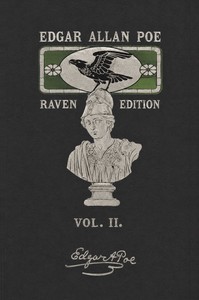
The Works of Edgar Allan Poe
Edgar Allan Poe, 1850
Poe's detective Dupin, a whirlpool, a black cat, a revenge vow: tales that made detection and dread into modern literary pleasures.
The Works of Edgar Allan Poe
Edgar Allan Poe, 1838
Shipwreck, starvation, obsessive grief, and a plague masquerade in an undertaker's shop: Poe's strangest long tales and sketches gathered in one volume.
Where to get it
Some of these links earn us a small commission, at no cost to you. It keeps BookFeed free.
Questions readers ask
- Is The Raven for me?
- You may like it if you enjoy gothic atmosphere, musical repetition, and a poem that treats grief as a haunting. The nineteenth-century diction and long, chanting lines can feel demanding if you prefer plain modern speech.
- What is The Raven like?
- A slow, mournful build of dread, with a lilting, old-fashioned voice and a refrain that keeps circling back. Feels like grief, dread and melancholy. About death, memory and madness.
- What should I read after The Raven?
- If you liked The Raven, try Uncle Silas (Sheridan Le Fanu), Short Fiction (Mary Shelley) and Kwaidan (Lafcadio Hearn).
A taste of the feed
What fear does to the body before the mind can decide.
Why did I remain silent and motionless while such an outrage was being committed? If, instead of being a very nervous girl, preoccupied with an undefinable terror of that wicked woman, I had possessed courage and presence of mind, I dare say I might have given an alarm, and escaped from the room without the slightest risk. But so it was; I could no more stir than the bird who, cowering under its ivy, sees the white owl sailing back and forward under its predatory cruise.
Uncle Silas · Sheridan Le Fanu
Three hundred years old, and still checking for grey hairs.
Am I, then, immortal? This is a question which I have asked myself, by day and night, for now three hundred and three years, and yet cannot answer it. I detected a grey hair amidst my brown locks this very day—that surely signifies decay. Yet it may have remained concealed there for three hundred years—for some persons have become entirely white-headed before twenty years of age.
Short Fiction · Mary Shelley
Read pages from books like this, one at a time
Keep reading in the feed