
Shadowings
Lafcadio Hearn (1850–1904), 1900
★ 3.79 from 106 ratings on Goodreads
A globe-trotting newspaperman in Meiji Japan collects ghost stories, insect songs, and notes on fear—curious, exact, and quietly strange. Hearn's prose moves slowly and precisely, mixing starlit wonder with a quiet unease, as if every observation carries a shadow.
Feels like wonder, unease and melancholy. About death, memory and art.
Who it’s for
You may like it if you enjoy essayistic travel writing, Japanese folklore, and prose that lingers on atmosphere rather than plot. Be prepared for nineteenth-century sentences and a few slow, reflective stretches; the ghostly pieces are eerie rather than thrilling.
Why read it
It offers a curious outsider's view of Meiji Japan and a steady, lyrical attention to fear, memory, and the natural world. Read it for the sentences and the strange, exact noticing.
Pages from the book
The night sea does not look like water; it looks like a mind.
THE moon had not yet risen; but the vast of the night was all seething with stars, and bridged by a Milky Way of extraordinary brightness. There was no wind; but the sea, far as sight could reach, was running in ripples of fire,—a vision of infernal beauty. Only the ripplings were radiant (between them was blackness absolute);—and the luminosity was amazing. Most of the undulations were yellow like candle-flame; but there were crimson lampings also,—and azure, and orange, and emerald. And the sinuous flickering of all seemed, not a pulsing of many waters, but a laboring of many wills,—a fleeting conscious and monstrous,—a writhing and a swarming incalculable, as of dragon-life in some depth of Erebus. A winter robe woven from discarded poems, thread by thread.
One is a roll of cloth for a new kimono,—cloth such as my Western reader never saw. The brown warp is cotton thread; but the woof is soft white paper string, irregularly speckled with black. When closely examined, the black specklings prove to be Chinese and Japanese characters;—for the paper woof is made out of manuscript,—manuscript of poems,—which has been deftly twisted into fine cord, with the written surface outwards. The general effect of the white, black, and brown in the texture is a warm mouse-grey. In many Izumo homes a similar kind of cloth is manufactured for family use; but this piece was woven especially for me by the mother of my pupil. It will make a most comfortable winter-robe; and when wearing it, I shall be literally clothed with poetry,—even as a divinity might be clothed with the sun. The first time another person's eyes seem to contain the whole world.
THERE is one adolescent moment never to be forgotten,—the moment when the boy learns that this world contains nothing more wonderful than a certain pair of eyes. At first the surprise of the discovery leaves him breathless: instinctively he turns away his gaze. That vision seemed too delicious to be true. But presently he ventures to look again,—fearing with a new fear,—afraid of the reality, afraid also of being observed;—and lo! his doubt dissolves in a new shock of ecstasy. Those eyes are even more wonderful than he had imagined—nay! they become more and yet more entrancing every successive time that he looks at them! Surely in all the universe there cannot be another such pair of eyes! What can lend them such enchantment? Why do they appear divine?... He feels that he must ask somebody to explain,—must propound to older and wiser heads the riddle of his new emotions. Lafcadio Hearn.Hearn was born on a Greek island, raised in Ireland, and became a Japanese subject as Koizumi Yakumo, teaching English literature in Matsue and Tokyo.
Books that feel like this


More by Lafcadio Hearn
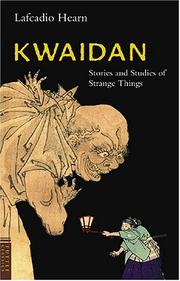
Kwaidan
Lafcadio Hearn, 1904
Ghost stories and insect essays from a Greek-born Irishman who became Japanese: a stranger's report on a country of hungry ghosts and cherry trees.
Where to get it
Some of these links earn us a small commission, at no cost to you. It keeps BookFeed free.
Questions readers ask
- Is Shadowings for me?
- You may like it if you enjoy essayistic travel writing, Japanese folklore, and prose that lingers on atmosphere rather than plot. Be prepared for nineteenth-century sentences and a few slow, reflective stretches; the ghostly pieces are eerie rather than thrilling.
- What is Shadowings like?
- Hearn's prose moves slowly and precisely, mixing starlit wonder with a quiet unease, as if every observation carries a shadow. Feels like wonder, unease and melancholy. About death, memory and art.
- What should I read after Shadowings?
- If you liked Shadowings, try Twice-told tales (Nathaniel Hawthorne), The King in Yellow (Robert W. Chambers) and Lamia (John Keats).
A taste of the feed
What a week of disappearing does to the person who loves you.
Poor Wakefield! little knowest thou thine own insignificance in this great world. No mortal eye but mine has traced thee. Go quietly to thy bed, foolish man, and on the morrow, if thou wilt be wise, get thee home to good Mrs. Wakefield and tell her the truth. Remove not thyself even for a little week from thy place in her chaste bosom. Were she for a single moment to deem thee dead or lost or lastingly divided from her, thou wouldst be woefully conscious of a change in thy true wife for ever after. It is perilous to make a chasm in human affections—not that they gape so long and wide, but so quickly close again.
Twice-told tales · Nathaniel Hawthorne
Dazzling all over, and yet somehow sorrowful.
She was a gordian shape of dazzling hue, Vermilion-spotted, golden, green, and blue; Striped like a zebra, freckled like a pard, Eyed like a peacock, and all crimson barr’d; And full of silver moons, that, as she breathed, Dissolv’d, or brighter shone, or interwreathed Their lustres with the gloomier tapestries— So rainbow-sided, touch’d with miseries, She seem’d, at once, some penanced lady elf, Some demon’s mistress, or the demon’s self. Upon her crest she wore a wannish fire Sprinkled with stars, like Ariadne’s tiar: Her head was serpent, but ah, bitter-sweet! She had a woman’s mouth with all its pearls complete:
Lamia · John Keats
The fear of people who feel too much, and the wish to burn slowly.
Involuntarily he made a gesture as if to ward it off with his hand. After all, he was afraid in his inmost heart of this mighty thing called passion. This storm-wind sweeping away everything settled and authorized and acquired in humanity as if it were dead leaves. He did not like it! This roaring flame squandering itself in its own smoke—no, he wanted to burn slowly.
Niels Lyhne · J. P. Jacobsen
Read pages from books like this, one at a time
Keep reading in the feed