
Beyond Good and Evil
Friedrich Nietzsche (1844–1900), 1886
★ 4.03 from 121.8k ratings on Goodreads
A sharp-tongued tour of the habits of mind we take for granted: why philosophers lie to themselves, what our morals hide, and what it takes to think without flattering yourself. Aphorisms arrive like quick jabs: curious, defiant, and impatient with comfortable moral assumptions.
Feels like curiosity, defiance and unease. About morality, identity and power.
Who it’s for
You may like it if you enjoy being provoked into examining your own moral assumptions and can appreciate a philosopher who writes in short, sharp bursts. Be warned that the aphoristic structure and nineteenth-century prose make it a demanding read without a single sustained argument to carry you along.
Why read it
It gives you a bracing set of questions about honesty, morality, and self-flattery, and a style that rewards slow attention rather than agreement.
Pages from the book
Suppose the truth were harmful, and your comfort a measure of your weakness.
Nobody will very readily regard a doctrine as true merely because it makes people happy or virtuous—excepting, perhaps, the amiable “Idealists,” who are enthusiastic about the good, true, and beautiful, and let all kinds of motley, coarse, and good-natured desirabilities swim about promiscuously in their pond. Happiness and virtue are no arguments. It is willingly forgotten, however, even on the part of thoughtful minds, that to make unhappy and to make bad are just as little counter-arguments. A thing could be TRUE, although it were in the highest degree injurious and dangerous; indeed, the fundamental constitution of existence might be such that one succumbed by a full knowledge of it—so that the strength of a mind might be measured by the amount of “truth” it could endure—or to speak more plainly, by the extent to which it REQUIRED truth attenuated, veiled, sweetened, damped, and falsified. Small aphorisms on shame, maturity and the vanity of a good name.
Who has not, at one time or another—sacrificed himself for the sakeof his good name?93. In affability there is no hatred of men, but precisely on thataccount a great deal too much contempt of men.94. The maturity of man—that means, to have reacquired the seriousnessthat one had as a child at play.95. To be ashamed of one’s immorality is a step on the ladder at the endof which one is ashamed also of one’s morality. A writer watches his sharpest thoughts go soft and respectable.
Alas! what are you, after all, my written and painted thoughts! Not long ago you were so variegated, young and malicious, so full of thorns and secret spices, that you made me sneeze and laugh—and now? You have already doffed your novelty, and some of you, I fear, are ready to become truths, so immortal do they look, so pathetically honest, so tedious! And was it ever otherwise? What then do we write and paint, we mandarins with Chinese brush, we immortalisers of things which LEND themselves to writing, what are we alone capable of painting? Alas, only that which is just about to fade and begins to lose its odour! Alas, only exhausted and departing storms and belated yellow sentiments! Alas, only birds strayed and fatigued by flight, which now let themselves be captured with the hand—with OUR hand! Friedrich Nietzsche.Nietzsche became professor of classical philology at Basel at 24, before he had finished his doctorate. He resigned the post at 34 because of poor health and spent his later years wandering between boarding houses.
Books that feel like this





More by Friedrich Nietzsche

Thus Spake Zarathustra
Friedrich Nietzsche, 1883
A prophet comes down from the mountain to tell you your values were borrowed, your comfort is a cage, and you could become something else.
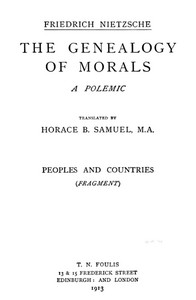
The Genealogy of Morals
Friedrich Nietzsche, 1887
Nietzsche's fiercest book asks where our ideas of good, guilt and duty actually came from, and finds debt, blood and self-torture underneath them.
Where to get it
Some of these links earn us a small commission, at no cost to you. It keeps BookFeed free.
Questions readers ask
- Is Beyond Good and Evil for me?
- You may like it if you enjoy being provoked into examining your own moral assumptions and can appreciate a philosopher who writes in short, sharp bursts. Be warned that the aphoristic structure and nineteenth-century prose make it a demanding read without a single sustained argument to carry you along.
- What is Beyond Good and Evil like?
- Aphorisms arrive like quick jabs: curious, defiant, and impatient with comfortable moral assumptions. Feels like curiosity, defiance and unease. About morality, identity and power.
- What should I read after Beyond Good and Evil?
- If you liked Beyond Good and Evil, try Kritik der reinen Vernunft (Immanuel Kant), The Prince (Niccolò Machiavelli) and The Essays or Counsels, Civil and Moral (Francis Bacon).
A taste of the feed
The most counterintuitive military idea in history: win with the enemy intact, not destroyed.
Sun Tzǔ said: In the practical art of war, the best thing of all is to take the enemy’s country whole and intact; to shatter and destroy it is not so good. So, too, it is better to capture an army entire than to destroy it, to capture a regiment, a detachment or a company entire than to destroy them.
The Art of War · Sun Tzu
Read pages from books like this, one at a time
Keep reading in the feed