
The Prince
Niccolò Machiavelli (1469–1527), 1532
A short, cool manual on how power is won and kept, written by a man who watched it up close. Its blunt realism still unsettles, and it still explains how leaders behave. Cool, aphoristic and fast-moving, with a blunt voice that turns statecraft into unsettling common sense.
Feels like curiosity and unease. About power, morality and society.
Who it’s for
You may like it if you enjoy short political arguments, sharp maxims and historical examples used to make a point. The prose is old and many examples come from Renaissance Italian and ancient military politics, so some passages can feel remote.
Why read it
It gives you a compact, unsentimental way to think about power and the excuses leaders make, and its bluntness still has the power to provoke.
Pages from the book
Two animals, each helpless without the other, and what survival asks of you.
A prince, therefore, being compelled knowingly to adopt the beast, ought to choose the fox and the lion; because the lion cannot defend himself against snares and the fox cannot defend himself against wolves. Therefore, it is necessary to be a fox to discover the snares and a lion to terrify the wolves. Those who rely simply on the lion do not understand what they are about. Therefore a wise lord cannot, nor ought he to, keep faith when such observance may be turned against him, and when the reasons that caused him to pledge it exist no longer. If men were entirely good this precept would not hold, but because they are bad, and will not keep faith with you, you too are not bound to observe it with them. Nor will there ever be wanting to a prince legitimate reasons to excuse this non-observance. Why almost everyone is judged by the surface and almost no one is known.
For this reason a prince ought to take care that he never lets anything slip from his lips that is not replete with the above-named five qualities, that he may appear to him who sees and hears him altogether merciful, faithful, humane, upright, and religious. There is nothing more necessary to appear to have than this last quality, inasmuch as men judge generally more by the eye than by the hand, because it belongs to everybody to see you, to few to come in touch with you. Every one sees what you appear to be, few really know what you are, and those few dare not oppose themselves to the opinion of the many, who have the majesty of the state to defend them; and in the actions of all men, and especially of princes, which it is not prudent to challenge, one judges by the result. An old question about whether being adored is worth less than being obeyed.
Upon this a question arises: whether it be better to be loved than feared or feared than loved? It may be answered that one should wish to be both, but, because it is difficult to unite them in one person, it is much safer to be feared than loved, when, of the two, either must be dispensed with. Because this is to be asserted in general of men, that they are ungrateful, fickle, false, cowardly, covetous, and as long as you succeed they are yours entirely; they will offer you their blood, property, life, and children, as is said above, when the need is far distant; but when it approaches they turn against you. Niccolò Machiavelli.Machiavelli was tortured on the strappado in 1513 on suspicion of plotting against the Medici. Soon after his release he wrote The Prince, and it was published only after his death.
Books that feel like this

More by Niccolò Machiavelli
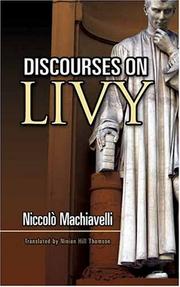
Discourses on Livy
Niccolò Machiavelli, 1531
Machiavelli reads Rome's history to ask how republics win, corrupt, and fall—and why the same appetites keep returning in every city.
Where to get it
Some of these links earn us a small commission, at no cost to you. It keeps BookFeed free.
Questions readers ask
- Is The Prince for me?
- You may like it if you enjoy short political arguments, sharp maxims and historical examples used to make a point. The prose is old and many examples come from Renaissance Italian and ancient military politics, so some passages can feel remote.
- What is The Prince like?
- Cool, aphoristic and fast-moving, with a blunt voice that turns statecraft into unsettling common sense. Feels like curiosity and unease. About power, morality and society.
- What should I read after The Prince?
- If you liked The Prince, try The Essays or Counsels, Civil and Moral (Francis Bacon), Beyond Good and Evil (Friedrich Nietzsche) and Sapiens (Yuval Noah Harari).
A taste of the feed
The thing you can't live without was once optional.
One of history’s few iron laws is that luxuries tend to become necessities and to spawn new obligations. Once people get used to a certain luxury, they take it for granted. Then they begin to count on it. Finally, they reach a point where they can’t live without it.
Sapiens · Yuval Noah Harari
He did not want a statue. He wanted a city that could live without him.
“I could give you many other reasons,” he concluded, “why you should feel confident in ultimate victory, if only you will make up your minds not to add to the empire while the war is in progress, and not to go out of your way to involve yourselves in new perils. What I fear is not the enemy’s strategy but our own mistakes.” The novelty of what he was proposing aroused great debate. Neither hawks nor doves were satisfied with his plan, but in the end, his reputation for wisdom carried the day and his strategy was approved. Several months later the fateful war began.
The Laws of Human Nature · Robert Greene
When the market stops following the rules, who is truly responsible for the collapse?
I was furious the situation had reached this point. A relatively small group of people—many on Wall Street, some not—had gambled that the housing market would keep booming forever. It didn’t. In a normal environment, the free market would render its judgment and they could fail.
Decision Points · George W. Bush
Read pages from books like this, one at a time
Keep reading in the feed