BookFeed

Books like Antigone

If Antigone stayed with you, these share its feel: defiance, love and family. Each comes with a real page, so you can tell in a minute.

About Antigone · Sophocles

  1. 1.Romeo and Juliet

    William Shakespeare, 1597

    Also love and grief. Two teenagers from feuding families fall in love over three days, and the adults around them keep choosing sides.

    Hood my unmann’d blood, bating in my cheeks,With thy black mantle; till strange love, grown bold,Think true love acted simple modesty.Come, night; come, Romeo; come, thou day in night;For thou wilt lie upon the wings of nightWhiter than new snow on a raven’s back.Come, gentle night, come, loving, black-brow’d night,Give me my Romeo; and, when he shall die,Take him and cut him out in little stars,And he will make the face of heaven so fineThat all the world will be in love with nightAnd pay no worship to the garish sun.
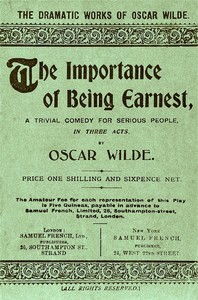
  2. 2.The Importance of Being Earnest

    Oscar Wilde, 1895

    Also defiance and freedom. Two friends invent imaginary relatives to escape their obligations, and their inventions collide in one country house full of people who talk in epigrams.

    To lose one parent, Mr. Worthing, may be regarded as a misfortune; to lose both looks like carelessness. Who was your father? He was evidently a man of some wealth. Was he born in what the Radical papers call the purple of commerce, or did he rise from the ranks of the aristocracy?
  3. 3.Clotel

    William Wells Brown, 1853

    Also defiance and freedom. The first novel by an African American, a slave narrative that follows the daughters of Thomas Jefferson as they are sold, separated, and hunted across the American South.

    “Ah; gentlemen, that is something like. This paper also states that she is very intelligent.” “Eight hundred.” “She is a devoted Christian, and perfectly trustworthy.” “Nine hundred.” “Nine fifty.” “Ten.” “Eleven.” “Twelve hundred.” Here the sale came to a dead stand. The auctioneer stopped, looked around, and began in a rough manner to relate some anecdotes relative to the sale of slaves, which, he said, had come under his own observation. At this juncture the scene was indeed strange. Laughing, joking, swearing, smoking, spitting, and talking kept up a continual hum and noise amongst the crowd; while the slave-girl stood with tears in her eyes, at one time looking towards her mother and sister, and at another towards the young man whom she hoped would become her purchaser. “The chastity of this girl is pure; she has never been from under her mother’s care; she is a virtuous creature.”
  4. 4.Paradise Lost

    John Milton, 1667

    Also freedom and defiance. A blind poet turns the fall of Adam and Eve into an epic of free will, ambition, and married love, and gives the devil its most persuasive voice.

    What matter where, if I be still the same,And what I should be, all but less than heWhom thunder hath made greater? Here at leastWe shall be free; the Almighty hath not builtHere for his envy, will not drive us hence:Here we may reign secure, and in my choiceTo reign is worth ambition though in Hell:Better to reign in Hell, than serve in Heaven.
  5. 5.Anna Karenina

    Leo Tolstoy, 1878

    Also love. A society novel about a marriage coming apart and a landowner trying to build a meaningful life, full of dinner tables, fields, jealousy and philosophy.

    Anna said what came to her lips, and marveled, hearing herself, at her own capacity for lying. How simple and natural were her words, and how likely that she was simply sleepy! She felt herself clad in an impenetrable armor of falsehood. She felt that some unseen force had come to her aid and was supporting her.
  6. 6.Jane Eyre

    Charlotte Brontë, 1847

    Also defiance and freedom. An orphan with no money, no beauty and a ferocious sense of her own worth takes a job at a strange house. A first-person voice that still feels startlingly direct.

    No sooner did I see that his attention was riveted on them, and that I might gaze without being observed, than my eyes were drawn involuntarily to his face; I could not keep their lids under control: they would rise, and the irids would fix on him. I looked, and had an acute pleasure in looking,—a precious yet poignant pleasure; pure gold, with a steely point of agony: a pleasure like what the thirst-perishing man might feel who knows the well to which he has crept is poisoned, yet stoops and drinks divine draughts nevertheless.
  7. 8.Ethan Frome

    Edith Wharton, 1911

    Also love and freedom. A stranded engineer in a snowbound New England village pieces together the story of a poor farmer, his invalid wife, and the young cousin who comes to keep house.

Read pages from books like this, one at a time

BookFeed is a feed of real passages from real books. It learns what moves you and finds your next book.

Open BookFeed

Free, no sign-up.