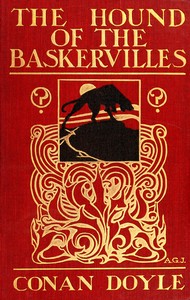
The Hound of the Baskervilles
Arthur Conan Doyle, 1902
A doctor, a cursed family and a great black hound on Dartmoor: Holmes and Watson test whether a legend can be murdered.
 BookFeed
Pages from The Hound of the Baskervilles that stand on their own, chosen for how they read today. The text is in the public domain.
A servant stands at a dark window, watching for something he won't name.
Barrymore was crouching at the window with the candle held against the glass. His profile was half turned towards me, and his face seemed to be rigid with expectation as he stared out into the blackness of the moor. For some minutes he stood watching intently. Then he gave a deep groan and with an impatient gesture he put out the light. Instantly I made my way back to my room, and very shortly came the stealthy steps passing once more upon their return journey. Long afterwards when I had fallen into a light sleep I heard a key turn somewhere in a lock, but I could not tell whence the sound came. What it all means I cannot guess, but there is some secret business going on in this house of gloom which sooner or later we shall get to the bottom of. A knock at the door can redraw the shape of a life.
“For the very simple reason that I see the dog himself on our very doorstep, and there is the ring of its owner. Don’t move, I beg you, Watson. He is a professional brother of yours, and your presence may be of assistance to me. Now is the dramatic moment of fate, Watson, when you hear a step upon the stair which is walking into your life, and you know not whether for good or ill. What does Dr. James Mortimer, the man of science, ask of Sherlock Holmes, the specialist in crime? Come in!” The countryside looks beautiful; the doctor sees only the year dying.
The wagonette swung round into a side road, and we curved upward through deep lanes worn by centuries of wheels, high banks on either side, heavy with dripping moss and fleshy hart’s-tongue ferns. Bronzing bracken and mottled bramble gleamed in the light of the sinking sun. Still steadily rising, we passed over a narrow granite bridge and skirted a noisy stream which gushed swiftly down, foaming and roaring amid the gray boulders. Both road and stream wound up through a valley dense with scrub oak and fir. At every turn Baskerville gave an exclamation of delight, looking eagerly about him and asking countless questions. To his eyes all seemed beautiful, but to me a tinge of melancholy lay upon the countryside, which bore so clearly the mark of the waning year. Yellow leaves carpeted the lanes and fluttered down upon us as we passed. Rain makes the mind reach for everyone else who is out in it.
October 17th.—All day today the rain poured down, rustling on the ivy and dripping from the eaves. I thought of the convict out upon the bleak, cold, shelterless moor. Poor devil! Whatever his crimes, he has suffered something to atone for them. And then I thought of that other one—the face in the cab, the figure against the moon. Was he also out in that deluge—the unseen watcher, the man of darkness? In the evening I put on my waterproof and I walked far upon the sodden moor, full of dark imaginings, the rain beating upon my face and the wind whistling about my ears. God help those who wander into the great mire now, for even the firm uplands are becoming a morass. I found the black tor upon which I had seen the solitary watcher, and from its craggy summit I looked out myself across the melancholy downs. What it costs to claim a home that comes with a curse.
“Whichever it is, my answer is fixed. There is no devil in hell, Mr. Holmes, and there is no man upon earth who can prevent me from going to the home of my own people, and you may take that to be my final answer.” His dark brows knitted and his face flushed to a dusky red as he spoke. It was evident that the fiery temper of the Baskervilles was not extinct in this their last representative. “Meanwhile,” said he, “I have hardly had time to think over all that you have told me. It’s a big thing for a man to have to understand and to decide at one sitting. I should like to have a quiet hour by myself to make up my mind. Now, look here, Mr. Holmes, it’s half-past eleven now and I am going back right away to my hotel. A landscape can feel older than every trace of the country that made you.
My previous letters and telegrams have kept you pretty well up to date as to all that has occurred in this most Godforsaken corner of the world. The longer one stays here the more does the spirit of the moor sink into one’s soul, its vastness, and also its grim charm. When you are once out upon its bosom you have left all traces of modern England behind you, but, on the other hand, you are conscious everywhere of the homes and the work of the prehistoric people. On all sides of you as you walk are the houses of these forgotten folk, with their graves and the huge monoliths which are supposed to have marked their temples. A sound with no source borrows its terror from what you already fear.
As if in answer to his words there rose suddenly out of the vast gloom of the moor that strange cry which I had already heard upon the borders of the great Grimpen Mire. It came with the wind through the silence of the night, a long, deep mutter, then a rising howl, and then the sad moan in which it died away. Again and again it sounded, the whole air throbbing with it, strident, wild, and menacing. The baronet caught my sleeve and his face glimmered white through the darkness. The last sight before sleep can colour the whole night.
I drew aside my curtains before I went to bed and looked out from my window. It opened upon the grassy space which lay in front of the hall door. Beyond, two copses of trees moaned and swung in a rising wind. A half moon broke through the rifts of racing clouds. In its cold light I saw beyond the trees a broken fringe of rocks, and the long, low curve of the melancholy moor. I closed the curtain, feeling that my last impression was in keeping with the rest. Arthur Conan Doyle, 1902
A doctor, a cursed family and a great black hound on Dartmoor: Holmes and Watson test whether a legend can be murdered.
Read pages from books like this, one at a time
BookFeed is a feed of real passages from real books. It learns what moves you and finds your next book.
Open BookFeedFree, no sign-up.