
Twenty Thousand Leagues under the Sea
Jules Verne (1828–1905), 1870
A naturalist is taken prisoner aboard Captain Nemo's submarine and shown the sea's strangest depths, creatures and ruins. A slow, wondering voyage through luminous depths, with a curious narrator and a brooding, witty captain.
Feels like wonder and awe. About adventure and society.
Who it’s for
You may enjoy this if you like armchair voyages, strange underwater landscapes, and a narrator who records everything he sees. Be prepared, though, for long catalogues of marine species and period scientific talk that slow the middle sections.
Why read it
It offers the pleasure of being carried into the ocean's strangest places, seen through a naturalist's eyes and shadowed by Nemo's uneasy genius.
Pages from the book
A man who has renounced his own century stands in a drowned city.
Whilst I was trying to fix in my mind every detail of this grand landscape, Captain Nemo remained motionless, as if petrified in mute ecstasy, leaning on a mossy stone. Was he dreaming of those generations long since disappeared? Was he asking them the secret of human destiny? Was it here this strange man came to steep himself in historical recollections, and live again this ancient life—he who wanted no modern one? What would I not have given to know his thoughts, to share them, to understand them! We remained for an hour at this place, contemplating the vast plains under the brightness of the lava, which was some times wonderfully intense. Rapid tremblings ran along the mountain caused by internal bubblings, deep noise, distinctly transmitted through the liquid medium were echoed with majestic grandeur. A man who has replaced the sun with a clock he can carry.
I could manufacture the air necessary for my consumption, but it is useless, because I go up to the surface of the water when I please. However, if electricity does not furnish me with air to breathe, it works at least the powerful pumps that are stored in spacious reservoirs, and which enable me to prolong at need, and as long as I will, my stay in the depths of the sea. It gives a uniform and unintermittent light, which the sun does not. Now look at this clock; it is electrical, and goes with a regularity that defies the best chronometers. I have divided it into twenty-four hours, like the Italian clocks, because for me there is neither night nor day, sun nor moon, but only that factitious light that I take with me to the bottom of the sea. Flowers that close at the touch of a hand, then turn back to stone.
The light produced a thousand charming varieties, playing in the midst of the branches that were so vividly coloured. I seemed to see the membraneous and cylindrical tubes tremble beneath the undulation of the waters. I was tempted to gather their fresh petals, ornamented with delicate tentacles, some just blown, the others budding, while a small fish, swimming swiftly, touched them slightly, like flights of birds. But if my hand approached these living flowers, these animated, sensitive plants, the whole colony took alarm. The white petals re-entered their red cases, the flowers faded as I looked, and the bush changed into a block of stony knobs. Jules Verne.Verne worked as a stockbroker before he was a novelist, writing in the early mornings and keeping his brokerage seat for years.
Books that feel like this



More by Jules Verne
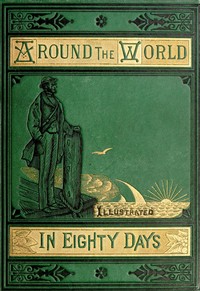
Around the World in Eighty Days
Jules Verne, 1872
A rich Londoner bets his fortune that he can circle the globe in eighty days, and spends every hour of them proving a timetable can beat the world.

Journey to the Center of the Earth
Jules Verne, 1864
A short-tempered professor, his reluctant nephew and a silent Icelandic guide climb into a volcano and keep going down.
Where to get it
Some of these links earn us a small commission, at no cost to you. It keeps BookFeed free.
Questions readers ask
- Is Twenty Thousand Leagues under the Sea for me?
- You may enjoy this if you like armchair voyages, strange underwater landscapes, and a narrator who records everything he sees. Be prepared, though, for long catalogues of marine species and period scientific talk that slow the middle sections.
- What is Twenty Thousand Leagues under the Sea like?
- A slow, wondering voyage through luminous depths, with a curious narrator and a brooding, witty captain. Feels like wonder and awe. About adventure and society.
- What should I read after Twenty Thousand Leagues under the Sea?
- If you liked Twenty Thousand Leagues under the Sea, try The Jungle Book (Rudyard Kipling), Alice's Adventures in Wonderland (Lewis Carroll) and Alaska (James Michener).
A taste of the feed
What a palace looks like a hundred years after the queens have gone.
He set his teeth and said nothing, but went with the shouting monkeys to a terrace above the red sandstone reservoirs that were half full of rainwater. There was a ruined summerhouse of white marble in the center of the terrace, built for queens dead a hundred years ago. The domed roof had half fallen in and blocked up the underground passage from the palace by which the queens used to enter; but the walls were made of screens of marble tracery—beautiful, milk-white fretwork, set with agates and cornelians and jasper and lapis lazuli, and as the moon came up behind the hill it shone through the openwork, casting shadows on the ground like black-velvet embroidery.
The Jungle Book · Rudyard Kipling
She scolds herself so well it brings her to tears.
“Come, there’s no use in crying like that!” said Alice to herself, rather sharply; “I advise you to leave off this minute!” She generally gave herself very good advice, (though she very seldom followed it), and sometimes she scolded herself so severely as to bring tears into her eyes; and once she remembered trying to box her own ears for having cheated herself in a game of croquet she was playing against herself, for this curious child was very fond of pretending to be two people. “But it’s no use now,” thought poor Alice, “to pretend to be two people! Why, there’s hardly enough of me left to make one respectable person!”
Alice's Adventures in Wonderland · Lewis Carroll
The night the ocean itself began to give off light.
While sailing a little south of the Plata on one very dark night, the sea presented a wonderful and most beautiful spectacle. There was a fresh breeze, and every part of the surface, which during the day is seen as foam, now glowed with a pale light. The vessel drove before her bows two billows of liquid phosphorus, and in her wake she was followed by a milky train. As far as the eye reached, the crest of every wave was bright, and the sky above the horizon, from the reflected glare of these livid flames, was not so utterly obscure as over the vault of the heavens.
The Voyage of the Beagle · Charles Darwin
Read pages from books like this, one at a time
Keep reading in the feed