
Tuesdays with Morrie
Mitch Albom, 1997
★ 4.22 from 1.3m ratings on Goodreads
A sportswriter reconnects with his dying sociology professor and records their Tuesday conversations about love, work, and fear. A tender, slow conversation with a dying teacher, warm and plainspoken, often melancholy, with grief close to the surface.
Feels like tenderness, melancholy and grief. About morality, death and love.
Who it’s for
You may like it if you are open to a gentle memoir built from conversations about love, work, fear, and memory. Some readers find the lessons clichéd, saccharine, or preachy, so the book can feel more sentimental than searching.
Why read it
The book gives you a short, plain record of a friendship sustained through illness and of one man's questions about how to live.
A page from the book
The dignity of being the oldest person in the room and not caring.
He used to go to this church in Harvard Square every Wednesday night for something called “Dance Free.” They had flashing lights and booming speakers and Morrie would wander in among the mostly student crowd, wearing a white T-shirt and black sweatpants and a towel around his neck, and whatever music was playing, that’s the music to which he danced. He’d do the lindy to Jimi Hendrix. He twisted and twirled, he waved his arms like a conductor on amphetamines, until sweat was dripping down the middle of his back. No one there knew he was a prominent doctor of sociology, with years of experience as a college professor and several well-respected books. They just thought he was some old nut. What readers say
Many readers describe being deeply moved, tearful, and reflective, finding uplift and comfort in the focus on love, mortality, family, and memory. Others found the lessons clichéd, saccharine, or preachy.
Mitch Albom.Morrie Schwartz was a real Brandeis sociologist who appeared on Ted Koppel's Nightline in 1995; those interviews made him famous before the book.
Books that feel like this

More by Mitch Albom
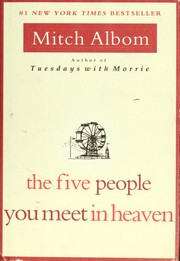
The Five People You Meet in Heaven
Mitch Albom, 2003
Eddie dies at the amusement park where he worked, then meets five strangers who show how his ordinary life touched other people's. A short book about unremarkable lives.
Where to get it
Some of these links earn us a small commission, at no cost to you. It keeps BookFeed free.
Questions readers ask
- Is Tuesdays with Morrie for me?
- You may like it if you are open to a gentle memoir built from conversations about love, work, fear, and memory. Some readers find the lessons clichéd, saccharine, or preachy, so the book can feel more sentimental than searching.
- What is Tuesdays with Morrie like?
- A tender, slow conversation with a dying teacher, warm and plainspoken, often melancholy, with grief close to the surface. Feels like tenderness, melancholy and grief. About morality, death and love.
- What should I read after Tuesdays with Morrie?
- If you liked Tuesdays with Morrie, try Angela's Ashes (Frank McCourt), Profiles in Courage (John F. Kennedy) and Of Mice and Men (John Steinbeck).
A taste of the feed
What a teacher gives a boy whose shoes are already broken.
He says, you have to study and learn so that you can make up your own mind about history and everything else but you can’t make up an empty mind. Stock your mind, stock your mind. You might be poor, your shoes might be broken, but your mind is a palace.
Angela's Ashes · Frank McCourt
What it costs to keep believing in a piece of land you'll never own.
They come, an’ they quit an’ go on; an’ every damn one of ‘em’s got a little piece of land in his head. An’ never a God damn one of ‘em ever gets it. Just like heaven. Ever’body wants a little piece of lan’. I read plenty of books out here. Nobody never gets to heaven, and nobody gets no land. It’s just in their head.
Of Mice and Men · John Steinbeck
The gap between a mother's corrections and a stranger's kindness.
It was hard not to compare Mrs Elm to her mother, who treated Nora like a mistake in need of correction. For instance, when she was a baby her mother had been so worried Nora’s left ear stuck out more than her right that she’d used sticky tape to address the situation, then disguised it beneath a woollen bonnet.
The Midnight Library · Matt Haig
Read pages from books like this, one at a time
Keep reading in the feed