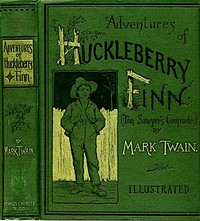
The Adventures of Huckleberry Finn
Mark Twain, 1884
A runaway boy and an enslaved man drift a raft down the Mississippi, and a child's plain talk quietly dismantles everything the adults around him believe.
 BookFeed Ελληνικά
1835–1910
Twain's best pages have a boy's ear for a lie and an old man's patience with the people telling it. Start with «The Adventures of Huckleberry Finn» for the river and the voice, or «Roughing It» if you want the comic travel book first: stagecoaches, swindlers, mines that pay nothing, and a coyote that outruns every dog.
Feels like wonder, freedom and war.
Start with The Adventures of Huckleberry Finn.
Twain grew up in Hannibal, Missouri, the river town he renamed St Petersburg and set Huck's story in; before writing, he was a licensed steamboat pilot on that same river.
What silence feels like when it isn't loneliness.
This second night we run between seven and eight hours, with a current that was making over four mile an hour. We catched fish and talked, and we took a swim now and then to keep off sleepiness. It was kind of solemn, drifting down the big, still river, laying on our backs looking up at the stars, and we didn’t ever feel like talking loud, and it warn’t often that we laughed—only a little kind of a low chuckle. We had mighty good weather as a general thing, and nothing ever happened to us at all—that night, nor the next, nor the next. Mark Twain, 1884
A runaway boy and an enslaved man drift a raft down the Mississippi, and a child's plain talk quietly dismantles everything the adults around him believe.
Mark Twain, 1872
Twain goes west in 1861 to dodge the war and get rich: stagecoaches, con men, silver mines that pay nothing, and a coyote that outruns every dog.
Read pages from books like this, one at a time
BookFeed is a feed of real passages from real books. It learns what moves you and finds your next book.
Open BookFeedFree, no sign-up.