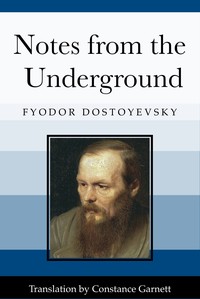
Notes from the Underground
Fyodor Dostoyevsky, 1864
A Petersburg clerk explains, at length and against his own interests, why he could never be a decent man: the original portrait of the over-thinking self.
 BookFeed Ελληνικά
1821–1881
Dostoyevsky puts you inside a mind that will not stop arguing with itself, and the heat and cramped rooms of his Petersburg make that argument physical. Start with «Notes from the Underground» if you want the short, sharp version of that voice, or «Crime and Punishment» if you want it spread across a whole feverish plot about a man trying to reason his way past his own conscience. Both books share a claustrophobic attention to self-justification and the cost of thinking too well about the wrong thing.
Feels like unease, freedom and wonder.
Dostoevsky wrote it in 1864, the year his wife Maria and then his brother Mikhail died; he was gambling and in debt, and the magazine that serialised it folded soon after.
Consciousness as a diagnosis: too much of it and you can't live.
I want now to tell you, gentlemen, whether you care to hear it or not, why I could not even become an insect. I tell you solemnly, that I have many times tried to become an insect. But I was not equal even to that. I swear, gentlemen, that to be too conscious is an illness—a real thorough-going illness. For man’s everyday needs, it would have been quite enough to have the ordinary human consciousness, that is, half or a quarter of the amount which falls to the lot of a cultivated man of our unhappy nineteenth century, especially one who has the fatal ill-luck to inhabit Petersburg, the most theoretical and intentional town on the whole terrestrial globe. (There are intentional and unintentional towns.) It would have been quite enough, for instance, to have the consciousness by which all so-called direct persons and men of action live. Fyodor Dostoyevsky, 1864
A Petersburg clerk explains, at length and against his own interests, why he could never be a decent man: the original portrait of the over-thinking self.
Read pages from books like this, one at a time
BookFeed is a feed of real passages from real books. It learns what moves you and finds your next book.
Open BookFeedFree, no sign-up.