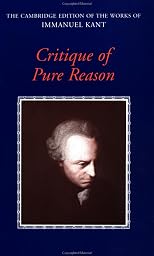
Kritik der reinen Vernunft
Immanuel Kant, 1781
A map of what the mind can know, written in the confident, stormy prose of the Enlightenment, and still a bracing account of reason's limits.
 BookFeed Ελληνικά
Kant published the first Critique at fifty-seven, then rewrote large parts of it for a second edition in 1787; scholars still cite the two versions as A and B.
Feels like curiosity, awe and power.
Making room for belief sometimes means refusing to know.
We have seen, therefore, that I am not allowed even to *assume*, for the sake of the necessary practical use of my reason *God, freedom, immortality*, unless at the same time *I deprive* speculative reason of its pretensions to transcendent insights. Reason, namely, in order to arrive at these, must employ principles which extend only to objects of possible experience, and which, if in spite of this they are applied also to what cannot be an object of experience, actually always change this into an appearance, thus rendering all practical *expansion* of pure reason impossible. Hence I had to suspend *knowledge* in order to make room for *belief*. For the dogmatism of metaphysics without a preceding critique of pure reason, is the source of all that disbelief which opposes morality and which is always very dogmatic. Immanuel Kant, 1781
A map of what the mind can know, written in the confident, stormy prose of the Enlightenment, and still a bracing account of reason's limits.
Read pages from books like this, one at a time
BookFeed is a feed of real passages from real books. It learns what moves you and finds your next book.
Open BookFeedFree, no sign-up.