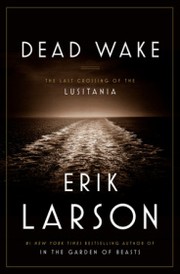
Dead Wake
Erik Larson, 2015
The Lusitania's last crossing, braided from passenger diaries, Cunard records, and the U-boat commander's log—a narrative history with a ticking clock.
 BookFeed Ελληνικά
Erik Larson writes history the way a reporter would, building a scene from letters, diaries and records until a past moment feels close enough to touch. In Dead Wake he follows the Lusitania across the Atlantic, cutting between passengers and the U-boat commander hunting it; in The Devil in the White City he sets the making of the 1893 Chicago World's Fair beside a doctor moving quietly through the same city. Start with either, though The Devil in the White City is the one to pick if you want the fuller picture of an era, and Dead Wake if you want the tighter clock.
Feels like dread, death and war.
Start with Dead Wake.
When launched in 1906, the Lusitania was the world's largest ship and briefly held the Blue Riband for the fastest Atlantic crossing.
A ship can hide its lights but not its silhouette.
With all but a few lights extinguished and all shades pulled and curtains drawn, the great liner slid forward through the sea, at times in fog, at times under a lacework of stars. But even in darkness, in moonlight and mist, the ship stood out. At one o’clock in the morning, Friday, May 7, the officers of a New York–bound vessel spotted the Lusitania and recognized it immediately as it passed some two miles off. “You could see the shape of the four funnels,” said the captain, Thomas M. Taylor; “she was the only ship with four funnels.” Erik Larson, 2015
The Lusitania's last crossing, braided from passenger diaries, Cunard records, and the U-boat commander's log—a narrative history with a ticking clock.
Erik Larson, 2003
Two stories braid through the 1893 Chicago World's Fair: the architects who built a white city and the charming doctor who moved through its shadows.
Read pages from books like this, one at a time
BookFeed is a feed of real passages from real books. It learns what moves you and finds your next book.
Open BookFeedFree, no sign-up.