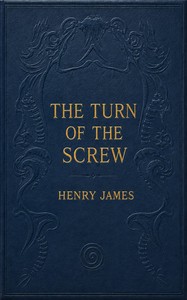
The Turn of the Screw
Henry James, 1898
A governess alone with two charming children begins to see figures no one else admits—and to wonder whether she is their protector or their danger.
 BookFeed Ελληνικά
Pages from The Turn of the Screw that stand on their own, chosen for how they read today. The text is in the public domain.
The moment a familiar place becomes a solitude because of one stranger.
My second was a violent perception of the mistake of my first: the man who met my eyes was not the person I had precipitately supposed. There came to me thus a bewilderment of vision of which, after these years, there is no living view that I can hope to give. An unknown man in a lonely place is a permitted object of fear to a young woman privately bred; and the figure that faced me was—a few more seconds assured me—as little anyone else I knew as it was the image that had been in my mind. I had not seen it in Harley Street—I had not seen it anywhere. The place, moreover, in the strangest way in the world, had, on the instant, and by the very fact of its appearance, become a solitude. What does it mean when a child goes silent at the water’s edge?
My heart had stood still for an instant with the wonder and terror of the question whether she too would see; and I held my breath while I waited for what a cry from her, what some sudden innocent sign either of interest or of alarm, would tell me. I waited, but nothing came; then, in the first place—and there is something more dire in this, I feel, than in anything I have to relate—I was determined by a sense that, within a minute, all sounds from her had previously dropped; and, in the second, by the circumstance that, also within the minute, she had, in her play, turned her back to the water. He knows there is no terror—and that makes the gaze hideous.
I had plenty of anguish after that extraordinary moment, but I had, thank God, no terror. And he knew I had not—I found myself at the end of an instant magnificently aware of this. I felt, in a fierce rigor of confidence, that if I stood my ground a minute I should cease—for the time, at least—to have him to reckon with; and during the minute, accordingly, the thing was as human and hideous as a real interview: hideous just because it was human, as human as to have met alone, in the small hours, in a sleeping house, some enemy, some adventurer, some criminal. It was the dead silence of our long gaze at such close quarters that gave the whole horror, huge as it was, its only note of the unnatural. To stay steady, she tightens her will and closes her eyes.
Here at present I felt afresh—for I had felt it again and again—how my equilibrium depended on the success of my rigid will, the will to shut my eyes as tight as possible to the truth that what I had to deal with was, revoltingly, against nature. I could only get on at all by taking “nature” into my confidence and my account, by treating my monstrous ordeal as a push in a direction unusual, of course, and unpleasant, but demanding, after all, for a fair front, only another turn of the screw of ordinary human virtue. No further apparitions—and still the corners of the house feel watched.
It was partly at such junctures as these and partly at quite different ones that, with the turn my matters had now taken, my predicament, as I have called it, grew most sensible. The fact that the days passed for me without another encounter ought, it would have appeared, to have done something toward soothing my nerves. Since the light brush, that second night on the upper landing, of the presence of a woman at the foot of the stair, I had seen nothing, whether in or out of the house, that one had better not have seen. There was many a corner round which I expected to come upon Quint, and many a situation that, in a merely sinister way, would have favored the appearance of Miss Jessel. The summer had turned, the summer had gone; the autumn had dropped upon Bly and had blown out half our lights. A ghost seen in daylight, mistaken first for a housemaid writing a letter.
Seated at my own table in clear noonday light I saw a person whom, without my previous experience, I should have taken at the first blush for some housemaid who might have stayed at home to look after the place and who, availing herself of rare relief from observation and of the schoolroom table and my pens, ink, and paper, had applied herself to the considerable effort of a letter to her sweetheart. There was an effort in the way that, while her arms rested on the table, her hands with evident weariness supported her head; but at the moment I took this in I had already become aware that, in spite of my entrance, her attitude strangely persisted. Then it was—with the very act of its announcing itself—that her identity flared up in a change of posture. The season when everything seems easy is its own kind of trap.
It was the first time, in a manner, that I had known space and air and freedom, all the music of summer and all the mystery of nature. And then there was consideration—and consideration was sweet. Oh, it was a trap—not designed, but deep—to my imagination, to my delicacy, perhaps to my vanity; to whatever, in me, was most excitable. The best way to picture it all is to say that I was off my guard. They gave me so little trouble—they were of a gentleness so extraordinary. I used to speculate—but even this with a dim disconnectedness—as to how the rough future (for all futures are rough!) would handle them and might bruise them. Her belief is a shelter, and a wall.
I drew a great security in this particular from her mere smooth aspect. There was nothing in her fresh face to pass on to others my horrible confidences. She believed me, I was sure, absolutely: if she hadn’t I don’t know what would have become of me, for I couldn’t have borne the business alone. But she was a magnificent monument to the blessing of a want of imagination, and if she could see in our little charges nothing but their beauty and amiability, their happiness and cleverness, she had no direct communication with the sources of my trouble. Henry James, 1898
A governess alone with two charming children begins to see figures no one else admits—and to wonder whether she is their protector or their danger.
Read pages from books like this, one at a time
BookFeed is a feed of real passages from real books. It learns what moves you and finds your next book.
Open BookFeedFree, no sign-up.