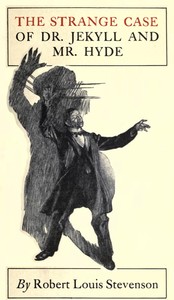
The strange case of Dr. Jekyll and Mr. Hyde
Robert Louis Stevenson, 1886
A short, fast Victorian mystery that works as a thriller and as a sharp study of respectability, appetite and the parts of ourselves we prefer to keep out of sight.
 BookFeed Ελληνικά
Pages from The strange case of Dr. Jekyll and Mr. Hyde that stand on their own, chosen for how they read today. The text is in the public domain.
The suspicion that a single self is a convenient fiction.
And it chanced that the direction of my scientific studies, which led wholly towards the mystic and the transcendental, reacted and shed a strong light on this consciousness of the perennial war among my members. With every day, and from both sides of my intelligence, the moral and the intellectual, I thus drew steadily nearer to that truth, by whose partial discovery I have been doomed to such a dreadful shipwreck: that man is not truly one, but truly two. I say two, because the state of my own knowledge does not pass beyond that point. Others will follow, others will outstrip me on the same lines; and I hazard the guess that man will be ultimately known for a mere polity of multifarious, incongruous and independent denizens. I, for my part, from the nature of my life, advanced infallibly in one direction and in one direction only. Nothing about him is wrong enough to explain the dread.
Then he began slowly to mount the street, pausing every step or two and putting his hand to his brow like a man in mental perplexity. The problem he was thus debating as he walked, was one of a class that is rarely solved. Mr. Hyde was pale and dwarfish, he gave an impression of deformity without any nameable malformation, he had a displeasing smile, he had borne himself to the lawyer with a sort of murderous mixture of timidity and boldness, and he spoke with a husky, whispering and somewhat broken voice; all these were points against him, but not all of these together could explain the hitherto unknown disgust, loathing and fear with which Mr. Utterson regarded him. “There must be something else,” said the perplexed gentleman. “There is something more, if I could find a name for it. God bless me, the man seems hardly human! A city's morning light, broken into every shade of dusk.
A great chocolate-coloured pall lowered over heaven, but the wind was continually charging and routing these embattled vapours; so that as the cab crawled from street to street, Mr. Utterson beheld a marvelous number of degrees and hues of twilight; for here it would be dark like the back-end of evening; and there would be a glow of a rich, lurid brown, like the light of some strange conflagration; and here, for a moment, the fog would be quite broken up, and a haggard shaft of daylight would glance in between the swirling wreaths. The dismal quarter of Soho seen under these changing glimpses, with its muddy ways, and slatternly passengers, and its lamps, which had never been extinguished or had been kindled afresh to combat this mournful reinvasion of darkness, seemed, in the lawyer’s eyes, like a district of some city in a nightmare. The fault he fears in his friend may be waiting in his own memory.
And the lawyer set out homeward with a very heavy heart. “Poor Harry Jekyll,” he thought, “my mind misgives me he is in deep waters! He was wild when he was young; a long while ago to be sure; but in the law of God, there is no statute of limitations. Ah, it must be that; the ghost of some old sin, the cancer of some concealed disgrace: punishment coming, pede claudo, years after memory has forgotten and self-love condoned the fault.” And the lawyer, scared by the thought, brooded awhile on his own past, groping in all the corners of memory, lest by chance some Jack-in-the-Box of an old iniquity should leap to light there. Fog outside, firelight within, and a bottle that remembers summer.
Presently after, he sat on one side of his own hearth, with Mr. Guest, his head clerk, upon the other, and midway between, at a nicely calculated distance from the fire, a bottle of a particular old wine that had long dwelt unsunned in the foundations of his house. The fog still slept on the wing above the drowned city, where the lamps glimmered like carbuncles; and through the muffle and smother of these fallen clouds, the procession of the town’s life was still rolling in through the great arteries with a sound as of a mighty wind. But the room was gay with firelight. What if the body is only a tent, easily blown open?
I began to perceive more deeply than it has ever yet been stated, the trembling immateriality, the mistlike transience, of this seemingly so solid body in which we walk attired. Certain agents I found to have the power to shake and pluck back that fleshly vestment, even as a wind might toss the curtains of a pavilion. Some friends are loved precisely for the quiet they bring.
Where Utterson was liked, he was liked well. Hosts loved to detain the dry lawyer, when the light-hearted and loose-tongued had already their foot on the threshold; they liked to sit a while in his unobtrusive company, practising for solitude, sobering their minds in the man’s rich silence after the expense and strain of gaiety. To this rule, Dr. Jekyll was no exception; and as he now sat on the opposite side of the fire—a large, well-made, smooth-faced man of fifty, with something of a slyish cast perhaps, but every mark of capacity and kindness—you could see by his looks that he cherished for Mr. Utterson a sincere and warm affection. The moment a quiet street begins to announce one stranger.
And at last his patience was rewarded. It was a fine dry night; frost in the air; the streets as clean as a ballroom floor; the lamps, unshaken by any wind, drawing a regular pattern of light and shadow. By ten o’clock, when the shops were closed, the by-street was very solitary and, in spite of the low growl of London from all round, very silent. Small sounds carried far; domestic sounds out of the houses were clearly audible on either side of the roadway; and the rumour of the approach of any passenger preceded him by a long time. Mr. Utterson had been some minutes at his post, when he was aware of an odd light footstep drawing near. Robert Louis Stevenson, 1886
A short, fast Victorian mystery that works as a thriller and as a sharp study of respectability, appetite and the parts of ourselves we prefer to keep out of sight.
Read pages from books like this, one at a time
BookFeed is a feed of real passages from real books. It learns what moves you and finds your next book.
Open BookFeedFree, no sign-up.