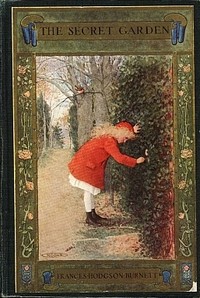
The Secret Garden
Frances Hodgson Burnett, 1911
A sour child, a locked garden and a boy who believes he is dying: a story about what attention can grow.
 BookFeed
Pages from The Secret Garden that stand on their own, chosen for how they read today. The text is in the public domain.
How an empty garden can be better company than a full house.
The sun was shining inside the four walls and the high arch of blue sky over this particular piece of Misselthwaite seemed even more brilliant and soft than it was over the moor. The robin flew down from his treetop and hopped about or flew after her from one bush to another. He chirped a good deal and had a very busy air, as if he were showing her things. Everything was strange and silent and she seemed to be hundreds of miles away from anyone, but somehow she did not feel lonely at all. All that troubled her was her wish that she knew whether all the roses were dead, or if perhaps some of them had lived and might put out leaves and buds as the weather got warmer. She did not want it to be a quite dead garden. The second before a door you have waited your whole life for.
And then she took a long breath and looked behind her up the long walk to see if anyone was coming. No one was coming. No one ever did come, it seemed, and she took another long breath, because she could not help it, and she held back the swinging curtain of ivy and pushed back the door which opened slowly—slowly. A boy who has frightened himself ill, and the girl rude enough to say so.
No one but Colin himself knew what effect those crossly spoken childish words had on him. If he had ever had anyone to talk to about his secret terrors—if he had ever dared to let himself ask questions—if he had had childish companions and had not lain on his back in the huge closed house, breathing an atmosphere heavy with the fears of people who were most of them ignorant and tired of him, he would have found out that most of his fright and illness was created by himself. But he had lain and thought of himself and his aches and weariness for hours and days and months and years. And now that an angry unsympathetic little girl insisted obstinately that he was not as ill as he thought he was he actually felt as if she might be speaking the truth. What a house has to do to make you feel safe in a gale.
Mary did not know what “wutherin’ ” meant until she listened, and then she understood. It must mean that hollow shuddering sort of roar which rushed round and round the house as if the giant no one could see were buffeting it and beating at the walls and windows to try to break in. But one knew he could not get in, and somehow it made one feel very safe and warm inside a room with a red coal fire. How a garden looks to the bird keeping an eye on the new arrivals.
But at the outset it seemed necessary to be on guard against the other two. In the first place the boy creature did not come into the garden on his legs. He was pushed in on a thing with wheels and the skins of wild animals were thrown over him. That in itself was doubtful. Then when he began to stand up and move about he did it in a queer unaccustomed way and the others seemed to have to help him. The robin used to secrete himself in a bush and watch this anxiously, his head tilted first on one side and then on the other. He thought that the slow movements might mean that he was preparing to pounce, as cats do. When cats are preparing to pounce they creep over the ground very slowly. The diet sworn at night, and the breakfast that defeats it.
He made up his mind to eat less, but unfortunately it was not possible to carry out this brilliant idea when he wakened each morning with an amazing appetite and the table near his sofa was set with a breakfast of homemade bread and fresh butter, snow-white eggs, raspberry jam and clotted cream. Mary always breakfasted with him and when they found themselves at the table—particularly if there were delicate slices of sizzling ham sending forth tempting odors from under a hot silver cover—they would look into each other’s eyes in desperation. Night on a moor, seen by a child nobody is expecting.
On and on they drove through the darkness, and though the rain stopped, the wind rushed by and whistled and made strange sounds. The road went up and down, and several times the carriage passed over a little bridge beneath which water rushed very fast with a great deal of noise. Mary felt as if the drive would never come to an end and that the wide, bleak moor was a wide expanse of black ocean through which she was passing on a strip of dry land. The idea that a thought is a physical thing, with a charge.
In each century since the beginning of the world wonderful things have been discovered. In the last century more amazing things were found out than in any century before. In this new century hundreds of things still more astounding will be brought to light. At first people refuse to believe that a strange new thing can be done, then they begin to hope it can be done, then they see it can be done—then it is done and all the world wonders why it was not done centuries ago. One of the new things people began to find out in the last century was that thoughts—just mere thoughts—are as powerful as electric batteries—as good for one as sunlight is, or as bad for one as poison. The emptiest house in England, and the small tenants keeping it company.
Mary crept softly across the room to look. The bright eyes belonged to a little gray mouse, and the mouse had eaten a hole into the cushion and made a comfortable nest there. Six baby mice were cuddled up asleep near her. If there was no one else alive in the hundred rooms there were seven mice who did not look lonely at all. Frances Hodgson Burnett, 1911
A sour child, a locked garden and a boy who believes he is dying: a story about what attention can grow.
Read pages from books like this, one at a time
BookFeed is a feed of real passages from real books. It learns what moves you and finds your next book.
Open BookFeedFree, no sign-up.