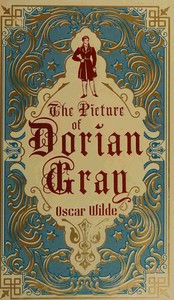
The Picture of Dorian Gray
Oscar Wilde, 1890
A beautiful young man wishes his portrait would age in his place. It is a sharp, funny, then frightening study of vanity, charm and moral drift, still uncomfortably current.
 BookFeed Ελληνικά
Pages from The Picture of Dorian Gray that stand on their own, chosen for how they read today. The text is in the public domain.
What it feels like to envy your own portrait.
“I am jealous of everything whose beauty does not die. I am jealous of the portrait you have painted of me. Why should it keep what I must lose? Every moment that passes takes something from me and gives something to it. Oh, if it were only the other way! If the picture could change, and I could be always what I am now! Why did you paint it? It will mock me some day—mock me horribly!” The hot tears welled into his eyes; he tore his hand away and, flinging himself on the divan, he buried his face in the cushions, as though he was praying. The case that experience teaches us nothing but how to repeat ourselves.
He began to wonder whether we could ever make psychology so absolute a science that each little spring of life would be revealed to us. As it was, we always misunderstood ourselves and rarely understood others. Experience was of no ethical value. It was merely the name men gave to their mistakes. Moralists had, as a rule, regarded it as a mode of warning, had claimed for it a certain ethical efficacy in the formation of character, had praised it as something that taught us what to follow and showed us what to avoid. But there was no motive power in experience. It was as little of an active cause as conscience itself. All that it really demonstrated was that our future would be the same as our past, and that the sin we had done once, and with loathing, we would do many times, and with joy. Why cramming your head with facts may be a way of fearing time.
It is a sad thing to think of, but there is no doubt that genius lasts longer than beauty. That accounts for the fact that we all take such pains to over-educate ourselves. In the wild struggle for existence, we want to have something that endures, and so we fill our minds with rubbish and facts, in the silly hope of keeping our place. The thoroughly well-informed man—that is the modern ideal. And the mind of the thoroughly well-informed man is a dreadful thing. It is like a bric-à-brac shop, all monsters and dust, with everything priced above its proper value. I think you will tire first, all the same. Some day you will look at your friend, and he will seem to you to be a little out of drawing, or you won’t like his tone of colour, or something. Loyalty, reconsidered as a failure of imagination.
“My dear boy, the people who love only once in their lives are really the shallow people. What they call their loyalty, and their fidelity, I call either the lethargy of custom or their lack of imagination. Faithfulness is to the emotional life what consistency is to the life of the intellect—simply a confession of failure. Faithfulness! I must analyse it some day. The passion for property is in it. There are many things that we would throw away if we were not afraid that others might pick them up. But I don’t want to interrupt you. Go on with your story.” The moment you realise a few words can do what music cannot.
Music had stirred him like that. Music had troubled him many times. But music was not articulate. It was not a new world, but rather another chaos, that it created in us. Words! Mere words! How terrible they were! How clear, and vivid, and cruel! One could not escape from them. And yet what a subtle magic there was in them! They seemed to be able to give a plastic form to formless things, and to have a music of their own as sweet as that of viol or of lute. Mere words! Was there anything so real as words? How a charming man ends a love affair by remembering only the dinner.
“Life has always poppies in her hands. Of course, now and then things linger. I once wore nothing but violets all through one season, as a form of artistic mourning for a romance that would not die. Ultimately, however, it did die. I forget what killed it. I think it was her proposing to sacrifice the whole world for me. That is always a dreadful moment. It fills one with the terror of eternity. Well—would you believe it?—a week ago, at Lady Hampshire’s, I found myself seated at dinner next the lady in question, and she insisted on going over the whole thing again, and digging up the past, and raking up the future. I had buried my romance in a bed of asphodel. She dragged it out again and assured me that I had spoiled her life. What the mind does when something too large is arriving.
Dorian Gray listened, open-eyed and wondering. The spray of lilac fell from his hand upon the gravel. A furry bee came and buzzed round it for a moment. Then it began to scramble all over the oval stellated globe of the tiny blossoms. He watched it with that strange interest in trivial things that we try to develop when things of high import make us afraid, or when we are stirred by some new emotion for which we cannot find expression, or when some thought that terrifies us lays sudden siege to the brain and calls on us to yield. After a time the bee flew away. He saw it creeping into the stained trumpet of a Tyrian convolvulus. The flower seemed to quiver, and then swayed gently to and fro. A dinner-table argument that goodness means answering only to yourself.
“To be good is to be in harmony with one’s self,” he replied, touching the thin stem of his glass with his pale, fine-pointed fingers. “Discord is to be forced to be in harmony with others. One’s own life—that is the important thing. As for the lives of one’s neighbours, if one wishes to be a prig or a Puritan, one can flaunt one’s moral views about them, but they are not one’s concern. Besides, individualism has really the higher aim. Modern morality consists in accepting the standard of one’s age. I consider that for any man of culture to accept the standard of his age is a form of the grossest immorality.” Temptation described as something that removes the very idea of choice.
There are moments, psychologists tell us, when the passion for sin, or for what the world calls sin, so dominates a nature that every fibre of the body, as every cell of the brain, seems to be instinct with fearful impulses. Men and women at such moments lose the freedom of their will. They move to their terrible end as automatons move. Choice is taken from them, and conscience is either killed, or, if it lives at all, lives but to give rebellion its fascination and disobedience its charm. For all sins, as theologians weary not of reminding us, are sins of disobedience. When that high spirit, that morning star of evil, fell from heaven, it was as a rebel that he fell. Oscar Wilde, 1890
A beautiful young man wishes his portrait would age in his place. It is a sharp, funny, then frightening study of vanity, charm and moral drift, still uncomfortably current.
Read pages from books like this, one at a time
BookFeed is a feed of real passages from real books. It learns what moves you and finds your next book.
Open BookFeedFree, no sign-up.