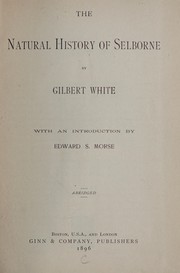
The Natural History of Selborne
Gilbert White, 1789
A country clergyman spends forty years watching the birds, worms, echoes and weather of one Hampshire parish, and writes it all down in letters of disarming charm.
 BookFeed Ελληνικά
Pages from The Natural History of Selborne that stand on their own, chosen for how they read today. The text is in the public domain.
The morning a whole species decides, at once, to leave.
If ever I saw anything like actual migration, it was last Michaelmas-day. I was travelling, and out early in the morning: at first there was a vast fog; but, by the time that I was got seven or eight miles from home towards the coast, the sun broke out into a delicate warm day. We were then on a large heath or common, and I could discern, as the mist began to break away, great numbers of swallows (hirundines rusticae) clustering on the stinted shrubs and bushes, as if they had roosted there all night. As soon as the air became clear and pleasant they all were on the wing at once; and, by a placid and easy flight, proceeded on southward towards the sea: after this I did not see any more flocks, only now and then a straggler. Mountains that look less like rock than something slowly growing.
Perhaps I may be singular in my opinion, and not so happy as to convey to you the same idea, but I never contemplate these mountains without thinking I perceive somewhat analogous to growth in their gentle swellings and smooch fungus-like protuberances, their fluted sides, and regular hollows and slopes, that carry at once the air of vegetative dilation and expansion…. Or was there ever a time when these immense masses of calcareous matter were drown into fermentation by some adventitious moisture; were raised and leavened into such shapes by some plastic power; and so made to swell and heave their broad backs into the sky so much above the less animated clay of the wild below? The delight of watching birds obey something you will never fully understand.
When I used to rise in a morning last autumn, and see the swallows and martins clustering on the chimneys and thatch of the neighbouring cottages, I could not help being touched with a secret delight, mixed with some degree of mortification: with delight to observe with how much ardour and punctuality those poor little birds obeyed the strong impulse towards migration, or hiding, imprinted on their minds by their great Creator; and with some degree of mortification, when I reflected that, after all our pains and inquiries, we are yet not quite certain to what regions they do migrate; and are still farther embarrassed to find that some do not actually migrate at all. Why the cold makes strangers into a crowd.
Now as to the business of food: as these animals are actuated by instinct to hunt for necessary food, they should not, one would suppose, crowd together in pursuit of sustenance at a time when it is most likely to fail: yet such associations do take place in hard weather chiefly, and thicken as the severity increases. As some kind of self-interest and self-defence is no doubt the motive for the proceeding, may it not arise from the helplessness of their state in such rigorous seasons; as men crowd together, when under great calamities, though they know not why? Perhaps approximation may dispel some degree of cold; and a crowd may make each individual appear safer from the ravages of birds of prey and other dangers. Everything worth studying is happening under the grass.
A good monography of worms would afford much entertainment and information at the same time, and would open a large and new field in natural history. Worms work most in the spring; but by no means lie torpid in the dead months; are out every mild night in the winter, as any person may be convinced that will take the pains to examine his grass-plots with a candle; are hermaphrodites, and much addicted to venery, and consequently very prolific. A wall built with such care that strangers mistake it for a joke.
From a notion of rendering their work the more elegant, and giving it a finish, masons chip this stone into small fragments about the size of the head of a large nail; and then stick the pieces into the wet mortar along the joints of their freestone walls: this embellishment carries an odd appearance, and has occasioned strangers sometimes to ask us pleasantly, ‘whether we fastened our walls together with tenpenny nails.’ Two hours of light, and why the poorest pay most for theirs.
Little farmers use rushes much in the short days, both morning and evening in the dairy and kitchen; but the very poor, who are always the worst economists, and therefore must continue very poor, buy an halfpenny candle every evening, which, in their blowing open rooms, does not burn much more than two hours. Thus have they only two hours’ light for their money instead of eleven. An echo that answers back in every language but its own.
In a district so diversified as this, so full of hollow vales, and hanging woods, it is no wonder that echoes should abound. Many we have discovered that return the cry of a pack of dogs, the notes of a hunting-horn, a tunable ring of bells, or the melody of birds, very agreeably: but we were still at a loss for a polysyllabical, articulate echo, till a young gentleman, who had parted from his company in a summer evening walk, and was calling after them, stumbled upon a very curious one in a spot where it might least be expected. At first he was much surprised, and could not be persuaded but that he was mocked by some boy; but, repeating his trials in several languages, and finding his respondent to be a very adroit polyglot, he then discerned the deception. The tune that arrives uninvited, usually before dawn.
When I hear fine music I am haunted with passages therefrom night and day; and especially at first waking, which, by their importunity, give me more uneasiness than pleasure: elegant lessons still tease my imagination, and recur irresistibly to my recollection at seasons, and even when I am desirous of thinking of more serious matters. Gilbert White, 1789
A country clergyman spends forty years watching the birds, worms, echoes and weather of one Hampshire parish, and writes it all down in letters of disarming charm.
Read pages from books like this, one at a time
BookFeed is a feed of real passages from real books. It learns what moves you and finds your next book.
Open BookFeedFree, no sign-up.