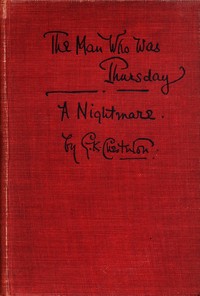
The Man Who Was Thursday
G. K. Chesterton, 1908
A poet-detective infiltrates a council of anarchists, each named for a day of the week, and the chase turns into a comic, vertiginous argument about whether the universe is friendly or hostile.
 BookFeed Ελληνικά
Pages from The Man Who Was Thursday that stand on their own, chosen for how they read today. The text is in the public domain.
Goodness looks like an accident and evil looks like a joke.
When I see the horrible back, I am sure the noble face is but a mask. When I see the face but for an instant, I know the back is only a jest. Bad is so bad, that we cannot but think good an accident; good is so good, that we feel certain that evil could be explained. How ordinary grass looks when you might be leaving it.
He felt a strange and vivid value in all the earth around him, in the grass under his feet; he felt the love of life in all living things. He could almost fancy that he heard the grass growing; he could almost fancy that even as he stood fresh flowers were springing up and breaking into blossom in the meadow—flowers blood red and burning gold and blue, fulfilling the whole pageant of the spring. And whenever his eyes strayed for a flash from the calm, staring, hypnotic eyes of the Marquis, they saw the little tuft of almond tree against the sky-line. He had the feeling that if by some miracle he escaped he would be ready to sit for ever before that almond tree, desiring nothing else in the world. How a face on a dark road can unravel your faith in faces.
Walking up a road at night, I have seen a lamp and a lighted window and a cloud make together a most complete and unmistakable face. If anyone in heaven has that face I shall know him again. Yet when I walked a little farther I found that there was no face, that the window was ten yards away, the lamp ten hundred yards, the cloud beyond the world. Well, Sunday’s face escaped me; it ran away to right and left, as such chance pictures run away. And so his face has made me, somehow, doubt whether there are any faces. I don’t know whether your face, Bull, is a face or a combination in perspective. Perhaps one black disc of your beastly glasses is quite close and another fifty miles away. Oh, the doubts of a materialist are not worth a dump. What pelicans suggest about the universe's sense of humour.
He remembered especially seeing pelicans, with their preposterous, pendant throats. He wondered why the pelican was the symbol of charity, except it was that it wanted a good deal of charity to admire a pelican. He remembered a hornbill, which was simply a huge yellow beak with a small bird tied on behind it. The whole gave him a sensation, the vividness of which he could not explain, that Nature was always making quite mysterious jokes. Sunday had told them that they would understand him when they had understood the stars. He wondered whether even the archangels understood the hornbill. What a single ally does to someone who has been alone.
Through all this ordeal his root horror had been isolation, and there are no words to express the abyss between isolation and having one ally. It may be conceded to the mathematicians that four is twice two. But two is not twice one; two is two thousand times one. That is why, in spite of a hundred disadvantages, the world will always return to monogamy. Why we dread the villain who is merely lost in thought.
But I’ll tell you what is a trifle creepy about Sunday. His room is neat, his clothes are neat, everything seems in order; but he’s absent-minded. Sometimes his great bright eyes go quite blind. For hours he forgets that you are there. Now absent-mindedness is just a bit too awful in a bad man. We think of a wicked man as vigilant. We can’t think of a wicked man who is honestly and sincerely dreamy, because we daren’t think of a wicked man alone with himself. An absentminded man means a good-natured man. It means a man who, if he happens to see you, will apologise. What if the man with the bomb only wants one perfect moment?
“An artist is identical with an anarchist,” he cried. “You might transpose the words anywhere. An anarchist is an artist. The man who throws a bomb is an artist, because he prefers a great moment to everything. He sees how much more valuable is one burst of blazing light, one peal of perfect thunder, than the mere common bodies of a few shapeless policemen. An artist disregards all governments, abolishes all conventions. The poet delights in disorder only. If it were not so, the most poetical thing in the world would be the Underground Railway.” Growing up among eccentrics leaves only one way to rebel.
He was one of those who are driven early in life into too conservative an attitude by the bewildering folly of most revolutionists. He had not attained it by any tame tradition. His respectability was spontaneous and sudden, a rebellion against rebellion. He came of a family of cranks, in which all the oldest people had all the newest notions. One of his uncles always walked about without a hat, and another had made an unsuccessful attempt to walk about with a hat and nothing else. His father cultivated art and self-realisation; his mother went in for simplicity and hygiene. Hence the child, during his tenderer years, was wholly unacquainted with any drink between the extremes of absinth and cocoa, of both of which he had a healthy dislike. Why the loudest talker in the garden is usually the humblest.
Syme strolled with her to a seat in the corner of the garden, and continued to pour out his opinions. For he was a sincere man, and in spite of his superficial airs and graces, at root a humble one. And it is always the humble man who talks too much; the proud man watches himself too closely. He defended respectability with violence and exaggeration. He grew passionate in his praise of tidiness and propriety. All the time there was a smell of lilac all round him. Once he heard very faintly in some distant street a barrel-organ begin to play, and it seemed to him that his heroic words were moving to a tiny tune from under or beyond the world. G. K. Chesterton, 1908
A poet-detective infiltrates a council of anarchists, each named for a day of the week, and the chase turns into a comic, vertiginous argument about whether the universe is friendly or hostile.
Read pages from books like this, one at a time
BookFeed is a feed of real passages from real books. It learns what moves you and finds your next book.
Open BookFeedFree, no sign-up.