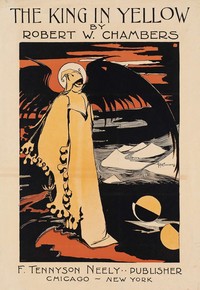
The King in Yellow
Robert W. Chambers, 1895
Stories from 1895: a forbidden play that drives its readers mad, a future New York with a suicide chamber, starving Paris under siege. Weird fiction before Lovecraft.
 BookFeed Ελληνικά
Pages from The King in Yellow that stand on their own, chosen for how they read today. The text is in the public domain.
Dusk, a drum, and a palace that will never hear this again.
The fading light lingered a moment on his belt and bayonet, then he passed into the shadows, drumming the echoes awake. The roll became fainter along the eastern terrace, then grew and grew and rattled with increasing sharpness when he passed the avenue by the bronze lion and turned down the western terrace walk. Louder and louder the drum sounded, and the echoes struck back the notes from the grey palace wall; and now the drummer loomed up before them—his red trousers a dull spot in the gathering gloom, the brass of his drum and bayonet touched with a pale spark, his epaulettes tossing on his shoulders. He passed leaving the crash of the drum in their ears, and far into the alley of trees they saw his little tin cup shining on his haversack. Walking home when your own body stops feeling like yours.
He walked through the hall and down the stairs, and found himself on the sidewalk in a quarter he did not know. Mechanically he looked up at the name of the street. The name was not familiar. He turned and steered his course toward some lights clustered at the end of the street. They proved farther away than he had anticipated, and after a long quest he came to the conclusion that his eyes had been mysteriously removed from their proper places and had been reset on either side of his head like those of a bird. It grieved him to think of the inconvenience this transformation might occasion him, and he attempted to cock up his head, hen-like, to test the mobility of his neck. Then an immense despair stole over him—tears gathered in the tear-ducts, his heart melted, and he collided with a tree. The strange dignity of a man who has built his own face.
When he had double-locked the door and pushed a heavy chest against it, he came and sat down beside me, peering up into my face with his little light-coloured eyes. Half a dozen new scratches covered his nose and cheeks, and the silver wires which supported his artificial ears had become displaced. I thought I had never seen him so hideously fascinating. He had no ears. The artificial ones, which now stood out at an angle from the fine wire, were his one weakness. They were made of wax and painted a shell pink, but the rest of his face was yellow. He might better have revelled in the luxury of some artificial fingers for his left hand, which was absolutely fingerless, but it seemed to cause him no inconvenience, and he was satisfied with his wax ears. What it sounds like when the music starts hunting something.
I belong to those children of an older and simpler generation who do not love to seek for psychological subtleties in art; and I have ever refused to find in music anything more than melody and harmony, but I felt that in the labyrinth of sounds now issuing from that instrument there was something being hunted. Up and down the pedals chased him, while the manuals blared approval. Poor devil! whoever he was, there seemed small hope of escape! The one book you have sworn never to open, lying on your own table.
I was dumbfounded. Who had placed it there? How came it in my rooms? I had long ago decided that I should never open that book, and nothing on earth could have persuaded me to buy it. Fearful lest curiosity might tempt me to open it, I had never even looked at it in bookstores. If I ever had had any curiosity to read it, the awful tragedy of young Castaigne, whom I knew, prevented me from exploring its wicked pages. I had always refused to listen to any description of it, and indeed, nobody ever ventured to discuss the second part aloud, so I had absolutely no knowledge of what those leaves might reveal. I stared at the poisonous mottled binding as I would at a snake. A besieged city, measured out in one boy's rope belt.
The street was almost deserted. A few women muffled in tattered military capes crept along the frozen pavement, and a wretchedly clad gamin hovered over the sewer-hole on the corner of the Boulevard. A rope around his waist held his rags together. From the rope hung a rat, still warm and bleeding. One butterfly lands, and a man is given back a life he isn't living.
Then a butterfly came and sat on a cluster of heliotrope and waved his crimson-banded wings in the hot sunshine. Hastings knew him for a friend, and before his eyes there came a vision of tall mulleins and scented milkweed alive with painted wings, a vision of a white house and woodbine-covered piazza—a glimpse of a man reading and a woman leaning over the pansy bed—and his heart was full. An art school where the bread is stale and the ambition isn't.
Monday morning at Julian’s, students fought for places; students with prior claims drove away others who had been anxiously squatting on coveted tabourets since the door was opened in hopes of appropriating them at roll-call; students squabbled over palettes, brushes, portfolios, or rent the air with demands for Ciceri and bread. The former, a dirty ex-model, who had in palmier days posed as Judas, now dispensed stale bread at one sou and made enough to keep himself in cigarettes. Monsieur Julian walked in, smiled a fatherly smile and walked out. His disappearance was followed by the apparition of the clerk, a foxy creature who flitted through the battling hordes in search of prey. Robert W. Chambers, 1895
Stories from 1895: a forbidden play that drives its readers mad, a future New York with a suicide chamber, starving Paris under siege. Weird fiction before Lovecraft.
Read pages from books like this, one at a time
BookFeed is a feed of real passages from real books. It learns what moves you and finds your next book.
Open BookFeedFree, no sign-up.