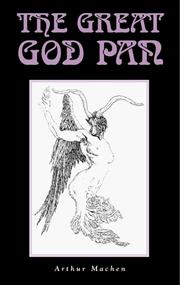
The Great God Pan
Arthur Machen, 1890
A laboratory experiment, a beautiful stranger and a London street where the ordinary world begins to thin.
 BookFeed Ελληνικά
Pages from The Great God Pan that stand on their own, chosen for how they read today. The text is in the public domain.
The moment a familiar path becomes somewhere you have never been.
Clarke tried to conceive the thing again, as he sat by the fire, and again his mind shuddered and shrank back, appalled before the sight of such awful, unspeakable elements enthroned as it were, and triumphant in human flesh. Before him stretched the long dim vista of the green causeway in the forest, as his friend had described it; he saw the swaying leaves and the quivering shadows on the grass, he saw the sunlight and the flowers, and far away, far in the long distance, the two figures moved toward him. One was Rachel, but the other? The cost of insisting that everything must have an explanation.
The ill-assorted pair moved slowly up Rupert Street; the one in dirty, evil-looking rags, and the other attired in the regulation uniform of a man about town, trim, glossy, and eminently well-to-do. Villiers had emerged from his restaurant after an excellent dinner of many courses, assisted by an ingratiating little flask of Chianti, and, in that frame of mind which was with him almost chronic, had delayed a moment by the door, peering round in the dimly-lighted street in search of those mysterious incidents and persons with which the streets of London teem in every quarter and every hour. Villiers prided himself as a practised explorer of such obscure mazes and byways of London life, and in this unprofitable pursuit he displayed an assiduity which was worthy of more serious employment. A forest so beautiful it smells like a closed room.
For many an hour I strayed through the maze of the forest, turning now to right and now to left, pacing slowly down long alleys of undergrowth, shadowy and chill, even under the midday sun, and halting beneath great oaks; lying on the short turf of a clearing where the faint sweet scent of wild roses came to me on the wind and mixed with the heavy perfume of the elder, whose mingled odour is like the odour of the room of the dead, a vapour of incense and corruption. I stood at the edges of the wood, gazing at all the pomp and procession of the foxgloves towering amidst the bracken and shining red in the broad sunshine, and beyond them into deep thickets of close undergrowth where springs boil up from the rock and nourish the water-weeds, dank and evil. The old myth wasn't a myth at all: it's happening on these streets.
“Very good. I can fancy what you saw. Yes; it is horrible enough; but after all, it is an old story, an old mystery played in our day, and in dim London streets instead of amidst the vineyards and the olive gardens. We know what happened to those who chanced to meet the Great God Pan, and those who are wise know that all symbols are symbols of something, not of nothing. It was, indeed, an exquisite symbol beneath which men long ago veiled their knowledge of the most awful, most secret forces which lie at the heart of all things; forces before which the souls of men must wither and die and blacken, as their bodies blacken under the electric current. Some knowledge is better left at the edge of the abyss.
“MY DEAR VILLIERS,—I have thought over the matter on which you consulted me the other night, and my advice to you is this. Throw the portrait into the fire, blot out the story from your mind. Never give it another thought, Villiers, or you will be sorry. You will think, no doubt, that I am in possession of some secret information, and to a certain extent that is the case. But I only know a little; I am like a traveller who has peered over an abyss, and has drawn back in terror. What I know is strange enough and horrible enough, but beyond my knowledge there are depths and horrors more frightful still, more incredible than any tale told of winter nights about the fire. London at two in the morning, when the streets belong to no one.
“I was at a house near Regent’s Park last night, and when I came away the fancy took me to walk home instead of taking a hansom. It was a clear pleasant night enough, and after a few minutes I had the streets pretty much to myself. It’s a curious thing, Austin, to be alone in London at night, the gas-lamps stretching away in perspective, and the dead silence, and then perhaps the rush and clatter of a hansom on the stones, and the fire starting up under the horse’s hoofs. I walked along pretty briskly, for I was feeling a little tired of being out in the night, and as the clocks were striking two I turned down Ashley Street, which, you know, is on my way. The particular heaviness of a house that has been left alone too long.
“I have always been rather fond of going over empty houses; there’s a sort of fascination about the desolate empty rooms, with the nails sticking in the walls, and the dust thick upon the window-sills. But I didn’t enjoy going over Number 20, Paul Street. I had hardly put my foot inside the passage when I noticed a queer, heavy feeling about the air of the house. Of course all empty houses are stuffy, and so forth, but this was something quite different; I can’t describe it to you, but it seemed to stop the breath. I went into the front room and the back room, and the kitchens downstairs; they were all dirty and dusty enough, as you would expect, but there was something strange about them all. I couldn’t define it to you, I only know I felt queer. The discomfort of a joke that turns out to be literal.
“I couldn’t tell you. I have heard she comes from South America, but after all, who she is is of little consequence. She is a very wealthy woman, there’s no doubt of that, and some of the best people have taken her up. I hear she has some wonderful claret, really marvellous wine, which must have cost a fabulous sum. Lord Argentine was telling me about it; he was there last Sunday evening. He assures me he has never tasted such a wine, and Argentine, as you know, is an expert. By the way, that reminds me, she must be an oddish sort of woman, this Mrs. Beaumont. Argentine asked her how old the wine was, and what do you think she said? ‘About a thousand years, I believe.’ When the police have no answer, the city starts inventing its own.
Clarke closed the book with a snap, and turned his chair towards the fire. When his friend sat one evening in that very chair, and told his story, Clarke had interrupted him at a point a little subsequent to this, had cut short his words in a paroxysm of horror. “My God!” he had exclaimed, “think, think what you are saying. It is too incredible, too monstrous; such things can never be in this quiet world, where men and women live and die, and struggle, and conquer, or maybe fail, and fall down under sorrow, and grieve and suffer strange fortunes for many a year; but not this, Phillips, not such things as this. There must be some explanation, some way out of the terror. Why, man, if such a case were possible, our earth would be a nightmare.” Arthur Machen, 1890
A laboratory experiment, a beautiful stranger and a London street where the ordinary world begins to thin.
Read pages from books like this, one at a time
BookFeed is a feed of real passages from real books. It learns what moves you and finds your next book.
Open BookFeedFree, no sign-up.