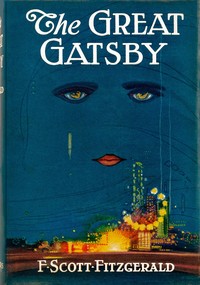
The Great Gatsby
F. Scott Fitzgerald, 1925
A short, dazzling novel about a summer of parties on Long Island and the man who throws them for one reason. Every sentence is built to be reread, and the ending is hard to shake.
 BookFeed Ελληνικά
Pages from The Great Gatsby that stand on their own, chosen for how they read today. The text is in the public domain.
A neighbour who throws the kind of party that needs eight servants to undo.
There was music from my neighbour’s house through the summer nights. In his blue gardens men and girls came and went like moths among the whisperings and the champagne and the stars. At high tide in the afternoon I watched his guests diving from the tower of his raft, or taking the sun on the hot sand of his beach while his two motorboats slit the waters of the Sound, drawing aquaplanes over cataracts of foam. On weekends his Rolls-Royce became an omnibus, bearing parties to and from the city between nine in the morning and long past midnight, while his station wagon scampered like a brisk yellow bug to meet all trains. And on Mondays eight servants, including an extra gardener, toiled all day with mops and scrubbing-brushes and hammers and garden-shears, repairing the ravages of the night before. The rare smile that makes you feel believed in at your best.
He smiled understandingly—much more than understandingly. It was one of those rare smiles with a quality of eternal reassurance in it, that you may come across four or five times in life. It faced—or seemed to face—the whole eternal world for an instant, and then concentrated on you with an irresistible prejudice in your favour. It understood you just so far as you wanted to be understood, believed in you as you would like to believe in yourself, and assured you that it had precisely the impression of you that, at your best, you hoped to convey. Precisely at that point it vanished—and I was looking at an elegant young roughneck, a year or two over thirty, whose elaborate formality of speech just missed being absurd. Some time before he introduced himself I’d got a strong impression that he was picking his words with care. A landscape where ash grows like wheat, and nobody asks why.
About halfway between West Egg and New York the motor road hastily joins the railroad and runs beside it for a quarter of a mile, so as to shrink away from a certain desolate area of land. This is a valley of ashes—a fantastic farm where ashes grow like wheat into ridges and hills and grotesque gardens; where ashes take the forms of houses and chimneys and rising smoke and, finally, with a transcendent effort, of ash-grey men, who move dimly and already crumbling through the powdery air. Occasionally a line of grey cars crawls along an invisible track, gives out a ghastly creak, and comes to rest, and immediately the ash-grey men swarm up with leaden spades and stir up an impenetrable cloud, which screens their obscure operations from your sight. How a skyline can feel like a first time, every time.
Over the great bridge, with the sunlight through the girders making a constant flicker upon the moving cars, with the city rising up across the river in white heaps and sugar lumps all built with a wish out of nonolfactory money. The city seen from the Queensboro Bridge is always the city seen for the first time, in its first wild promise of all the mystery and the beauty in the world. The brief, sharp joy of belonging to a place you are leaving.
When we pulled out into the winter night and the real snow, our snow, began to stretch out beside us and twinkle against the windows, and the dim lights of small Wisconsin stations moved by, a sharp wild brace came suddenly into the air. We drew in deep breaths of it as we walked back from dinner through the cold vestibules, unutterably aware of our identity with this country for one strange hour, before we melted indistinguishably into it again. One restless sleeper's nightmare of the place he moved to.
Even when the East excited me most, even when I was most keenly aware of its superiority to the bored, sprawling, swollen towns beyond the Ohio, with their interminable inquisitions which spared only the children and the very old—even then it had always for me a quality of distortion. West Egg, especially, still figures in my more fantastic dreams. I see it as a night scene by El Greco: a hundred houses, at once conventional and grotesque, crouching under a sullen, overhanging sky and a lustreless moon. In the foreground four solemn men in dress suits are walking along the sidewalk with a stretcher on which lies a drunken woman in a white evening dress. Her hand, which dangles over the side, sparkles cold with jewels. Gravely the men turn in at a house—the wrong house. But no one knows the woman’s name, and no one cares. Being inside the party and outside it at the same moment.
The bottle of whisky—a second one—was now in constant demand by all present, excepting Catherine, who “felt just as good on nothing at all.” Tom rang for the janitor and sent him for some celebrated sandwiches, which were a complete supper in themselves. I wanted to get out and walk eastward toward the park through the soft twilight, but each time I tried to go I became entangled in some wild, strident argument which pulled me back, as if with ropes, into my chair. Yet high over the city our line of yellow windows must have contributed their share of human secrecy to the casual watcher in the darkening streets, and I saw him too, looking up and wondering. I was within and without, simultaneously enchanted and repelled by the inexhaustible variety of life. That sinking hour when a city heads out and you are not going.
Again at eight o’clock, when the dark lanes of the Forties were lined five deep with throbbing taxicabs, bound for the theatre district, I felt a sinking in my heart. Forms leaned together in the taxis as they waited, and voices sang, and there was laughter from unheard jokes, and lighted cigarettes made unintelligible circles inside. Imagining that I, too, was hurrying towards gaiety and sharing their intimate excitement, I wished them well. Some voices make every ordinary sentence sound like a promise.
I looked back at my cousin, who began to ask me questions in her low, thrilling voice. It was the kind of voice that the ear follows up and down, as if each speech is an arrangement of notes that will never be played again. Her face was sad and lovely with bright things in it, bright eyes and a bright passionate mouth, but there was an excitement in her voice that men who had cared for her found difficult to forget: a singing compulsion, a whispered “Listen,” a promise that she had done gay, exciting things just a while since and that there were gay, exciting things hovering in the next hour. A young man buys a shelf of books to become someone else.
There was so much to read, for one thing, and so much fine health to be pulled down out of the young breath-giving air. I bought a dozen volumes on banking and credit and investment securities, and they stood on my shelf in red and gold like new money from the mint, promising to unfold the shining secrets that only Midas and Morgan and Maecenas knew. And I had the high intention of reading many other books besides. I was rather literary in college—one year I wrote a series of very solemn and obvious editorials for the Yale News—and now I was going to bring back all such things into my life and become again that most limited of all specialists, the “well-rounded man.” This isn’t just an epigram—life is much more successfully looked at from a single window, after all. F. Scott Fitzgerald, 1925
A short, dazzling novel about a summer of parties on Long Island and the man who throws them for one reason. Every sentence is built to be reread, and the ending is hard to shake.
Read pages from books like this, one at a time
BookFeed is a feed of real passages from real books. It learns what moves you and finds your next book.
Open BookFeedFree, no sign-up.