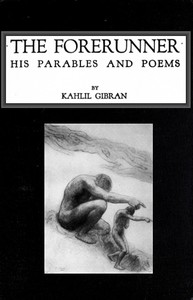
The Forerunner
Kahlil Gibran, 1892
An allegorical journey into the deepest chambers of the human heart, where wisdom is found not in answers, but in the language of nature and solitude.
 BookFeed Ελληνικά
Pages from The Forerunner that stand on their own, chosen for how they read today. The text is in the public domain.
When opposing forces find common ground, what does that common ground look like?
They say the jackal and the moleDrink from the self-same streamWhere the lion comes to drink.And they say the eagle and the vultureDig their beaks into the same carcass,And are at peace, one with the other,In the presence of the dead thing.O love, whose lordly handHas bridled my desires,And raised my hunger and my thirstTo dignity and pride,Let not the strong in me and the constantEat the bread or drink the wineThat tempt my weaker self. The greatest triumphs of the spirit are sometimes found only in the profound humility of regret.
After saying these things the Forerunner covered his face with his hands and wept bitterly. For he knew in his heart that love humiliated in its nakedness is greater than love that seeks triumph in disguise; and he was ashamed. When consumption becomes infinite, is there a point where desire simply destroys itself?
In my wanderings I once saw upon an island a man-headed, iron-hoofed monster who ate of the earth and drank of the sea incessantly. And for a long while I watched him. Then I approached him and said, “Have you never enough; is your hunger never satisfied and your thirst never quenched?” When softness is relentlessly judged, what becomes the only defense left for a fragile heart?
“And I said ‘I will love them more. Aye, even more. I will hide my love with seeming to hate, and disguise my tenderness as bitterness. I will wear an iron mask, and only when armed and mailed shall I seek them.’ What does joy feel like when it is mistaken for public humiliation?
Now as the dreamer rode through the city upon the naked horse, with the trumpeter and the drummer before him, the inhabitants of the city came running forth at the sound of the noise, and when they saw him they laughed one and all, and the children ran after him in companies from street to street. And the dreamer’s heart was filled with ecstasy, and his eyes shone upon them. For to him the tablet was a sign of the king’s blessing and the procession was in his honour. The price of true peace is often a kingdom, yet one king willingly traded it all for a forest.
And he said, “Nay, my friend, you knocked at the gate of my silences and received but a trifle. For who would not leave a kingdom for a forest where the seasons sing and dance ceaselessly? Many are those who have given their kingdom for less than solitude and the sweet fellowship of aloneness. Countless are the eagles who descend from the upper air to live with moles that they may know the secrets of the earth. There are those who renounce the kingdom of dreams that they may not seem distant from the dreamless. And those who renounce the kingdom of nakedness and cover their souls that others may not be ashamed in beholding truth uncovered and beauty unveiled. Two birds racing for the same morsel reveal a truth about rivalry and the cycle of life.
Once, high above a pasture, where a sheep and a lamb were grazing, an eagle was circling and gazing hungrily down upon the lamb. And as he was about to descend and seize his prey, another eagle appeared and hovered above the sheep and her young with the same hungry intent. Then the two rivals began to fight filling the sky with their fierce cries. Kahlil Gibran, 1892
An allegorical journey into the deepest chambers of the human heart, where wisdom is found not in answers, but in the language of nature and solitude.
Read pages from books like this, one at a time
BookFeed is a feed of real passages from real books. It learns what moves you and finds your next book.
Open BookFeedFree, no sign-up.