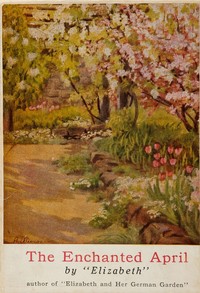
The Enchanted April
Elizabeth von Arnim, 1922
Four Englishwomen answer an advertisement for a castle in Italy and swap grey London for a month of wistaria, freesias and unaccountable happiness.
 BookFeed Ελληνικά
Pages from The Enchanted April that stand on their own, chosen for how they read today. The text is in the public domain.
Why we wrap ourselves in small things when the night gets too large.
She pulled her wrap closer round her with a gesture of defence, of keeping out and off. She didn’t want to grow sentimental. Difficult not to, here; the marvellous night stole in through all one’s chinks, and brought in with it, whether one wanted them or not, enormous feelings—feelings one couldn’t manage, great things about death and time and waste; glorious and devastating things, magnificent and bleak, at once rapture and terror and immense, heart-cleaving longing. She felt small and dreadfully alone. She felt uncovered and defenceless. Instinctively she pulled her wrap closer. With this thing of chiffon she tried to protect herself from the eternities. What happens when fear of someone quietly turns into amusement.
She laughed. She had never said anything like that to Mellersh yet, and the idea of it amused her. But why had she not? Oh yes—she used to be afraid of him. Funny to be afraid of anybody; and especially of one’s husband, whom one saw in his more simplified moments, such as asleep, and not breathing properly through his nose. The very specific ache of wanting to matter to just one person.
Rose clasped her hands tight round her knees. How passionately she longed to be important to somebody again—not important on platforms, not important as an asset in an organization, but privately important, just to one other person, quite privately, nobody else to know or notice. It didn’t seem much to ask in a world so crowded with people, just to have one of them, only one out of all the millions, to oneself. Somebody who needed one, who thought of one, who was eager to come to one—oh, oh how dreadfully one wanted to be precious! The morning luxury nobody quite admits to wanting: a bed to yourself.
She was in a little bedroom with bare white walls and a stone floor and sparse old furniture. The beds—there were two—were made of iron, enamelled black and painted with bunches of gay flowers. She lay putting off the great moment of going to the window as one puts off opening a precious letter, gloating over it. She had no idea what time it was; she had forgotten to wind up her watch ever since, centuries ago, she last went to bed in Hampstead. No sounds were to be heard in the house, so she supposed it was very early, yet she felt as if she had slept a long while—so completely rested, so perfectly content. She lay with her arms clasped round her head thinking how happy she was, her lips curved upwards in a delighted smile. In bed by herself: adorable condition. The moment a view stops being scenery and becomes an event.
All the radiance of April in Italy lay gathered together at her feet. The sun poured in on her. The sea lay asleep in it, hardly stirring. Across the bay the lovely mountains, exquisitely different in colour, were asleep too in the light; and underneath her window, at the bottom of the flower-starred grass slope from which the wall of the castle rose up, was a great cypress, cutting through the delicate blues and violets and rose-colours of the mountains and the sea like a great black sword. A husband remembered through the medium of badly behaved pasta.
It was very well cooked, but Mrs. Fisher had never cared for macaroni, especially not this long, worm-shaped variety. She found it difficult to eat—slippery, wriggling off her fork, making her look, she felt, undignified when, having got it as she supposed into her mouth, ends of it yet hung out. Always, too, when she ate it she was reminded of Mr. Fisher. He had during their married life behaved very much like macaroni. He had slipped, he had wriggled, he had made her feel undignified, and when at last she had got him safe, as she thought, there had invariably been little bits of him that still, as it were, hung out. The indignity of feeling young again, late in life.
Sternly she tried to frown the unseemly sensation down. Burgeon, indeed. She had heard of dried staffs, pieces of mere dead wood, suddenly putting forth fresh leaves, but only in legend. She was not in legend. She knew perfectly what was due to herself. Dignity demanded that she should have nothing to do with fresh leaves at her age; and yet there it was—the feeling that presently, that at any moment now, she might crop out all green. The particular joy of something you once rationed, now growing everywhere.
The delicate and delicious fragrance of the freesias came in through the door and floated round Mrs. Wilkins’s enraptured nostrils. Freesias in London were quite beyond her. Occasionally she went into a shop and asked what they cost, so as just to have an excuse for lifting up a bunch and smelling them, well knowing that it was something awful like a shilling for about three flowers. Here they were everywhere—bursting out of every corner and carpeting the rose beds. Imagine it—having freesias to pick in armsful if you wanted to, and with glorious sunshine flooding the room, and in your summer frock, and its being only the first of April! The night your own busy life first sounds like noise.
She had been intensely surprised. She knew stars and darkness did produce unusual emotions because, in others, she had seen them being produced, but they had not before done it in herself. A noise all about nothing. Could she be quite well? she had wondered. For a long while past she had been aware that her life was a noise, but it had seemed to be very much about something; a noise, indeed, about so much that she felt she must get out of earshot for a little or she would be completely, and perhaps permanently, deafened. But suppose it was only a noise about nothing? Elizabeth von Arnim, 1922
Four Englishwomen answer an advertisement for a castle in Italy and swap grey London for a month of wistaria, freesias and unaccountable happiness.
Read pages from books like this, one at a time
BookFeed is a feed of real passages from real books. It learns what moves you and finds your next book.
Open BookFeedFree, no sign-up.