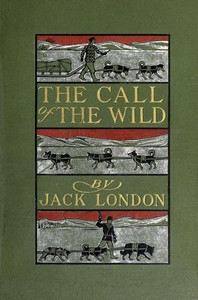
The Call of the Wild
Jack London, 1903
A pampered dog is stolen, sold to the Klondike gold rush, and taught the club before he learns the sled — then something older starts calling.
 BookFeed
Pages from The Call of the Wild that stand on their own, chosen for how they read today. The text is in the public domain.
The strange forgetfulness that arrives when you are most alive.
There is an ecstasy that marks the summit of life, and beyond which life cannot rise. And such is the paradox of living, this ecstasy comes when one is most alive, and it comes as a complete forgetfulness that one is alive. This ecstasy, this forgetfulness of living, comes to the artist, caught up and out of himself in a sheet of flame; it comes to the soldier, war-mad on a stricken field and refusing quarter; and it came to Buck, leading the pack, sounding the old wolf-cry, straining after the food that was alive and that fled swiftly before him through the moonlight. He was sounding the deeps of his nature, and of the parts of his nature that were deeper than he, going back into the womb of Time. The first songs were sad, and something in us still answers them.
With the aurora borealis flaming coldly overhead, or the stars leaping in the frost dance, and the land numb and frozen under its pall of snow, this song of the huskies might have been the defiance of life, only it was pitched in minor key, with long-drawn wailings and half-sobs, and was more the pleading of life, the articulate travail of existence. It was an old song, old as the breed itself—one of the first songs of the younger world in a day when songs were sad. It was invested with the woe of unnumbered generations, this plaint by which Buck was so strangely stirred. When he moaned and sobbed, it was with the pain of living that was of old the pain of his wild fathers, and the fear and mystery of the cold and dark that was to them fear and mystery. The dead do not leave us; they sit down at the fire.
He was older than the days he had seen and the breaths he had drawn. He linked the past with the present, and the eternity behind him throbbed through him in a mighty rhythm to which he swayed as the tides and seasons swayed. He sat by John Thornton’s fire, a broad-breasted dog, white-fanged and long-furred; but behind him were the shades of all manner of dogs, half-wolves and wild wolves, urgent and prompting, tasting the savor of the meat he ate, thirsting for the water he drank, scenting the wind with him, listening with him and telling him the sounds made by the wild life in the forest, dictating his moods, directing his actions, lying down to sleep with him when he lay down, and dreaming with him and beyond him and becoming themselves the stuff of his dreams. What a blow teaches you that no kindness could.
He was beaten (he knew that); but he was not broken. He saw, once for all, that he stood no chance against a man with a club. He had learned the lesson, and in all his after life he never forgot it. That club was a revelation. It was his introduction to the reign of primitive law, and he met the introduction halfway. The facts of life took on a fiercer aspect; and while he faced that aspect uncowed, he faced it with all the latent cunning of his nature aroused. As the days went by, other dogs came, in crates and at the ends of ropes, some docilely, and some raging and roaring as he had come; and, one and all, he watched them pass under the dominion of the man in the red sweater. The pride of being needed by work that is wearing you out.
It was inevitable that the clash for leadership should come. Buck wanted it. He wanted it because it was his nature, because he had been gripped tight by that nameless, incomprehensible pride of the trail and trace—that pride which holds dogs in the toil to the last gasp, which lures them to die joyfully in the harness, and breaks their hearts if they are cut out of the harness. This was the pride of Dave as wheel-dog, of Sol-leks as he pulled with all his strength; the pride that laid hold of them at break of camp, transforming them from sour and sullen brutes into straining, eager, ambitious creatures; the pride that spurred them on all day and dropped them at pitch of camp at night, letting them fall back into gloomy unrest and uncontent. What a body can lose and still keep pulling.
And through it all Buck staggered along at the head of the team as in a nightmare. He pulled when he could; when he could no longer pull, he fell down and remained down till blows from whip or club drove him to his feet again. All the stiffness and gloss had gone out of his beautiful furry coat. The hair hung down, limp and draggled, or matted with dried blood where Hal’s club had bruised him. His muscles had wasted away to knotty strings, and the flesh pads had disappeared, so that each rib and every bone in his frame were outlined cleanly through the loose hide that was wrinkled in folds of emptiness. It was heartbreaking, only Buck’s heart was unbreakable. The man in the red sweater had proved that. Two kinds of patience, and only one of them is chosen.
There is a patience of the wild—dogged, tireless, persistent as life itself—that holds motionless for endless hours the spider in its web, the snake in its coils, the panther in its ambuscade; this patience belongs peculiarly to life when it hunts its living food; and it belonged to Buck as he clung to the flank of the herd, retarding its march, irritating the young bulls, worrying the cows with their half-grown calves, and driving the wounded bull mad with helpless rage. For half a day this continued. Buck multiplied himself, attacking from all sides, enveloping the herd in a whirlwind of menace, cutting out his victim as fast as it could rejoin its mates, wearing out the patience of creatures preyed upon, which is a lesser patience than that of creatures preying. How quickly necessity redraws the line between right and wrong.
This first theft marked Buck as fit to survive in the hostile Northland environment. It marked his adaptability, his capacity to adjust himself to changing conditions, the lack of which would have meant swift and terrible death. It marked, further, the decay or going to pieces of his moral nature, a vain thing and a handicap in the ruthless struggle for existence. It was all well enough in the Southland, under the law of love and fellowship, to respect private property and personal feelings; but in the Northland, under the law of club and fang, whoso took such things into account was a fool, and in so far as he observed them he would fail to prosper. Jack London, 1903
A pampered dog is stolen, sold to the Klondike gold rush, and taught the club before he learns the sled — then something older starts calling.
Read pages from books like this, one at a time
BookFeed is a feed of real passages from real books. It learns what moves you and finds your next book.
Open BookFeedFree, no sign-up.