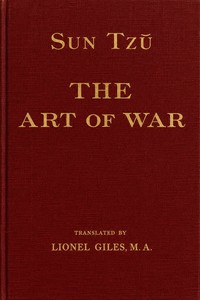
The Art of War
Sun Tzu, -500
A 2,500-year-old manual for conflict, written for generals and read by anyone who has to hold a position, win an argument, or know when to walk away.
 BookFeed
Pages from The Art of War that stand on their own, chosen for how they read today. The text is in the public domain.
The most counterintuitive military idea in history: win with the enemy intact, not destroyed.
Sun Tzǔ said: In the practical art of war, the best thing of all is to take the enemy’s country whole and intact; to shatter and destroy it is not so good. So, too, it is better to capture an army entire than to destroy it, to capture a regiment, a detachment or a company entire than to destroy them. The battle is already decided before the first arrow flies.
Now the general who wins a battle makes many calculations in his temple ere the battle is fought. The general who loses a battle makes but few calculations beforehand. Thus do many calculations lead to victory, and few calculations to defeat: how much more no calculation at all! How deception works in war and in everyday life.
Hence, when able to attack, we must seem unable; when using our forces, we must seem inactive; when we are near, we must make the enemy believe we are far away; when far away, we must make him believe we are near. The one battle plan that almost always fails.
The rule is, not to besiege walled cities if it can possibly be avoided. The preparation of mantlets, movable shelters, and various implements of war, will take up three whole months; and the piling up of mounds over against the walls will take three months more. When the general's temper costs an army its life.
The general, unable to control his irritation, will launch his men to the assault like swarming ants, with the result that one-third of his men are slain, while the town still remains untaken. Such are the disastrous effects of a siege. The ugliest book on winning ever written.
Hence a wise general makes a point of foraging on the enemy. One cartload of the enemy’s provisions is equivalent to twenty of one’s own, and likewise a single picul of his provender is equivalent to twenty from one’s own store. Sun Tzu, -500
A 2,500-year-old manual for conflict, written for generals and read by anyone who has to hold a position, win an argument, or know when to walk away.
Read pages from books like this, one at a time
BookFeed is a feed of real passages from real books. It learns what moves you and finds your next book.
Open BookFeedFree, no sign-up.