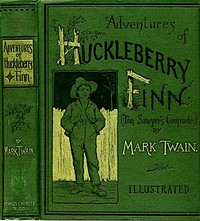
The Adventures of Huckleberry Finn
Mark Twain, 1884
A runaway boy and an enslaved man drift a raft down the Mississippi, and a child's plain talk quietly dismantles everything the adults around him believe.
 BookFeed
Pages from The Adventures of Huckleberry Finn that stand on their own, chosen for how they read today. The text is in the public domain.
What silence feels like when it isn't loneliness.
This second night we run between seven and eight hours, with a current that was making over four mile an hour. We catched fish and talked, and we took a swim now and then to keep off sleepiness. It was kind of solemn, drifting down the big, still river, laying on our backs looking up at the stars, and we didn’t ever feel like talking loud, and it warn’t often that we laughed—only a little kind of a low chuckle. We had mighty good weather as a general thing, and nothing ever happened to us at all—that night, nor the next, nor the next. A working definition of conscience, from a boy who has one.
So we poked along back home, and I warn’t feeling so brash as I was before, but kind of ornery, and humble, and to blame, somehow—though I hadn’t done nothing. But that’s always the way; it don’t make no difference whether you do right or wrong, a person’s conscience ain’t got no sense, and just goes for him anyway. If I had a yaller dog that didn’t know no more than a person’s conscience does I would pison him. It takes up more room than all the rest of a person’s insides, and yet ain’t no good, nohow. Tom Sawyer he says the same. A boy describes his father with an anatomist's calm and no love at all.
He was most fifty, and he looked it. His hair was long and tangled and greasy, and hung down, and you could see his eyes shining through like he was behind vines. It was all black, no gray; so was his long, mixed-up whiskers. There warn’t no color in his face, where his face showed; it was white; not like another man’s white, but a white to make a body sick, a white to make a body’s flesh crawl—a tree-toad white, a fish-belly white. As for his clothes—just rags, that was all. He had one ankle resting on t’other knee; the boot on that foot was busted, and two of his toes stuck through, and he worked them now and then. His hat was laying on the floor—an old black slouch with the top caved in, like a lid. A sermon on brotherly love, delivered to men who brought their guns.
Next Sunday we all went to church, about three mile, everybody a-horseback. The men took their guns along, so did Buck, and kept them between their knees or stood them handy against the wall. The Shepherdsons done the same. It was pretty ornery preaching—all about brotherly love, and suchlike tiresomeness; but everybody said it was a good sermon, and they all talked it over going home, and had such a powerful lot to say about faith and good works and free grace and preforeordestination, and I don’t know what all, that it did seem to me to be one of the roughest Sundays I had run across yet. How fog rearranges your sense of whether you're moving at all.
I kept quiet, with my ears cocked, about fifteen minutes, I reckon. I was floating along, of course, four or five miles an hour; but you don’t ever think of that. No, you feel like you are laying dead still on the water; and if a little glimpse of a snag slips by you don’t think to yourself how fast you’re going, but you catch your breath and think, my! how that snag’s tearing along. If you think it ain’t dismal and lonesome out in a fog that way by yourself in the night, you try it once—you’ll see. What it costs to apologise to someone you were taught to look down on.
It was fifteen minutes before I could work myself up to go and humble myself to a nigger; but I done it, and I warn’t ever sorry for it afterwards, neither. I didn’t do him no more mean tricks, and I wouldn’t done that one if I’d a knowed it would make him feel that way. Every childhood gang has one member quietly keeping the accounts.
We played robber now and then about a month, and then I resigned. All the boys did. We hadn’t robbed nobody, hadn’t killed any people, but only just pretended. We used to hop out of the woods and go charging down on hog-drivers and women in carts taking garden stuff to market, but we never hived any of them. Tom Sawyer called the hogs “ingots,” and he called the turnips and stuff “julery,” and we would go to the cave and powwow over what we had done, and how many people we had killed and marked. But I couldn’t see no profit in it. A summer afternoon so quiet it starts to feel like a message.
When I got there it was all still and Sunday-like, and hot and sunshiny; the hands was gone to the fields; and there was them kind of faint dronings of bugs and flies in the air that makes it seem so lonesome and like everybody’s dead and gone; and if a breeze fans along and quivers the leaves it makes you feel mournful, because you feel like it’s spirits whispering—spirits that’s been dead ever so many years—and you always think they’re talking about you. As a general thing it makes a body wish he was dead, too, and done with it all. How long a camp-meeting conversion lasts once the whisky is within reach.
So they shook it, one after the other, all around, and cried. The judge’s wife she kissed it. Then the old man he signed a pledge—made his mark. The judge said it was the holiest time on record, or something like that. Then they tucked the old man into a beautiful room, which was the spare room, and in the night some time he got powerful thirsty and clumb out on to the porch-roof and slid down a stanchion and traded his new coat for a jug of forty-rod, and clumb back again and had a good old time; and towards daylight he crawled out again, drunk as a fiddler, and rolled off the porch and broke his left arm in two places, and was most froze to death when somebody found him after sunup. Grief's stage manager, gliding through the room without a sound.
When the place was packed full the undertaker he slid around in his black gloves with his softy soothering ways, putting on the last touches, and getting people and things all shipshape and comfortable, and making no more sound than a cat. He never spoke; he moved people around, he squeezed in late ones, he opened up passageways, and done it with nods, and signs with his hands. Then he took his place over against the wall. He was the softest, glidingest, stealthiest man I ever see; and there warn’t no more smile to him than there is to a ham. Mark Twain, 1884
A runaway boy and an enslaved man drift a raft down the Mississippi, and a child's plain talk quietly dismantles everything the adults around him believe.
Read pages from books like this, one at a time
BookFeed is a feed of real passages from real books. It learns what moves you and finds your next book.
Open BookFeedFree, no sign-up.