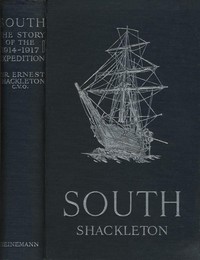
South
Ernest Shackleton, 1919
A first-hand account of a ship crushed in Antarctic ice and a crew that must improvise its way home, told in the plain, dry voice of the man responsible for them.
 BookFeed Ελληνικά
Pages from South that stand on their own, chosen for how they read today. The text is in the public domain.
The moment open water returns after months of white.
We made our way through the lanes till at noon we were suddenly spewed out of the pack into the open ocean. Dark blue and sapphire green ran the seas. Our sails were soon up, and with a fair wind we moved over the waves like three Viking ships on the quest of a lost Atlantis. With the sheet well out and the sun shining bright above, we enjoyed for a few hours a sense of the freedom and magic of the sea, compensating us for pain and trouble in the days that had passed. At last we were free from the ice, in water that our boats could navigate. Thoughts of home, stifled by the deadening weight of anxious days and nights, came to birth once more, and the difficulties that had still to be overcome dwindled in fancy almost to nothing. At midnight, the clearing sky turns out to be something else.
He was thoroughly cramped, and we had to drag him beneath the decking and massage him before he could unbend himself and get into a sleeping-bag. A hard north-westerly gale came up on the eleventh day (May 5) and shifted to the south-west in the late afternoon. The sky was overcast and occasional snow-squalls added to the discomfort produced by a tremendous cross-sea—the worst, I thought, that we had experienced. At midnight I was at the tiller and suddenly noticed a line of clear sky between the south and south-west. I called to the other men that the sky was clearing, and then a moment later I realized that what I had seen was not a rift in the clouds but the white crest of an enormous wave. During twenty-six years’ experience of the ocean in all its moods I had not encountered a wave so gigantic. On the frozen horizon, cities build themselves and dissolve within the hour.
“The distant pack is thrown up into towering barrier-like cliffs, which are reflected in blue lakes and lanes of water at their base. Great white and golden cities of Oriental appearance at close intervals along these clifftops indicate distant bergs, some not previously known to us. Floating above these are wavering violet and creamy lines of still more remote bergs and pack. The lines rise and fall, tremble, dissipate, and reappear in an endless transformation scene. The southern pack and bergs, catching the sun’s rays, are golden, but to the north the ice-masses are purple. Here the bergs assume changing forms, first a castle, then a balloon just clear of the horizon, that changes swiftly into an immense mushroom, a mosque, or a cathedral. The principal characteristic is the vertical lengthening of the object, a small pressure-ridge being given the appearance of a line of battlements or towering cliffs. Two seals nap on the same ice that may kill you.
I noticed enviously the calm peaceful attitudes of two seals which lolled lazily on a rocking floe. They were at home and had no reason for worry or cause for fear. If they thought at all, I suppose they counted it an ideal day for a joyous journey on the tumbling ice. To us it was a day that seemed likely to lead to no more days. Three penguins meet the first humans they have ever seen with perfect manners.
“We walk up to them, talking loudly and assuming a threatening aspect. Notwithstanding our bad manners, the three birds turn towards us, bowing ceremoniously. Then, after a closer inspection, they conclude that we are undesirable acquaintances and make off across the floe. We head them off and finally shepherd them close to the ship, where the frenzied barking of the dogs so frightens them that they make a determined effort to break through the line. We seize them. One bird of philosophic mien goes quietly, led by one flipper. The others show fight, but all are imprisoned in an igloo for the night.... In the afternoon we see five emperors in the western lead and capture one. Kerr and Cheetham fight a valiant action with two large birds. Kerr rushes at one, seizes it, and is promptly knocked down by the angered penguin, which jumps on his chest before retiring. A crew rations fire, and one man sings an unknown song.
It was the rule that one match must serve when the Primus was being lit. We had no lamp for the compass and during the early days of the voyage we would strike a match when the steersman wanted to see the course at night; but later the necessity for strict economy impressed itself upon us, and the practice of striking matches at night was stopped. We had one water-tight tin of matches. I had stowed away in a pocket, in readiness for a sunny day, a lens from one of the telescopes, but this was of no use during the voyage. The sun seldom shone upon us. The glass of the compass got broken one night, and we contrived to mend it with adhesive tape from the medicine-chest. One of the memories that comes to me from those days is of Crean singing at the tiller. Ten lodgers in the attic, and the ceiling will not rise.
“In the attic, formed by the two upturned boats, live ten unkempt and careless lodgers, who drop boots, mitts, and other articles of apparel on to the men below. Reindeer hairs rain down incessantly day and night, with every movement that they make in their moulting bags. These, with penguin feathers and a little grit from the floor, occasionally savour the hooshes. Thank heaven man is an adaptable brute! If we dwell sufficiently long in this hut, we are likely to alter our method of walking, for our ceiling, which is but four feet six inches high at its highest part, compels us to walk bent double or on all fours. Ice squeezes a ship the way fingers squeeze a fruit stone.
After the ship had come to a standstill in her new position very heavy pressure was set up. Some of the trenails were started and beams buckled slightly under the terrific stresses. But the Endurance had been built to withstand the attacks of the ice, and she lifted bravely as the floes drove beneath her. The effects of the pressure around us were awe-inspiring. Mighty blocks of ice, gripped between meeting floes, rose slowly till they jumped like cherry-stones squeezed between thumb and finger. The pressure of millions of tons of moving ice was crushing and smashing inexorably. If the ship was once gripped firmly her fate would be sealed. What it feels like to be small inside a machine of ice.
The pack within our range of vision was being subjected to enormous compression, such as might be caused by cyclonic winds, opposing ocean currents, or constriction in a channel of some description. The pressure-ridges, massive and threatening, testified to the overwhelming nature of the forces that were at work. Huge blocks of ice, weighing many tons, were lifted into the air and tossed aside as other masses rose beneath them. We were helpless intruders in a strange world, our lives dependent upon the play of grim elementary forces that made a mock of our puny efforts. The sea ahead is not water but a puzzle that will not come apart.
I had been prepared for evil conditions in the Weddell Sea, but had hoped that in December and January, at any rate, the pack would be loose, even if no open water was to be found. What we were actually encountering was fairly dense pack of a very obstinate character. Pack-ice might be described as a gigantic and interminable jigsaw-puzzle devised by nature. Ernest Shackleton, 1919
A first-hand account of a ship crushed in Antarctic ice and a crew that must improvise its way home, told in the plain, dry voice of the man responsible for them.
Read pages from books like this, one at a time
BookFeed is a feed of real passages from real books. It learns what moves you and finds your next book.
Open BookFeedFree, no sign-up.