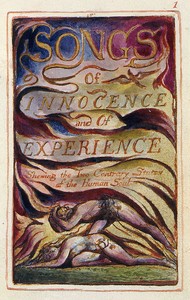
Songs of Innocence and of Experience
William Blake, 1794
Short poems about lambs, tigers, chimney sweeps and London streets, paired to show one world seen first with trust, then with disillusion. Readable in an evening.
 BookFeed Ελληνικά
Pages from Songs of Innocence and of Experience that stand on their own, chosen for how they read today. The text is in the public domain.
Can the maker of the gentlest creature also have made the fiercest?
What the hammer? what the chain?In what furnace was thy brain?What the anvil? what dread graspDare its deadly terrors clasp?When the stars threw down their spears,And watered heaven with their tears,Did He smile His work to see?Did He who made the lamb make thee?Tiger, tiger, burning brightIn the forests of the night,What immortal hand or eyeDare frame thy fearful symmetry? Walking a city where every face carries the same mark.
I wander through each chartered street,Near where the chartered Thames does flow,A mark in every face I meet,Marks of weakness, marks of woe.In every cry of every man,In every infant’s cry of fear,In every voice, in every ban,The mind-forged manacles I hear:How the chimney-sweeper’s cryEvery blackening church appals,And the hapless soldier’s sighRuns in blood down palace-walls. What happens to the anger you decide not to mention.
I was angry with my friend:I told my wrath, my wrath did end.I was angry with my foe:I told it not, my wrath did grow.And I watered it in fearsNight and morning with my tears,And I sunnèd it with smilesAnd with soft deceitful wiles. Going back to where you used to play, and finding it fenced.
I went to the Garden of Love,And saw what I never had seen;A Chapel was built in the midst,Where I used to play on the green.And the gates of this Chapel were shut,And ‘Thou shalt not’ writ over the door;So I turned to the Garden of LoveThat so many sweet flowers bore.And I saw it was filled with graves,And tombstones where flowers should be;And priests in black gowns were walking their rounds,And binding with briars my joys and desires. A careless swipe at an insect turns into a question about your own life.
Little Fly,Thy summer’s playMy thoughtless handHas brushed away.Am not IA fly like thee?Or art not thouA man like me?For I dance,And drink, and sing,Till some blind handShall brush my wing. Why a creature made for song goes quiet when shut indoors.
Ah then at times I drooping sit,And spend many an anxious hour;Nor in my book can I take delight,Nor sit in learning’s bower,Worn through with the dreary shower.How can the bird that is born for joySit in a cage and sing?How can a child, when fears annoy,But droop his tender wing,And forget his youthful spring! The first complaint of a person newly arrived in the world.
My mother groaned, my father wept:Into the dangerous world I leapt,Helpless, naked, piping loud,Like a fiend hid in a cloud.Struggling in my father’s hands,Striving against my swaddling bands,Bound and weary, I thought bestTo sulk upon my mother’s breast. A boy makes a cheerful, practical case for putting a pub in church.
Dear mother, dear mother, the Church is cold;But the Alehouse is healthy, and pleasant, and warm.Besides, I can tell where I am used well;Such usage in heaven will never do well.But, if at the Church they would give us some ale,And a pleasant fire our souls to regale,We’d sing and we’d pray all the livelong day,Nor ever once wish from the Church to stray. A nurse hears children playing and feels something other than peace.
When the voices of children are heard on the green,And whisperings are in the dale,The days of my youth rise fresh in my mind,My face turns green and pale.Then come home, my children, the sun is gone down,And the dews of night arise;Your spring and your day are wasted in play,And your winter and night in disguise. The odd moment when a song is so happy it makes someone cry.
Piping down the valleys wild,Piping songs of pleasant glee,On a cloud I saw a child,And he laughing said to me:‘Pipe a song about a Lamb!’So I piped with merry cheer.‘Piper, pipe that song again.’So I piped: he wept to hear.‘Drop thy pipe, thy happy pipe;Sing thy songs of happy cheer!’So I sung the same again,While he wept with joy to hear. William Blake, 1794
Short poems about lambs, tigers, chimney sweeps and London streets, paired to show one world seen first with trust, then with disillusion. Readable in an evening.
Read pages from books like this, one at a time
BookFeed is a feed of real passages from real books. It learns what moves you and finds your next book.
Open BookFeedFree, no sign-up.