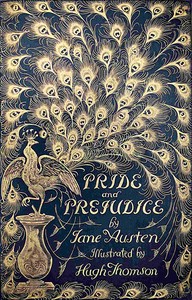
Pride and Prejudice
Jane Austen, 1813
A sharp-eyed comedy about money, manners and misjudgment, in which a quick-witted woman and a proud man keep being wrong about each other. Funnier and more cutting than its reputation suggests.
 BookFeed Ελληνικά
Pages from Pride and Prejudice that stand on their own, chosen for how they read today. The text is in the public domain.
A man reframes his self-interest as an act of atonement.
Having now a good house and a very sufficient income, he intended to marry; and in seeking a reconciliation with the Longbourn family he had a wife in view, as he meant to choose one of the daughters, if he found them as handsome and amiable as they were represented by common report. This was his plan of amends—of atonement—for inheriting their father’s estate; and he thought it an excellent one, full of eligibility and suitableness, and excessively generous and disinterested on his own part. A neighbourhood decides whom a stranger belongs to before he arrives.
However little known the feelings or views of such a man may be on his first entering a neighbourhood, this truth is so well fixed in the minds of the surrounding families, that he is considered as the rightful property of some one or other of their daughters. Twenty-three years of marriage, and one spouse is still a mystery to the other.
Mr. Bennet was so odd a mixture of quick parts, sarcastic humour, reserve, and caprice, that the experience of three-and-twenty years had been insufficient to make his wife understand his character. Her mind was less difficult to develope. She was a woman of mean understanding, little information, and uncertain temper. When she was discontented, she fancied herself nervous. The business of her life was to get her daughters married: its solace was visiting and news. How quickly a room decides who is charming and who is unforgivable.
Mr. Bingley had soon made himself acquainted with all the principal people in the room: he was lively and unreserved, danced every dance, was angry that the ball closed so early, and talked of giving one himself at Netherfield. Such amiable qualities must speak for themselves. What a contrast between him and his friend! Mr. Darcy danced only once with Mrs. Hurst and once with Miss Bingley, declined being introduced to any other lady, and spent the rest of the evening in walking about the room, speaking occasionally to one of his own party. His character was decided. He was the proudest, most disagreeable man in the world, and everybody hoped that he would never come there again. Amongst the most violent against him was Mrs. Bennet, whose dislike of his general behaviour was sharpened into particular resentment by his having slighted one of her daughters. Being stared at by someone whose good opinion you've decided not to want.
Mrs. Hurst sang with her sister; and while they were thus employed, Elizabeth could not help observing, as she turned over some music-books that lay on the instrument, how frequently Mr. Darcy’s eyes were fixed on her. She hardly knew how to suppose that she could be an object of admiration to so great a man, and yet that he should look at her because he disliked her was still more strange. She could only imagine, however, at last, that she drew his notice because there was something about her more wrong and reprehensible, according to his ideas of right, than in any other person present. The supposition did not pain her. She liked him too little to care for his approbation. When the same man keeps turning up on your favourite walk.
More than once did Elizabeth, in her ramble within the park, unexpectedly meet Mr. Darcy. She felt all the perverseness of the mischance that should bring him where no one else was brought; and, to prevent its ever happening again, took care to inform him, at first, that it was a favourite haunt of hers. How it could occur a second time, therefore, was very odd! Yet it did, and even the third. It seemed like wilful ill-nature, or a voluntary penance; for on these occasions it was not merely a few formal inquiries and an awkward pause and then away, but he actually thought it necessary to turn back and walk with her. What a house full of sisters can learn about a man from a window.
In a few days Mr. Bingley returned Mr. Bennet’s visit, and sat about ten minutes with him in his library. He had entertained hopes of being admitted to a sight of the young ladies, of whose beauty he had heard much; but he saw only the father. The ladies were somewhat more fortunate, for they had the advantage of ascertaining, from an upper window, that he wore a blue coat and rode a black horse. Visiting hours with a woman who has opinions about your furniture.
Very few days passed in which Mr. Collins did not walk to Rosings, and not many in which his wife did not think it necessary to go likewise; and till Elizabeth recollected that there might be other family livings to be disposed of, she could not understand the sacrifice of so many hours. Now and then they were honoured with a call from her Ladyship, and nothing escaped her observation that was passing in the room during these visits. She examined into their employments, looked at their work, and advised them to do it differently; found fault with the arrangement of the furniture, or detected the housemaid in negligence; and if she accepted any refreshment, seemed to do it only for the sake of finding out that Mrs. Collins’s joints of meat were too large for her family. The weather as a topic, rescued by the person talking about it.
Mr. Wickham was the happy man towards whom almost every female eye was turned, and Elizabeth was the happy woman by whom he finally seated himself; and the agreeable manner in which he immediately fell into conversation, though it was only on its being a wet night, and on the probability of a rainy season, made her feel that the commonest, dullest, most threadbare topic might be rendered interesting by the skill of the speaker. Jane Austen, 1813
A sharp-eyed comedy about money, manners and misjudgment, in which a quick-witted woman and a proud man keep being wrong about each other. Funnier and more cutting than its reputation suggests.
Read pages from books like this, one at a time
BookFeed is a feed of real passages from real books. It learns what moves you and finds your next book.
Open BookFeedFree, no sign-up.