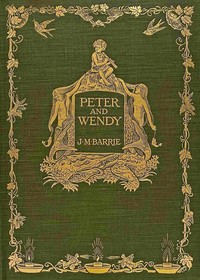
Peter Pan
J. M. Barrie, 1911
A boy who refuses to grow up flies three children to an island of pirates, fairies and mermaids—and shows how much childhood costs.
 BookFeed
Pages from Peter Pan that stand on their own, chosen for how they read today. The text is in the public domain.
No one gets over the first time they are treated unfairly.
Not the pain of this but its unfairness was what dazed Peter. It made him quite helpless. He could only stare, horrified. Every child is affected thus the first time he is treated unfairly. All he thinks he has a right to when he comes to you to be yours is fairness. After you have been unfair to him he will love you again, but will never afterwards be quite the same boy. No one ever gets over the first unfairness; no one except Peter. He often met it, but he always forgot it. I suppose that was the real difference between him and all the rest. The most dangerous man on the island travels in a chariot pulled by his own crew.
In the midst of them, the blackest and largest in that dark setting, reclined James Hook, or as he wrote himself, Jas. Hook, of whom it is said he was the only man that the Sea-Cook feared. He lay at his ease in a rough chariot drawn and propelled by his men, and instead of a right hand he had the iron hook with which ever and anon he encouraged them to increase their pace. As dogs this terrible man treated and addressed them, and as dogs they obeyed him. In person he was cadaverous and blackavized, and his hair was dressed in long curls, which at a little distance looked like black candles, and gave a singularly threatening expression to his handsome countenance. The closest you get to the lagoon is behind your own eyelids.
If you shut your eyes and are a lucky one, you may see at times a shapeless pool of lovely pale colours suspended in the darkness; then if you squeeze your eyes tighter, the pool begins to take shape, and the colours become so vivid that with another squeeze they must go on fire. But just before they go on fire you see the lagoon. This is the nearest you ever get to it on the mainland, just one heavenly moment; if there could be two moments you might see the surf and hear the mermaids singing. The place you have never been can still feel like home.
Wendy and John and Michael stood on tip-toe in the air to get their first sight of the island. Strange to say, they all recognized it at once, and until fear fell upon them they hailed it, not as something long dreamt of and seen at last, but as a familiar friend to whom they were returning home for the holidays. Every night a mother sorts through the day her children have left behind.
Mrs. Darling first heard of Peter when she was tidying up her children’s minds. It is the nightly custom of every good mother after her children are asleep to rummage in their minds and put things straight for next morning, repacking into their proper places the many articles that have wandered during the day. If you could keep awake (but of course you can’t) you would see your own mother doing this, and you would find it very interesting to watch her. It is quite like tidying up drawers. You would see her on her knees, I expect, lingering humorously over some of your contents, wondering where on earth you had picked this thing up, making discoveries sweet and not so sweet, pressing this to her cheek as if it were as nice as a kitten, and hurriedly stowing that out of sight. A boy feeds his friends by stealing from birds, and thinks it normal.
Sometimes it was dark and sometimes light, and now they were very cold and again too warm. Did they really feel hungry at times, or were they merely pretending, because Peter had such a jolly new way of feeding them? His way was to pursue birds who had food in their mouths suitable for humans and snatch it from them; then the birds would follow and snatch it back; and they would all go chasing each other gaily for miles, parting at last with mutual expressions of good-will. But Wendy noticed with gentle concern that Peter did not seem to know that this was rather an odd way of getting your bread and butter, nor even that there are other ways. The boy who lives for adventure invents the game of having none.
Adventures, of course, as we shall see, were of daily occurrence; but about this time Peter invented, with Wendy’s help, a new game that fascinated him enormously, until he suddenly had no more interest in it, which, as you have been told, was what always happened with his games. It consisted in pretending not to have adventures, in doing the sort of thing John and Michael had been doing all their lives, sitting on stools flinging balls in the air, pushing each other, going out for walks and coming back without having killed so much as a grizzly. To see Peter doing nothing on a stool was a great sight; he could not help looking solemn at such times, to sit still seemed to him such a comic thing to do. He boasted that he had gone walking for the good of his health. A boy tries to murder grown-ups by breathing faster.
But of course he cared very much; and he was so full of wrath against grown-ups, who, as usual, were spoiling everything, that as soon as he got inside his tree he breathed intentionally quick short breaths at the rate of about five to a second. He did this because there is a saying in the Neverland that, every time you breathe, a grown-up dies; and Peter was killing them off vindictively as fast as possible. A boy tries to glue his shadow back on with bathroom soap.
If he thought at all, but I don’t believe he ever thought, it was that he and his shadow, when brought near each other, would join like drops of water, and when they did not he was appalled. He tried to stick it on with soap from the bathroom, but that also failed. A shudder passed through Peter, and he sat on the floor and cried. J. M. Barrie, 1911
A boy who refuses to grow up flies three children to an island of pirates, fairies and mermaids—and shows how much childhood costs.
Read pages from books like this, one at a time
BookFeed is a feed of real passages from real books. It learns what moves you and finds your next book.
Open BookFeedFree, no sign-up.