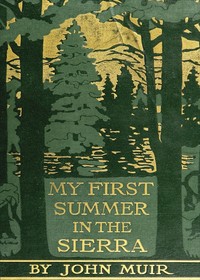
My First Summer in the Sierra
John Muir, 1911
A young Scot joins a sheep drive into the high Sierra in 1869 and writes daily, ecstatic journal entries about granite, light and water, as if seeing mountains for the first time.
 BookFeed Ελληνικά
Pages from My First Summer in the Sierra that stand on their own, chosen for how they read today. The text is in the public domain.
Pull on any one thing and the whole mountain moves.
No Sierra landscape that I have seen holds anything truly dead or dull, or any trace of what in manufactories is called rubbish or waste; everything is perfectly clean and pure and full of divine lessons. This quick, inevitable interest attaching to everything seems marvelous until the hand of God becomes visible; then it seems reasonable that what interests Him may well interest us. When we try to pick out anything by itself, we find it hitched to everything else in the universe. One fancies a heart like our own must be beating in every crystal and cell, and we feel like stopping to speak to the plants and animals as friendly fellow mountaineers. Drawing a landscape you know you can't truly pass on.
I would fain draw everything in sight—rock, tree, and leaf. But little can I do beyond mere outlines,—marks with meanings like words, readable only to myself,—yet I sharpen my pencils and work on as if others might possibly be benefited. Whether these picture-sheets are to vanish like fallen leaves or go to friends like letters, matters not much; for little can they tell to those who have not themselves seen similar wildness, and like a language have learned it. No pain here, no dull empty hours, no fear of the past, no fear of the future. These blessed mountains are so compactly filled with God’s beauty, no petty personal hope or experience has room to be. What it feels like when hurry quietly leaves you.
Another glorious Sierra day in which one seems to be dissolved and absorbed and sent pulsing onward we know not where. Life seems neither long nor short, and we take no more heed to save time or make haste than do the trees and stars. This is true freedom, a good practical sort of immortality. Yonder rises another white skyland. How sharply the yellow pine spires and the palm-like crowns of the sugar pines are outlined on its smooth white domes. And hark! the grand thunder billows booming, rolling from ridge to ridge, followed by the faithful shower. Why ruin, looked at long enough, might be another word for making.
Glad to get back to the green side of the mountains, though I have greatly enjoyed the gray east side and hope to see more of it. Reading these grand mountain manuscripts displayed through every vicissitude of heat and cold, calm and storm, upheaving volcanoes and down-grinding glaciers, we see that everything in Nature called destruction must be creation—a change from beauty to beauty. Following one raindrop to wherever it happens to land.
How interesting to trace the history of a single raindrop! It is not long, geologically speaking, as we have seen, since the first raindrops fell on the newborn leafless Sierra landscapes. How different the lot of these falling now! Happy the showers that fall on so fair a wilderness,—scarce a single drop can fail to find a beautiful spot,—on the tops of the peaks, on the shining glacier pavements, on the great smooth domes, on forests and gardens and brushy moraines, plashing, glinting, pattering, laving. Saying goodnight to a bear, a fly and a grasshopper.
Sundown, and I must to camp. Good-night, friends three,—brown bear, rugged boulder of energy in groves and gardens fair as Eden; restless, fussy fly with gauzy wings stirring the air around all the world; and grasshopper, crisp, electric spark of joy enlivening the massy sublimity of the mountains like the laugh of a child. Thank you, thank you all three for your quickening company. Heaven guide every wing and leg. Good-night friends three, good-night. What constant company with a flock does to a man's mind.
The shepherd in Scotland seldom thinks of being anything but a shepherd. He has probably descended from a race of shepherds and inherited a love and aptitude for the business almost as marked as that of his collie. He has but a small flock to look after, sees his family and neighbors, has time for reading in fine weather, and often carries books to the fields with which he may converse with kings. The oriental shepherd, we read, called his sheep by name; they knew his voice and followed him. The flocks must have been small and easily managed, allowing piping on the hills and ample leisure for reading and thinking. But whatever the blessings of sheep-culture in other times and countries, the California shepherd, as far as I’ve seen or heard, is never quite sane for any considerable time. Of all Nature’s voices baa is about all he hears. A night spent on a rock between a waterfall and the stars.
After dark, when the camp was at rest, I groped my way back to the altar boulder and passed the night on it,—above the water, beneath the leaves and stars,—everything still more impressive than by day, the fall seen dimly white, singing Nature’s old love song with solemn enthusiasm, while the stars peering through the leaf-roof seemed to join in the white water’s song. Precious night, precious day to abide in me forever. Thanks be to God for this immortal gift. Watching light play on stone and finding it lovelier than painting.
How beautiful a rock is made by leaf shadows! Those of the live oak are particularly clear and distinct, and beyond all art in grace and delicacy, now still as if painted on stone, now gliding softly as if afraid of noise, now dancing, waltzing in swift, merry swirls, or jumping on and off sunny rocks in quick dashes like wave embroidery on seashore cliffs. How true and substantial is this shadow beauty, and with what sublime extravagance is beauty thus multiplied! A valley of waterfalls, and the visitors who came to fish.
It seems strange that visitors to Yosemite should be so little influenced by its novel grandeur, as if their eyes were bandaged and their ears stopped. Most of those I saw yesterday were looking down as if wholly unconscious of anything going on about them, while the sublime rocks were trembling with the tones of the mighty chanting congregation of waters gathered from all the mountains round about, making music that might draw angels out of heaven. Yet respectable-looking, even wise-looking people were fixing bits of worms on bent pieces of wire to catch trout. Sport they called it. John Muir, 1911
A young Scot joins a sheep drive into the high Sierra in 1869 and writes daily, ecstatic journal entries about granite, light and water, as if seeing mountains for the first time.
Read pages from books like this, one at a time
BookFeed is a feed of real passages from real books. It learns what moves you and finds your next book.
Open BookFeedFree, no sign-up.