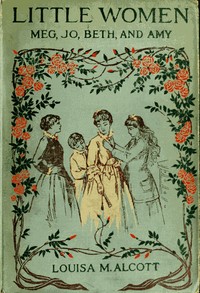
Little Women
Louisa May Alcott, 1868
Four sisters, one thin purse and a long war, learning to work, quarrel, write and love in a New England town that feels like your own street.
 BookFeed Ελληνικά
Pages from Little Women that stand on their own, chosen for how they read today. The text is in the public domain.
What a small bird can do for someone who is very tired.
Jo could not speak; and for several minutes there was no sound but the sigh of the wind and the lapping of the tide. A white-winged gull flew by, with the flash of sunshine on its silvery breast; Beth watched it till it vanished, and her eyes were full of sadness. A little gray-coated sand-bird came tripping over the beach, “peeping” softly to itself, as if enjoying the sun and sea; it came quite close to Beth, looked at her with a friendly eye, and sat upon a warm stone, dressing its wet feathers, quite at home. Beth smiled, and felt comforted, for the tiny thing seemed to offer its small friendship, and remind her that a pleasant world was still to be enjoyed. The happiness of being nowhere but inside your own invention.
She did not think herself a genius by any means; but when the writing fit came on, she gave herself up to it with entire abandon, and led a blissful life, unconscious of want, care, or bad weather, while she sat safe and happy in an imaginary world, full of friends almost as real and dear to her as any in the flesh. Sleep forsook her eyes, meals stood untasted, day and night were all too short to enjoy the happiness which blessed her only at such times, and made these hours worth living, even if they bore no other fruit. The divine afflatus usually lasted a week or two, and then she emerged from her “vortex,” hungry, sleepy, cross, or despondent. Furniture that remembers more of your childhood than you do.
Now, the old sofa was a regular patriarch of a sofa—long, broad, well-cushioned, and low; a trifle shabby, as well it might be, for the girls had slept and sprawled on it as babies, fished over the back, rode on the arms, and had menageries under it as children, and rested tired heads, dreamed dreams, and listened to tender talk on it as young women. They all loved it, for it was a family refuge, and one corner had always been Jo’s favorite lounging-place. Among the many pillows that adorned the venerable couch was one, hard, round, covered with prickly horsehair, and furnished with a knobby button at each end; this repulsive pillow was her especial property, being used as a weapon of defence, a barricade, or a stern preventive of too much slumber. The small ritual that decides whether a day can be borne.
They always looked back before turning the corner, for their mother was always at the window, to nod and smile, and wave her hand to them. Somehow it seemed as if they couldn’t have got through the day without that; for, whatever their mood might be, the last glimpse of that motherly face was sure to affect them like sunshine. Discovering your mother is not a saint, and loving her more.
The patience and the humility of the face she loved so well was a better lesson to Jo than the wisest lecture, the sharpest reproof. She felt comforted at once by the sympathy and confidence given her; the knowledge that her mother had a fault like hers, and tried to mend it, made her own easier to bear and strengthened her resolution to cure it; though forty years seemed rather a long time to watch and pray, to a girl of fifteen. How fast a proud man can be undone by being needed.
If the roof of the house had suddenly flown off, the old gentleman wouldn’t have been more astonished; but he liked it—oh, dear, yes, he liked it amazingly!—and was so touched and pleased by that confiding little kiss that all his crustiness vanished; and he just set her on his knee, and laid his wrinkled cheek against her rosy one, feeling as if he had got his own little granddaughter back again. Beth ceased to fear him from that moment, and sat there talking to him as cosily as if she had known him all her life; for love casts out fear, and gratitude can conquer pride. When she went home, he walked with her to her own gate, shook hands cordially, and touched his hat as he marched back again, looking very stately and erect, like a handsome, soldierly old gentleman, as he was. The fear of turning thirty, and the quiet case against it.
It seldom is, at first, and thirty seems the end of all things to five-and-twenty; but it’s not so bad as it looks, and one can get on quite happily if one has something in one’s self to fall back upon. At twenty-five, girls begin to talk about being old maids, but secretly resolve that they never will be; at thirty they say nothing about it, but quietly accept the fact, and, if sensible, console themselves by remembering that they have twenty more useful, happy years, in which they may be learning to grow old gracefully. Don’t laugh at the spinsters, dear girls, for often very tender, tragical romances are hidden away in the hearts that beat so quietly under the sober gowns, and many silent sacrifices of youth, health, ambition, love itself, make the faded faces beautiful in God’s sight. A coat that argues for its owner's kindness.
His very clothes seemed to partake of the hospitable nature of the wearer. They looked as if they were at ease, and liked to make him comfortable; his capacious waistcoat was suggestive of a large heart underneath; his rusty coat had a social air, and the baggy pockets plainly proved that little hands often went in empty and came out full; his very boots were benevolent, and his collars never stiff and raspy like other people’s. How to survive a departure: feed the crying children.
“I’m going to write you a regular volume, for I’ve got heaps to tell, though I’m not a fine young lady travelling on the continent. When I lost sight of father’s dear old face, I felt a trifle blue, and might have shed a briny drop or two, if an Irish lady with four small children, all crying more or less, hadn’t diverted my mind; for I amused myself by dropping gingerbread nuts over the seat every time they opened their mouths to roar. Louisa May Alcott, 1868
Four sisters, one thin purse and a long war, learning to work, quarrel, write and love in a New England town that feels like your own street.
Read pages from books like this, one at a time
BookFeed is a feed of real passages from real books. It learns what moves you and finds your next book.
Open BookFeedFree, no sign-up.