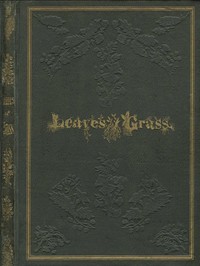
Leaves of Grass
Walt Whitman, 1855
A big, boastful, tender American voice that talks directly to you across time, celebrating bodies, cities and ordinary people. Dip in anywhere and find yourself addressed.
 BookFeed Ελληνικά
Pages from Leaves of Grass that stand on their own, chosen for how they read today. The text is in the public domain.
Two eagles fall through the air locked together, then part.
Skirting the river road, (my forenoon walk, my rest,) Skyward in air a sudden muffled sound, the dalliance of the eagles, The rushing amorous contact high in space together, The clinching interlocking claws, a living, fierce, gyrating wheel, Four beating wings, two beaks, a swirling mass tight grappling, In tumbling turning clustering loops, straight downward falling, Till o’er the river pois’d, the twain yet one, a moment’s lull, A motionless still balance in the air, then parting, talons loosing, Upward again on slow-firm pinions slanting, their separate diverse flight, She hers, he his, pursuing. The sound that empties every bed, bargain and courtroom at once.
Beat! beat! drums!—blow! bugles! blow! Over the traffic of cities—over the rumble of wheels in the streets; Are beds prepared for sleepers at night in the houses? no sleepers must sleep in those beds, No bargainers’ bargains by day—no brokers or speculators—would they continue? Would the talkers be talking? would the singer attempt to sing? Would the lawyer rise in the court to state his case before the judge? Then rattle quicker, heavier drums—you bugles wilder blow. Why a withered wreath stays on its nail a little longer.
Somehow I cannot let it go yet, funeral though it is, Let it remain back there on its nail suspended, With pink, blue, yellow, all blanch’d, and the white now gray and ashy, One wither’d rose put years ago for thee, dear friend; But I do not forget thee. Hast thou then faded? Is the odor exhaled? Are the colors, vitalities, dead? No, while memories subtly play—the past vivid as ever; For but last night I woke, and in that spectral ring saw thee, Thy smile, eyes, face, calm, silent, loving as ever: So let the wreath hang still awhile within my eye-reach, It is not yet dead to me, nor even pallid. What if simply being near people were already more than enough?
4 I have perceiv’d that to be with those I like is enough, To stop in company with the rest at evening is enough, To be surrounded by beautiful, curious, breathing, laughing flesh is enough, To pass among them or touch any one, or rest my arm ever so lightly round his or her neck for a moment, what is this then? I do not ask any more delight, I swim in it as in a sea. The poet talks you out of idealising him before you even start.
Are you the new person drawn toward me? To begin with take warning, I am surely far different from what you suppose; Do you suppose you will find in me your ideal? Do you think it so easy to have me become your lover? Do you think the friendship of me would be unalloy’d satisfaction? Do you think I am trusty and faithful? Do you see no further than this facade, this smooth and tolerant manner of me? Do you suppose yourself advancing on real ground toward a real heroic man? Have you no thought O dreamer that it may be all maya, illusion? On shedding earlier versions of yourself without mourning them.
O living always, always dying! O the burials of me past and present, O me while I stride ahead, material, visible, imperious as ever; O me, what I was for years, now dead, (I lament not, I am content;) O to disengage myself from those corpses of me, which I turn and look at where I cast them, To pass on, (O living! always living!) and leave the corpses behind. A case for the quiet last years as the best ones.
Not from successful love alone, Nor wealth, nor honor’d middle age, nor victories of politics or war; But as life wanes, and all the turbulent passions calm, As gorgeous, vapory, silent hues cover the evening sky, As softness, fulness, rest, suffuse the frame, like freshier, balmier air, As the days take on a mellower light, and the apple at last hangs really finish’d and indolent-ripe on the tree, Then for the teeming quietest, happiest days of all! The brooding and blissful halcyon days! A poet promises to be present in every room of your life.
If you stand at work in a shop I stand as nigh as the nighest in the same shop, If you bestow gifts on your brother or dearest friend I demand as good as your brother or dearest friend, If your lover, husband, wife, is welcome by day or night, I must be personally as welcome, If you become degraded, criminal, ill, then I become so for your sake, If you remember your foolish and outlaw’d deeds, do you think I cannot remember my own foolish and outlaw’d deeds? If you carouse at the table I carouse at the opposite side of the table, If you meet some stranger in the streets and love him or her, why I often meet strangers in the street and love them. A poet explains his purpose by pointing at April rain and rocks.
Do you guess I have some intricate purpose?Well I have, for the Fourth-month showers have, and the mica on theside of a rock has.Do you take it I would astonish?Does the daylight astonish? does the early redstart twitteringthrough the woods?Do I astonish more than they?This hour I tell things in confidence,I might not tell everybody, but I will tell you. Why a poet refuses to picture the world as something built.
It is no small matter, this round and delicious globe moving so exactly in its orbit for ever and ever, without one jolt or the untruth of a single second, I do not think it was made in six days, nor in ten thousand years, nor ten billions of years, Nor plann’d and built one thing after another as an architect plans and builds a house. Walt Whitman, 1855
A big, boastful, tender American voice that talks directly to you across time, celebrating bodies, cities and ordinary people. Dip in anywhere and find yourself addressed.
Read pages from books like this, one at a time
BookFeed is a feed of real passages from real books. It learns what moves you and finds your next book.
Open BookFeedFree, no sign-up.