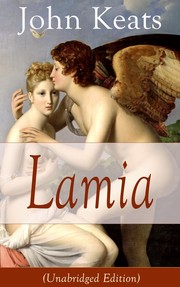
Lamia
John Keats, 1820
A serpent becomes a woman, a philosopher refuses to look away, and a feast is conjured out of nothing: Keats's late poem of magic against analysis.
 BookFeed Ελληνικά
Pages from Lamia that stand on their own, chosen for how they read today. The text is in the public domain.
Dazzling all over, and yet somehow sorrowful.
She was a gordian shape of dazzling hue,Vermilion-spotted, golden, green, and blue;Striped like a zebra, freckled like a pard,Eyed like a peacock, and all crimson barr’d;And full of silver moons, that, as she breathed,Dissolv’d, or brighter shone, or interwreathedTheir lustres with the gloomier tapestries—So rainbow-sided, touch’d with miseries,She seem’d, at once, some penanced lady elf,Some demon’s mistress, or the demon’s self.Upon her crest she wore a wannish fireSprinkled with stars, like Ariadne’s tiar:Her head was serpent, but ah, bitter-sweet!She had a woman’s mouth with all its pearls complete: What is lost every time we explain something beautiful.
Upon her aching forehead be there hungThe leaves of willow and of adder’s tongue;And for the youth, quick, let us strip for himThe thyrsus, that his watching eyes may swimInto forgetfulness; and, for the sage,Let spear-grass and the spiteful thistle wageWar on his temples. Do not all charms flyAt the mere touch of cold philosophy?There was an awful rainbow once in heaven:We know her woof, her texture; she is givenIn the dull catalogue of common things. The uncomfortable arithmetic of love and money.
Love in a hut, with water and a crust,Is—Love, forgive us!—cinders, ashes, dust;Love in a palace is perhaps at lastMore grievous torment than a hermit’s fast—That is a doubtful tale from faery land,Hard for the non-elect to understand. A city at night, murmuring like a storm that hasn't arrived.
As men talk in a dream, so Corinth all,Throughout her palaces imperial,And all her populous streets and temples lewd,Mutter’d, like tempest in the distance brew’d,To the wide-spreaded night above her towers.Men, women, rich and poor, in the cool hours,Shuffled their sandals o’er the pavement white,Companion’d or alone; while many a lightFlared, here and there, from wealthy festivals,And threw their moving shadows on the walls,Or found them cluster’d in the corniced shadeOf some arch’d temple door, or dusky colonnade. The hour of a party when the room stops being a room.
Soft went the music the soft air along,While fluent Greek a vowel’d undersongKept up among the guests discoursing lowAt first, for scarcely was the wine at flow;But when the happy vintage touch’d their brains,Louder they talk, and louder come the strainsOf powerful instruments—the gorgeous dyes,The space, the splendour of the draperies,The roof of awful richness, nectarous cheer,Beautiful slaves, and Lamia’s self, appear,Now, when the wine has done its rosy deed,And every soul from human trammels freed,No more so strange; for merry wine, sweet wine,Will make Elysian shades not too fair, too divine. A woman who can define exactly where pleasure ends and pain begins.
Ah, happy Lycius!—for she was a maidMore beautiful than ever twisted braid,Or sigh’d, or blush’d, or on spring-flowered leaSpread a green kirtle to the minstrelsy:A virgin purest lipp’d, yet in the loreOf love deep learned to the red heart’s core:Not one hour old, yet of sciential brainTo unperplex bliss from its neighbour pain;Define their pettish limits, and estrangeTheir points of contact, and swift counterchange;Intrigue with the specious chaos, and dispartIts most ambiguous atoms with sure art; A door that opens only for the two people it was built for.
A pillar’d porch, with lofty portal door,Where hung a silver lamp, whose phosphor glowReflected in the slabbed steps below,Mild as a star in water; for so new,And so unsullied was the marble hue,So through the crystal polish, liquid fine,Ran the dark veins, that none but feet divineCould e’er have touch’d there. The ceiling keeps a second copy of every drifting wreath.
Of wealthy lustre was the banquet-room,Fill’d with pervading brilliance and perfume:Before each lucid pannel fuming stoodA censer fed with myrrh and spiced wood,Each by a sacred tripod held aloft,Whose slender feet wide-swerv’d upon the softWool-woofed carpets: fifty wreaths of smokeFrom fifty censers their light voyage tookTo the high roof, still mimick’d as they roseAlong the mirror’d walls by twin-clouds odorous. John Keats, 1820
A serpent becomes a woman, a philosopher refuses to look away, and a feast is conjured out of nothing: Keats's late poem of magic against analysis.
Read pages from books like this, one at a time
BookFeed is a feed of real passages from real books. It learns what moves you and finds your next book.
Open BookFeedFree, no sign-up.