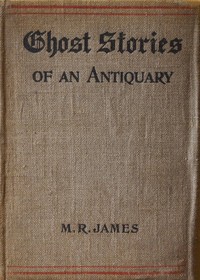
Ghost Stories of an Antiquary
M. R. James, 1928
Cambridge scholars and country clergymen blunder into things better left buried, told in the driest, most exact English—and it still frightens.
 BookFeed Ελληνικά
Pages from Ghost Stories of an Antiquary that stand on their own, chosen for how they read today. The text is in the public domain.
The worst part isn't the teeth—it's the intelligence in the eyes.
He flew out of his chair with deadly, inconceivable terror clutching at his heart. The shape, whose left hand rested on the table, was rising to a standing posture behind his seat, its right hand crooked above his scalp. There was black and tattered drapery about it; the coarse hair covered it as in the drawing. The lower jaw was thin—what can I call it?—shallow, like a beast’s; teeth showed behind the black lips; there was no nose; the eyes, of a fiery yellow, against which the pupils showed black and intense, and the exulting hate and thirst to destroy life which shone there, were the most horrifying features in the whole vision. There was intelligence of a kind in them—intelligence beyond that of a beast, below that of a man. Whistle once and it answers. The mistake is whistling twice.
The feelings which this horror stirred in Dennistoun were the intensest physical fear and the most profound mental loathing. What did he do? What could he do? He has never been quite certain what words he said, but he knows that he spoke, that he grasped blindly at the silver crucifix, that he was conscious of a movement towards him on the part of the demon, and that he screamed with the voice of an animal in hideous pain. An old print that redraws itself, one terrible frame at a time.
There was the house, as before, under the waning moon and the drifting clouds. The window that had been open was shut, and the figure was once more on the lawn: but not this time crawling cautiously on hands and knees. Now it was erect and stepping swiftly, with long strides, towards the front of the picture. The moon was behind it, and the black drapery hung down over its face so that only hints of that could be seen, and what was visible made the spectators profoundly thankful that they could see no more than a white dome-like forehead and a few straggling hairs. The head was bent down, and the arms were tightly clasped over an object which could be dimly seen and identified as a child, whether dead or living it was not possible to say. Some faces are unforgettable because there was nothing in them to read.
Parkins, who very much dislikes being questioned about it, did once describe something of it in my hearing, and I gathered that what he chiefly remembers about it is a horrible, an intensely horrible, face of crumpled linen. What expression he read upon it he could not or would not tell, but that the fear of it went nigh to maddening him is certain. Even after it's over, a surplice on a door can still ruin a night.
There is really nothing more to tell, but, as you may imagine, the Professor’s views on certain points are less clear cut than they used to be. His nerves, too, have suffered: he cannot even now see a surplice hanging on a door quite unmoved, and the spectacle of a scarecrow in a field late on a winter afternoon has cost him more than one sleepless night. You can see moonlight through their hands, and that is the least of it.
Whilst the girl stood still, half smiling, with her hands clasped over her heart, the boy, a thin shape, with black hair and ragged clothing, raised his arms in the air with an appearance of menace and of unappeasable hunger and longing. The moon shone upon his almost transparent hands, and Stephen saw that the nails were fearfully long and that the light shone through them. As he stood with his arms thus raised, he disclosed a terrifying spectacle. On the left side of his chest there opened a black and gaping rent; and there fell upon Stephen’s brain, rather than upon his ear, the impression of one of those hungry and desolate cries that he had heard resounding over the woods of Aswarby all that evening. In another moment this dreadful pair had moved swiftly and noiselessly over the dry gravel, and he saw them no more. The half-dark plays tricks; the horror is that it might not be tricks.
There is very little light about the bedstead, but there is a strange movement there; it seems as if Sir Richard were moving his head rapidly to and fro with only the slightest possible sound. And now you would guess, so deceptive is the half-darkness, that he had several heads, round and brownish, which move back and forward, even as low as his chest. It is a horrible illusion. Is it nothing more? There! something drops off the bed with a soft plump, like a kitten, and is out of the window in a flash; another—four—and after that there is quiet again. Two passengers are counted aboard who never once come to dinner.
The net result of the reckoning is always the same. Twenty-eight people appear in the enumeration, one being always a man in a long black cloak and broad hat, and another a “short figure in dark cloak and hood”. On the other hand, it is always noted that only twenty-six passengers appear at meals, and that the man in the cloak is perhaps absent, and the short figure is certainly absent. M. R. James, 1928
Cambridge scholars and country clergymen blunder into things better left buried, told in the driest, most exact English—and it still frightens.
Read pages from books like this, one at a time
BookFeed is a feed of real passages from real books. It learns what moves you and finds your next book.
Open BookFeedFree, no sign-up.