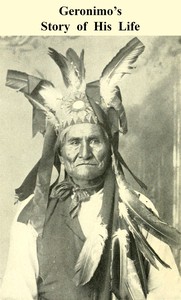
Geronimo’s Story of His Life
Geronimo, 1906
The Apache leader's own account of a life spent at war with two nations, dictated in captivity — and full of sharp, curious attention to the world that imprisoned him.
 BookFeed Ελληνικά
Pages from Geronimo’s Story of His Life that stand on their own, chosen for how they read today. The text is in the public domain.
The first day of a life with no purpose left in it.
I stood until all had passed, hardly knowing what I would do—I had no weapon, nor did I hardly wish to fight, neither did I contemplate recovering the bodies of my loved ones, for that was forbidden. I did not pray, nor did I resolve to do anything in particular, for I had no purpose left. I finally followed the tribe silently, keeping just within hearing distance of the soft noise of the feet of the retreating Apaches. A religion with no church, no sabbath, no holidays, and no less worship.
Our life also had a religious side. We had no churches, no religious organizations, no sabbath day, no holidays, and yet we worshiped. Sometimes the whole tribe would assemble to sing and pray; sometimes a smaller number, perhaps only two or three. The songs had a few words, but were not formal. The singer would occasionally put in such words as he wished instead of the usual tone sound. Sometimes we prayed in silence; sometimes each one prayed aloud; sometimes an aged person prayed for all of us. At other times one would rise and speak to us of our duties to each other and to Usen. Our services were short. An old warrior recites his wounds the way other men recite achievements.
During my many wars with the Mexicans I received eight wounds, as follows: shot in the right leg above the knee, and still carry the bullet; shot through the left forearm; wounded in the right leg below the knee with a saber; wounded on top of the head with the butt of a musket; shot just below the outer corner of the left eye; shot in left side; shot in the back. I have killed many Mexicans; I do not know how many, for frequently I did not count them. Some of them were not worth counting. What a man who has nearly died can and cannot tell you about dying.
I myself have lain unconscious on the battlefield, and while in that condition have had some strange thoughts or experiences; but they are very dim and I cannot recall them well enough to relate them. Many Indians believed this warrior, and I cannot say that he did not tell the truth. I wish I knew that what he said is beyond question true. But perhaps it is as well that we are not certain. A promise built to outlast the men who made it.
We stood between his troopers and my warriors. We placed a large stone on the blanket before us. Our treaty was made by this stone, and it was to last until the stone should crumble to dust; so we made the treaty, and bound each other with an oath. A man who has ridden through real weather pays to sit inside a fake storm.
We went into another place and the manager took us into a little room that was made like a cage; then everything around us seemed to be moving; soon the air looked blue, then there were black clouds moving with the wind. Pretty soon it was clear outside; then we saw a few thin white clouds; then the clouds grew thicker, and it rained and hailed with thunder and lightning. Then the thunder retreated and a rainbow appeared in the distance; then it became dark, the moon rose and thousands of stars came out. Soon the sun came up, and we got out of the little room. This was a good show, but it was so strange and unnatural that I was glad to be on the streets again. A country being measured by strangers who have not yet said why.
Every day they measured land with curious instruments and put down marks which we could not understand. They were good men, and we were sorry when they had gone on into the west. They were not soldiers. These were the first white men I ever saw. How far a child could hide when the whole country was home.
With my brothers and sisters I played about my father’s home. Sometimes we played at hide-and-seek among the rocks and pines; sometimes we loitered in the shade of the cottonwood trees or sought the shudock (a kind of wild cherry) while our parents worked in the field. Sometimes we played that we were warriors. We would practice stealing upon some object that represented an enemy, and in our childish imitation often perform the feats of war. Sometimes we would hide away from our mother to see if she could find us, and often when thus concealed go to sleep and perhaps remain hidden for many hours. Geronimo, 1906
The Apache leader's own account of a life spent at war with two nations, dictated in captivity — and full of sharp, curious attention to the world that imprisoned him.
Read pages from books like this, one at a time
BookFeed is a feed of real passages from real books. It learns what moves you and finds your next book.
Open BookFeedFree, no sign-up.