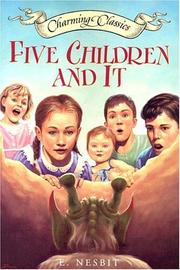
Five Children and It
E. Nesbit, 1902
Five siblings dig up a grumpy sand-fairy who grants one wish a day, and every wish goes gloriously wrong. Edwardian mischief with real teeth.
 BookFeed Ελληνικά
Pages from Five Children and It that stand on their own, chosen for how they read today. The text is in the public domain.
The world at dawn really does point its shadows the other way.
Have you ever been up at five o’clock on a fine summer morning? It is very beautiful. The sunlight is pinky and yellowy, and all the grass and trees are covered with dew-diamonds. And all the shadows go the opposite way to the way they do in the evening, which is very interesting and makes you feel as though you were in a new other world. The right words are missing; a live map almost does it.
All the words in the English Dictionary, and in the Greek Lexicon as well, are, I find, of no use at all to tell you exactly what it feels like to be flying, so I will not try. But I will say that to look down on the fields and woods instead of along at them, is something like looking at a beautiful live map, where, instead of silly colours on paper, you have real moving sunny woods and green fields laid out one after the other. As Cyril said, and I can’t think where he got hold of such a strange expression, “It does you a fair treat!” It was most wonderful and more like real magic than any wish the children had had yet. When the adult who explains the sun also warns you about swallowing thread.
“I didn’t ask you,” said Jane, biting off a needleful of thread as she had always been strictly forbidden to do. (Perhaps you don’t know that if you bite off ends of cotton and swallow them they wind tight round your heart and kill you? My nurse told me this, and she told me also about the earth going round the sun. Now what is one to believe—what with nurses and science?) What if getting money were easy and spending it were impossible?
And now the children began to see one of the laws of nature turn upside down and stand on its head like an acrobat. Any grown-up person would tell you that money is hard to get and easy to spend. But the fairy money had been easy to get, and spending it was not only hard, it was almost impossible. Why a thing dropped by accident always breaks, and never on purpose.
Anthea lifted down the heavy water-jug—it had a pattern of storks and long grasses on it, which Anthea never forgot. She carried it into the dressing-room, and carefully emptied the water out of it into the bath. Then she took the jug back into the bedroom and dropped it on the floor. You know how a jug always breaks if you happen to drop it by accident. If you happen to drop it on purpose, it is quite different. Anthea dropped that jug three times, and it was as unbroken as ever. So at last she had to take her father’s boot-tree and break the jug with that in cold blood. It was heartless work. How long does it take something impossible to feel routine?
It is wonderful how quickly you get used to things, even the most astonishing. Five minutes before, the children had had no more idea than you that there was such a thing as a sand-fairy in the world, and now they were talking to it as though they had known it all their lives. How real a children's game can get before it turns frightening.
The children drew a deep breath of relief, but it ended in a moan of terror. For bright knives were being brandished all about them. Next moment each child was seized by an Indian; each closed its eyes and tried not to scream. They waited for the sharp agony of the knife. It did not come. Next moment they were released, and fell in a trembling heap. Their heads did not hurt at all. They only felt strangely cool! Wild war-whoops rang in their ears. When they ventured to open their eyes they saw four of their foes dancing round them with wild leaps and screams, and each of the four brandished in his hand a scalp of long flowing black hair. They put their hands to their heads—their own scalps were safe! The poor untutored savages had indeed scalped the children. Everyone has three perfect wishes ready, until someone offers to grant them.
I daresay you have often thought what you would do if you had three wishes given you, and have despised the old man and his wife in the black-pudding story, and felt certain that if you had the chance you could think of three really useful wishes without a moment’s hesitation. These children had often talked this matter over, but, now the chance had suddenly come to them, they could not make up their minds. The particular silence that follows the wrong remark at a family table.
Then there was a little silence. Robert was not proud of himself for having been so cross, and the others were not proud of him either. You often notice that sort of silence when someone has said something it ought not to—and everyone else holds its tongue and waits for the one who oughtn’t to have said it is sorry. E. Nesbit, 1902
Five siblings dig up a grumpy sand-fairy who grants one wish a day, and every wish goes gloriously wrong. Edwardian mischief with real teeth.
Read pages from books like this, one at a time
BookFeed is a feed of real passages from real books. It learns what moves you and finds your next book.
Open BookFeedFree, no sign-up.