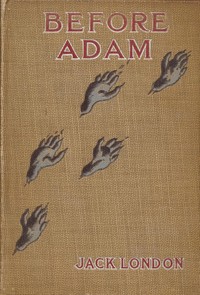
Before Adam
Jack London, 1906
A man dreams his way back into the body of a prehistoric ancestor and finds that fear, desire and laughter are older than language.
 BookFeed Ελληνικά
Pages from Before Adam that stand on their own, chosen for how they read today. The text is in the public domain.
How a group dances itself out of a rage it cannot act on.
And so, with mad antics, leaping, reeling, and overbalancing, we danced and sang in the sombre twilight of the primeval world, inducing forgetfulness, achieving unanimity, and working ourselves up into sensuous frenzy. And so it was that our rage against Red-Eye was soothed away by art, and we screamed the wild choruses of the hee-hee council until the night warned us of its terrors, and we crept away to our holes in the rocks, calling softly to one another, while the stars came out and darkness settled down. The end of the world is a few people in the mud.
Very strong upon me is one picture. Large trees are about us, and from their branches hang gray filaments of moss, while great creepers, like monstrous serpents, curl around the trunks and writhe in tangles through the air. And all about is the mud, soft mud, that bubbles forth gases, and that heaves and sighs with internal agitations. And in the midst of all this are a dozen of us. We are lean and wretched, and our bones show through our tight-stretched skins. We do not sing and chatter and laugh. We play no pranks. For once our volatile and exuberant spirits are hopelessly subdued. We make plaintive, querulous noises, look at one another, and cluster close together. It is like the meeting of the handful of survivors after the day of the end of the world. The rage was there; the word for it was not.
We were very angry, insanely, vociferously angry. Beating our chests, bristling, and gnashing our teeth, we gathered together in our rage. We felt the prod of gregarious instinct, the drawing together as though for united action, the impulse toward cooperation. In dim ways this need for united action was impressed upon us. But there was no way to achieve it because there was no way to express it. We did not turn to, all of us, and destroy Red-Eye, because we lacked a vocabulary. We were vaguely thinking thoughts for which there were no thought-symbols. These thought-symbols were yet to be slowly and painfully invented. The forest that waits behind your eyes when you close them.
Ah, those endless forests, and their horror-haunted gloom! For what eternities have I wandered through them, a timid, hunted creature, starting at the least sound, frightened of my own shadow, keyed-up, ever alert and vigilant, ready on the instant to dash away in mad flight for my life. For I was the prey of all manner of fierce life that dwelt in the forest, and it was in ecstasies of fear that I fled before the hunting monsters. The chase is the romance; the direction is the strategy.
If I had tripped or stumbled in that open space, there would have been no chance for me. But I didn’t. And I didn’t care whether I did or not. I was in such mood that I would have faced old Saber-Tooth himself, or a score of arrow-shooting Fire People. Such was the madness of love … with me. With the Swift One it was different. She was very wise. She did not take any real risks, and I remember, on looking back across the centuries to that wild love-chase, that when the pigs delayed me she did not run away very fast, but waited, rather, for me to take up the pursuit again. Also, she directed her retreat before me, going always in the direction she wanted to go. What it looks like when a familiar thing becomes a monster.
We looked at it with startled eyes. The heat of it drove us back. Another tree caught, and another, and then half a dozen. We were frightened. The monster had broken loose. We crouched down in fear, while the fire ate around the circle and hemmed us in. Into Lop-Ear’s eyes came the plaintive look that always accompanied incomprehension, and I know that in my eyes must have been the same look. We huddled, with our arms around each other, until the heat began to reach us and the odor of burning hair was in our nostrils. Then we made a dash of it, and fled away westward through the forest, looking back and laughing as we ran. The body you have was once a set of party tricks.
Oh, believe me, we were amazingly simple. But we did know a lot that is not known today. We could twitch our ears, prick them up and flatten them down at will. And we could scratch between our shoulders with ease. We could throw stones with our feet. I have done it many a time. And for that matter, I could keep my knees straight, bend forward from the hips, and touch, not the tips of my fingers, but the points of my elbows, to the ground. And as for bird-nesting—well, I only wish the twentieth-century boy could see us. But we made no collections of eggs. We ate them. What strength looks like when beauty was never part of the plan.
There was an elemental economy about his body—as was there about all our bodies. The chest was deep, it is true, cavernously deep; but there were no full-swelling muscles, no wide-spreading shoulders, no clean-limbed straightness, no generous symmetry of outline. It represented strength, that body of my father’s, strength without beauty; ferocious, primordial strength, made to clutch and grip and rend and destroy. Jack London, 1906
A man dreams his way back into the body of a prehistoric ancestor and finds that fear, desire and laughter are older than language.
Read pages from books like this, one at a time
BookFeed is a feed of real passages from real books. It learns what moves you and finds your next book.
Open BookFeedFree, no sign-up.