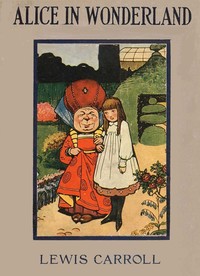
Alice's Adventures in Wonderland
Lewis Carroll, 1865
A girl falls down a rabbit hole into a world where nothing keeps its size, its manners or its temper, and keeps asking the questions everyone else stopped asking.
 BookFeed
Pages from Alice's Adventures in Wonderland that stand on their own, chosen for how they read today. The text is in the public domain.
She scolds herself so well it brings her to tears.
“Come, there’s no use in crying like that!” said Alice to herself, rather sharply; “I advise you to leave off this minute!” She generally gave herself very good advice, (though she very seldom followed it), and sometimes she scolded herself so severely as to bring tears into her eyes; and once she remembered trying to box her own ears for having cheated herself in a game of croquet she was playing against herself, for this curious child was very fond of pretending to be two people. “But it’s no use now,” thought poor Alice, “to pretend to be two people! Why, there’s hardly enough of me left to make one respectable person!” The morning you wake up unable to prove you're still yourself.
Alice took up the fan and gloves, and, as the hall was very hot, she kept fanning herself all the time she went on talking: “Dear, dear! How queer everything is to-day! And yesterday things went on just as usual. I wonder if I’ve been changed in the night? Let me think: was I the same when I got up this morning? I almost think I can remember feeling a little different. But if I’m not the same, the next question is, Who in the world am I? Ah, that’s the great puzzle!” And she began thinking over all the children she knew that were of the same age as herself, to see if she could have been changed for any of them. Leaving a party and hoping, just once, that someone calls you back.
This piece of rudeness was more than Alice could bear: she got up in great disgust, and walked off; the Dormouse fell asleep instantly, and neither of the others took the least notice of her going, though she looked back once or twice, half hoping that they would call after her: the last time she saw them, they were trying to put the Dormouse into the teapot. The peculiar good sense of a child checking a magic bottle for a warning.
It was all very well to say “Drink me,” but the wise little Alice was not going to do that in a hurry. “No, I’ll look first,” she said, “and see whether it’s marked ‘poison’ or not”; for she had read several nice little histories about children who had got burnt, and eaten up by wild beasts and other unpleasant things, all because they would not remember the simple rules their friends had taught them: such as, that a red-hot poker will burn you if you hold it too long; and that if you cut your finger very deeply with a knife, it usually bleeds; and she had never forgotten that, if you drink much from a bottle marked “poison,” it is almost certain to disagree with you, sooner or later. A game whose equipment is alive and has no intention of cooperating.
“Get to your places!” shouted the Queen in a voice of thunder, and people began running about in all directions, tumbling up against each other; however, they got settled down in a minute or two, and the game began. Alice thought she had never seen such a curious croquet-ground in her life; it was all ridges and furrows; the balls were live hedgehogs, the mallets live flamingoes, and the soldiers had to double themselves up and to stand on their hands and feet, to make the arches. What it's like to watch a child dream and not be in the dream.
First, she dreamed of little Alice herself, and once again the tiny hands were clasped upon her knee, and the bright eager eyes were looking up into hers—she could hear the very tones of her voice, and see that queer little toss of her head to keep back the wandering hair that would always get into her eyes—and still as she listened, or seemed to listen, the whole place around her became alive with the strange creatures of her little sister’s dream. What a flame is after the candle has been blown out.
First, however, she waited for a few minutes to see if she was going to shrink any further: she felt a little nervous about this; “for it might end, you know,” said Alice to herself, “in my going out altogether, like a candle. I wonder what I should be like then?” And she tried to fancy what the flame of a candle is like after the candle is blown out, for she could not remember ever having seen such a thing. The moment a howling baby stops being a person and becomes livestock.
So she set the little creature down, and felt quite relieved to see it trot away quietly into the wood. “If it had grown up,” she said to herself, “it would have made a dreadfully ugly child: but it makes rather a handsome pig, I think.” The first sentence of her French primer turns out to be a threat.
“Perhaps it doesn’t understand English,” thought Alice; “I daresay it’s a French mouse, come over with William the Conqueror.” (For, with all her knowledge of history, Alice had no very clear notion how long ago anything had happened.) So she began again: “Où est ma chatte?” which was the first sentence in her French lesson-book. The Mouse gave a sudden leap out of the water, and seemed to quiver all over with fright. “Oh, I beg your pardon!” cried Alice hastily, afraid that she had hurt the poor animal’s feelings. “I quite forgot you didn’t like cats.” Lewis Carroll, 1865
A girl falls down a rabbit hole into a world where nothing keeps its size, its manners or its temper, and keeps asking the questions everyone else stopped asking.
Read pages from books like this, one at a time
BookFeed is a feed of real passages from real books. It learns what moves you and finds your next book.
Open BookFeedFree, no sign-up.